Elongation at Break Explained: Ductility, Bend Radius and Formability
Permanent stretch at fracture.
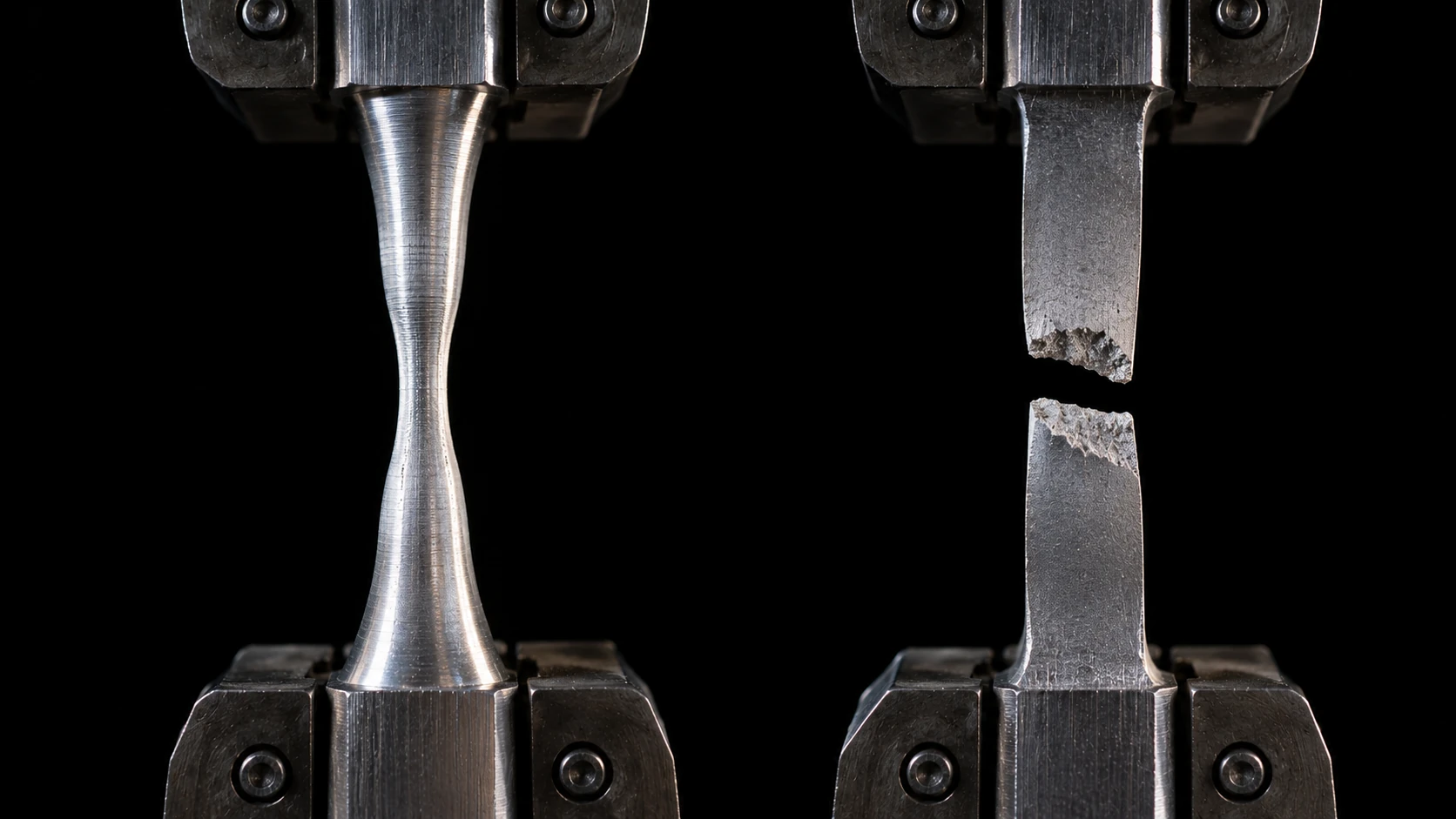
Elongation at break is how much longer a tensile specimen is after it breaks, as a percentage of where it started. A material that stretches a long way is ductile; one that barely stretches is brittle.
Two marks are scribed on the specimen a set distance apart — the gauge length, usually 2 in (50 mm) for sheet. After fracture the two halves are fitted together and the distance between the marks is measured again. Only the permanent stretch counts; the elastic part sprang back when it broke.
The figure lumps together two kinds of strain. Uniform elongation happens before the peak load, while the whole gauge length stretches evenly; it is what matters for stretch forming. Necking strain is concentrated in a short zone near the fracture. Because the neck is about the same size whatever the gauge length, a shorter gauge length gives a higher percentage — so a value measured over 50 mm is not comparable with one over 5.65√A0 or 4D.
A companion number, reduction of area, measures how much the cross-section shrank at the fracture. It reflects the true local ductility better than elongation does, and it is reported on many bar and plate certificates.
How it is measured.
Elongation comes from the tensile test (ASTM E8/E8M; ASTM D638 for plastics). Product specifications state the gauge length and the minimum elongation, often by thickness — thin sheet usually shows lower elongation than thicker plate of the same alloy because there is less material to neck.
Direction matters. Rolled sheet has a grain: grains and inclusions are stretched along the rolling direction. Specimens cut across the rolling direction usually show lower elongation, and the difference shows up directly in bending.
For formability, the most direct test is the bend test itself — ASTM E290 bends a strip around a mandrel of a set radius and inspects the outside surface for cracks. Many sheet specifications set a minimum bend radius by bend test rather than relying on elongation.
How materials compare.
Annealed austenitic stainless and pure copper are among the most ductile metals at 40–60%. Mild steel sheet runs 25–45%. Heat-treated aluminum and titanium alloys sit around 10–15%. Hardened steels, cast plate and glass-filled plastics fall below 10%. Unfilled thermoplastics such as UHMW and PTFE can stretch several hundred percent, but they do it at very low stress.
Strength and elongation usually trade against each other inside a family — the stronger temper stretches less. Plot yield against elongation in the library to see each family slope down and to the right.
| Stocked grade | Elongation at break (%) | Process |
|---|---|---|
| 304 | 60 | Laser cutting, Press brake bending |
| 316 | 60 | Laser cutting, Press brake bending |
| PA-11 (HP MJF) | 50 | MJF 3D printing |
| A1008 cold rolled | 40 | Laser cutting, Press brake bending |
| A1008 electro-galvanized | 40 | Laser cutting, Press brake bending |
| G90 galvanized | 30 | Laser cutting, Press brake bending |
| A36 HR pickled & oiled | 23 | Laser cutting, Press brake bending |
| A36 mill finish | 23 | Laser cutting, Press brake bending |
| HSLAS Grade 50 | 22 | Laser cutting |
| Corten (weathering) | 21 | Laser cutting, Press brake bending |
| PA-12 (HP MJF) | 20 | MJF 3D printing |
| 5052-H32 | 12 | Laser cutting, Press brake bending, CNC machining |
| 6061-T6 | 12 | Laser cutting, Press brake bending, CNC machining |
| 7075-T6 | 11 | Laser cutting, CNC machining |
| PA-12 glass bead (HP MJF) | 10 | MJF 3D printing |
| 1100-H14 | 9 | Laser cutting, Press brake bending |
| AR500 | 8 | Laser cutting |
| MIC-6 cast plate | 3 | Laser cutting, CNC machining |
No tabulated value for 1095 spring steel, hardened.
How engineers use it.
Strain in a bend
When sheet bends, the neutral axis stays roughly the same length while the outside surface stretches and the inside compresses. For an inside radius R and thickness t, the engineering strain at the outer surface is approximately:
That is why a sharp inside corner is so much harder on the material than a radius of one or two thicknesses, and why a 180° hem — effectively R = 0 — is reserved for the most ductile grades.
Why elongation is not a radius rule
5052-H32 and 6061-T6 both test at about 12% elongation, and the formula says the outside of a 1t bend strains 33%. 5052-H32 makes that bend without trouble; 6061-T6 at the same radius may crack. The difference is how the strain is distributed. A tensile bar averages strain over 2 inches, while a bend concentrates it in a thin surface layer that can tolerate far more local strain than the bar's average — if the material spreads that strain evenly. 5052, a solid-solution alloy, does. Peak-aged 6061-T6 tends to concentrate strain into narrow shear bands, so it runs out of local ductility sooner. Reduction of area and bend tests capture this; elongation does not.
So use elongation to rank materials and to flag low-ductility tempers, and take actual minimum radii from tested tables — like the per-gauge bend data on our material pages — or from a test bend.
Ductile failure as a safety feature
A ductile part that is overloaded bends, stretches and gives visible warning. A brittle one cracks without notice. Structural and safety-critical parts usually carry a minimum elongation for that reason, and welds are tested for it with guided bend tests.
What it means in fabrication.
- Bend radius. Low-elongation tempers need larger radii. 7075-T6, AR500, MIC-6 cast plate and hardened spring steel are flat-part materials in our catalog.
- Grain direction. Bend lines parallel to the rolling direction crack first. On marginal materials, orient parts on the sheet so critical bends run across the grain — note it on the drawing if it matters.
- Hems and tight returns. 5052-H32, 1100, mild steel and 304 hem well; heat-treated alloys do not.
- Edges. Burrs and micro-cracks at a cut edge reduce the strain the edge can take; a bend that runs off a rough edge can split from it. Laser-cut edges are clean, and bend relief keeps tears from starting at corners.
- Work hardening. Every bend uses up some ductility. Rebending, straightening or forming a bend that crosses a previous one is harder on the material than the first operation.
Common mistakes.
- Comparing elongations from different gauge lengths. A 50 mm and a 5.65√A0 value for the same material differ.
- Turning elongation into a minimum radius. It underestimates what ductile alloys can do and says nothing about strain localisation. Use tested bend data.
- Ignoring the temper letter. 5052-O and 5052-H38 are the same alloy with very different ductility. The temper is part of the material.
Common questions.
What is a good elongation for bending sheet metal?
There is no single threshold. Mild steel (25–45%), 304 stainless (40–60%) and 5052-H32 (about 12%) all bend tightly; 6061-T6 at a similar 12% needs larger radii. Use tested bend tables for the specific temper and thickness.
What is the difference between elongation and reduction of area?
Elongation is the increase in gauge length at fracture. Reduction of area is the decrease in cross-section at the fracture point. Reduction of area reflects local ductility in the neck and correlates better with bendability.
Why does elongation depend on gauge length?
Necking strain is concentrated in a short zone of roughly fixed size. Over a short gauge length that zone is a larger fraction of the total, so the percentage is higher.
Sources & standards.
Values on this page are typical figures for comparison, drawn from the same data as our materials library. Design to the minimums in the governing specification, and ask for mill test reports when the number matters.
- ASTM E8/E8M — Tension Testing of Metallic Materials
Gauge lengths, elongation and reduction-of-area measurement.
- ASTM E290 — Bend Testing of Material for Ductility
Mandrel bend tests used to qualify minimum bend radii.
- Aluminum Association, Aluminum Standards and Data
Elongation by alloy, temper and thickness for wrought aluminum.
- ASM Handbook, Vol. 14B: Metalworking — Sheet Forming
Bendability, strain in bending, uniform elongation and formability.
Related guides and tools.
Choosing between two materials?
Send the part and the property that matters — weight, stiffness, heat, conductivity — and we will tell you which stocked grade fits and what it does to the price.
Start a quote ↗