Thermal Conductivity Explained: Heat Flow, Heat Sinks, Welding and Laser Cutting
How readily heat flows.
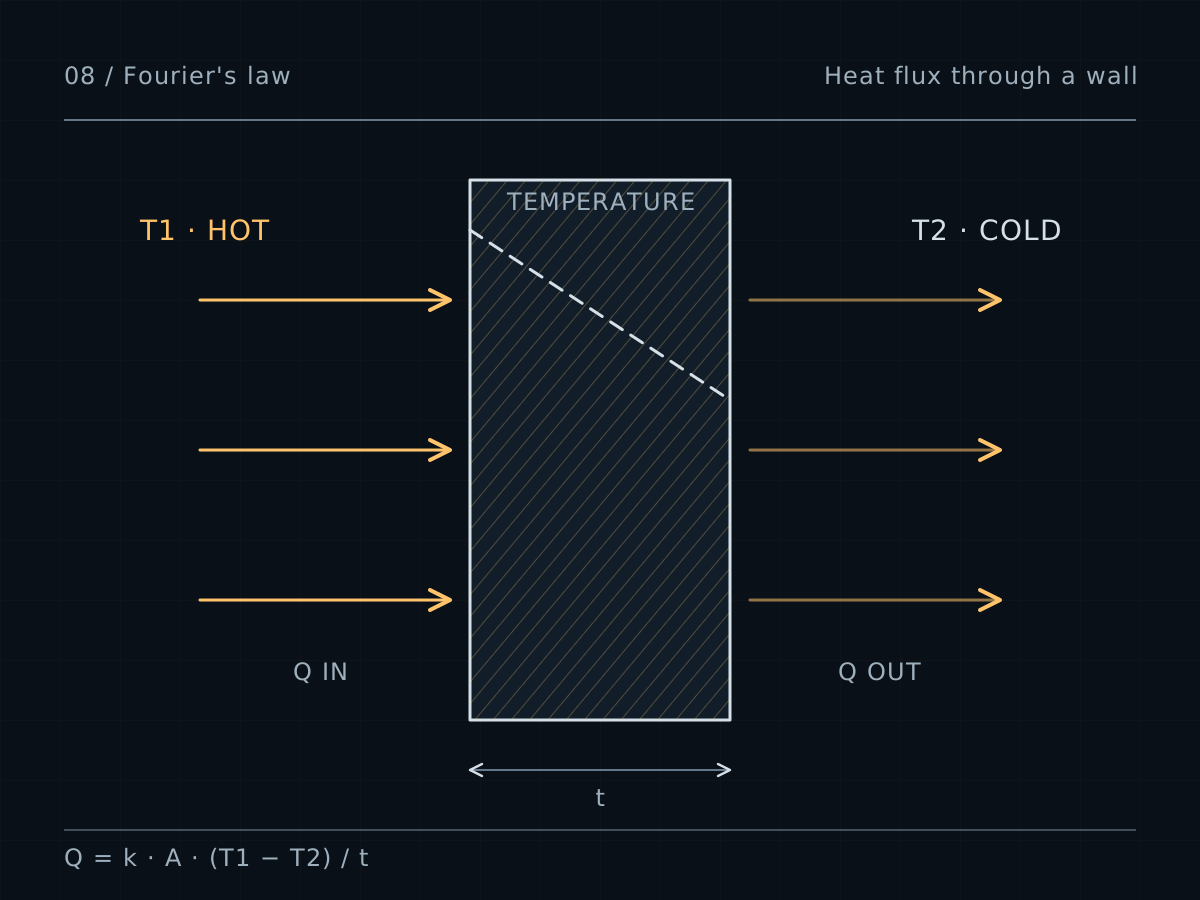
Put a hot face on one side of a plate and a cold face on the other, and heat flows from hot to cold. Thermal conductivity, k, says how much flows for a given temperature difference and thickness.
This is Fourier's law. Double the area or the temperature difference and the heat flow doubles; double the thickness and it halves. The unit, W/m·K, is the watts that cross a 1 m² slab 1 m thick for each kelvin (or °C) of difference.
Why metals conduct and plastics insulate
In metals, heat is carried mainly by the same free electrons that carry electric current. That is why the best thermal conductors — copper, silver, aluminum — are also the best electrical conductors (the Wiedemann–Franz law ties the two together). In polymers, heat has to pass as vibrations along tangled chains, which is slow: nylon and acetal sit near 0.2–0.4 W/m·K, roughly a thousandth of copper.
Why alloys conduct less than pure metals
Alloying atoms scatter the electrons. The effect is large: pure aluminum is about 237 W/m·K, 1100 about 218, 6061 about 167 and 5052 about 138. Copper drops from about 390 to around 120 in brass. Chromium and nickel take austenitic stainless down to about 16 W/m·K — a third of mild steel and a tenth of 5052.
How it is measured.
The most common modern method is laser flash (ASTM E1461): a pulse heats one face of a small disc, and an infrared detector times how fast the heat reaches the other face. That gives thermal diffusivity, which is converted to conductivity with the density and specific heat: k = α · ρ · cp.
Steady-state methods measure k directly by holding a temperature difference across a sample and measuring the heat flow — ASTM E1225 for solids, C177 (guarded hot plate) for insulation, and D5470 for thermal interface materials such as pads and greases. Conductivity changes with temperature, so a value is only complete with the temperature it was measured at; the library uses room-temperature figures.
How materials compare.
Conductivity spans more than three orders of magnitude, so the chart is logarithmic.
Within the metals the order is consistent: copper alloys, then aluminum, then magnesium, carbon steel, stainless, titanium and nickel superalloys. Ti-6Al-4V and Inconel are among the poorest metallic conductors, which is a large part of why they are hard to machine — heat stays in the cut.
| Stocked grade | Thermal conductivity (W/m·K) | Thermal conductivity (BTU/h·ft·°F) | Process |
|---|---|---|---|
| 1100-H14 | 218 | 126 | Laser cutting, Press brake bending |
| 6061-T6 | 167 | 96.5 | Laser cutting, Press brake bending, CNC machining |
| MIC-6 cast plate | 142 | 82 | Laser cutting, CNC machining |
| 5052-H32 | 138 | 79.7 | Laser cutting, Press brake bending, CNC machining |
| 7075-T6 | 130 | 75.1 | Laser cutting, CNC machining |
| A1008 cold rolled | 59 | 34.1 | Laser cutting, Press brake bending |
| A1008 electro-galvanized | 59 | 34.1 | Laser cutting, Press brake bending |
| G90 galvanized | 59 | 34.1 | Laser cutting, Press brake bending |
| A36 HR pickled & oiled | 51.9 | 30 | Laser cutting, Press brake bending |
| A36 mill finish | 51.9 | 30 | Laser cutting, Press brake bending |
| 1095 spring steel, hardened | 49.8 | 28.8 | Laser cutting |
| 316 | 16.3 | 9.42 | Laser cutting, Press brake bending |
| 304 | 16.2 | 9.36 | Laser cutting, Press brake bending |
No tabulated value for HSLAS Grade 50, Corten (weathering), AR500, PA-12 (HP MJF), PA-11 (HP MJF), PA-12 glass bead (HP MJF).
How engineers use it.
Spreading and removing heat
For electronics enclosures, LED mounts and power-supply chassis, conductivity decides how well the metal spreads a hot spot over a larger area that can shed heat to air. A useful way to think about it is thermal resistance, which adds up like electrical resistance along the heat's path:
Through the thickness of a sheet, conduction resistance is tiny — a 1/8″ 6061 wall under a 4 in² component would pass about 1,500 W across a 20 °F difference, far more than the component makes. The bottlenecks are almost always elsewhere: the contact between component and wall (fix it with a thermal pad or compound and enough clamping pressure), and the convection from the wall to the air (fix it with area, fins and airflow). Spreading sideways along a thin sheet is where k really matters, because the path is long and the section is thin. That is the case for aluminum over steel, and for thicker gauge under hot components.
Thermal breaks
Sometimes the goal is the opposite: keep heat out of a sensitive part or off a cold surface. Low-conductivity standoffs and spacers — stainless, titanium, G-10, PEEK — make effective thermal breaks between a hot assembly and its frame.
Transient heating
For how fast a part warms up or cools down, the governing property is thermal diffusivity, α = k / (ρ·cp). Aluminum both conducts well and stores relatively little heat per volume, so it reaches equilibrium quickly; stainless lags.
What it means in fabrication.
- Welding. Aluminum conducts heat away from the weld pool roughly three times faster than steel, so it needs more heat input and a faster travel speed, and the heat-affected zone is wide. Stainless holds heat at the joint, which concentrates distortion and causes heat tint; tack sequence and fixturing matter more.
- Laser cutting. High conductivity drains energy from the cut front. Together with high reflectivity, that is why aluminum, brass and copper cut slower than steel of the same thickness and need more power. See the fiber laser cutting guide.
- Machining. Low-conductivity alloys trap heat at the tool edge, so stainless and titanium need lower speeds and more coolant — see the machining heat guide.
- Finishing. Thick, conductive parts take longer to reach powder-coat cure temperature; oven time is set by the heaviest section.
Common mistakes.
- Using pure-metal values for alloys. Pure aluminum's 237 W/m·K is not 5052's 138, and pure copper is three times brass.
- Treating conductivity as the whole thermal path. Contact resistance and convection to air usually dominate. A thicker wall does not help a component that is poorly clamped to it.
- Ignoring coatings and anodizing. Powder coat and paint add a resistance layer; anodize is thin but electrically insulating, which matters where the part doubles as a ground path.
Common questions.
Which is the better heat conductor, aluminum or steel?
Aluminum, by a wide margin. 6061 is about 167 W/m·K and 5052 about 138, compared with about 50–60 for carbon steel and about 16 for 304 stainless.
Why is stainless steel such a poor conductor?
Its chromium and nickel scatter the conduction electrons that carry heat in metals. Austenitic stainless conducts about a third as well as carbon steel and a tenth as well as aluminum alloys.
What is the difference between thermal conductivity and thermal diffusivity?
Conductivity is how much heat flows under a steady temperature difference. Diffusivity is conductivity divided by the heat capacity per volume, and it governs how quickly temperature changes spread through a part.
Sources & standards.
Values on this page are typical figures for comparison, drawn from the same data as our materials library. Design to the minimums in the governing specification, and ask for mill test reports when the number matters.
- ASTM E1461 — Thermal Diffusivity by the Flash Method
Laser flash measurement of diffusivity, converted to conductivity.
- ASTM E1225 — Thermal Conductivity of Solids by the Guarded-Comparative-Longitudinal Heat Flow Technique
Steady-state method for metals and ceramics.
- ASTM D5470 — Thermal Transmission Properties of Thermally Conductive Electrical Insulation Materials
Test for thermal pads, greases and interface materials.
- F. P. Incropera et al., Fundamentals of Heat and Mass Transfer
Fourier conduction, thermal resistance networks and diffusivity.
Related guides and tools.
Choosing between two materials?
Send the part and the property that matters — weight, stiffness, heat, conductivity — and we will tell you which stocked grade fits and what it does to the price.
Start a quote ↗