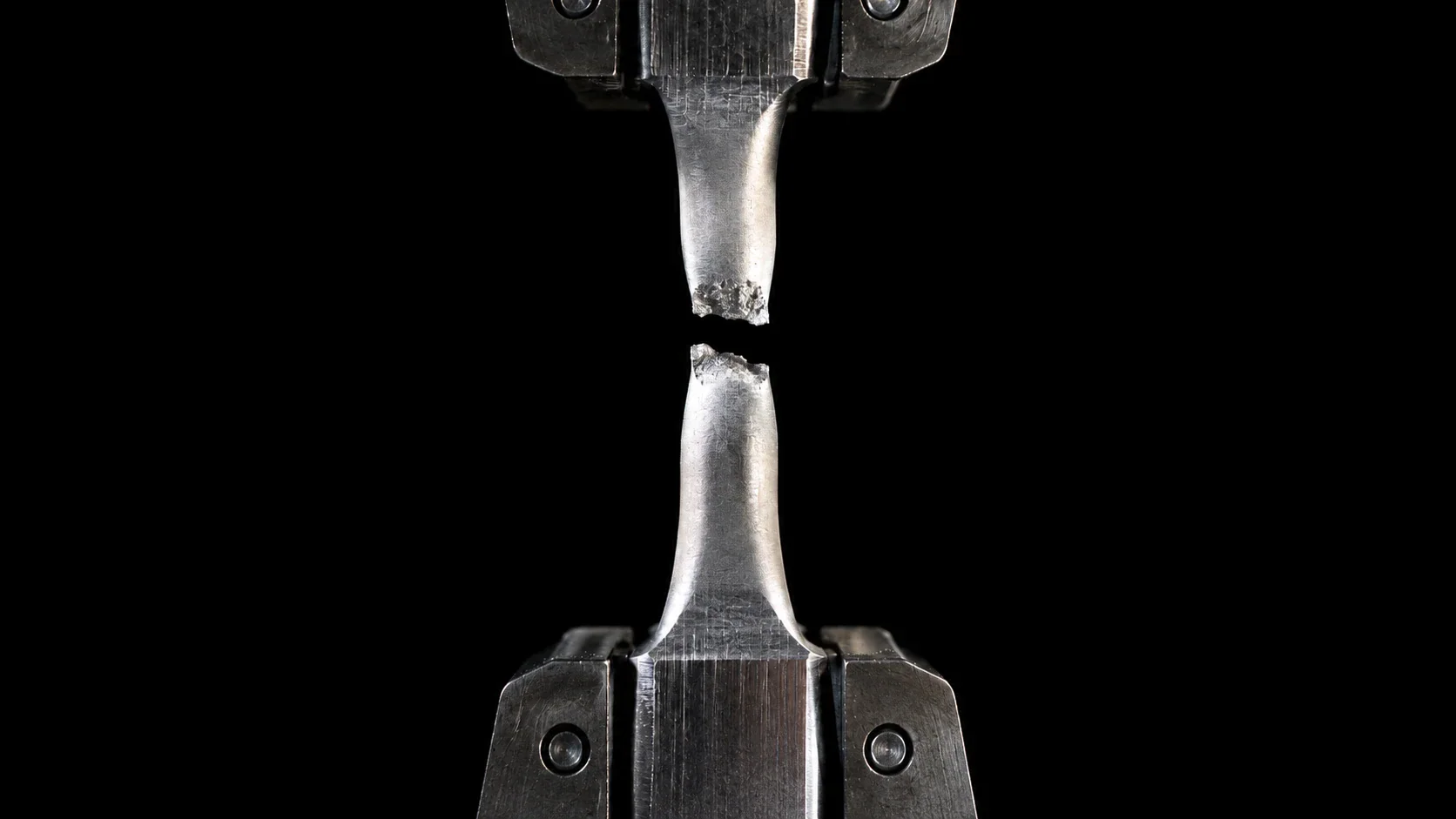
Tensile Strength Explained: Ultimate Strength, Necking and the Yield Ratio
The top of the curve.
Pull a ductile metal past yield and it keeps getting stronger as it stretches — until it doesn't. Tensile strength, or ultimate tensile strength (UTS), is the highest stress it reaches.
After yield, every increment of stretch tangles more dislocations together, which makes the next increment harder. That is work hardening, and it is why the stress–strain curve keeps rising. At the same time the specimen gets thinner. At the peak, the material's hardening can no longer keep up with the shrinking cross-section; one spot thins faster than the rest, and a neck forms. From there the load falls until the specimen breaks.
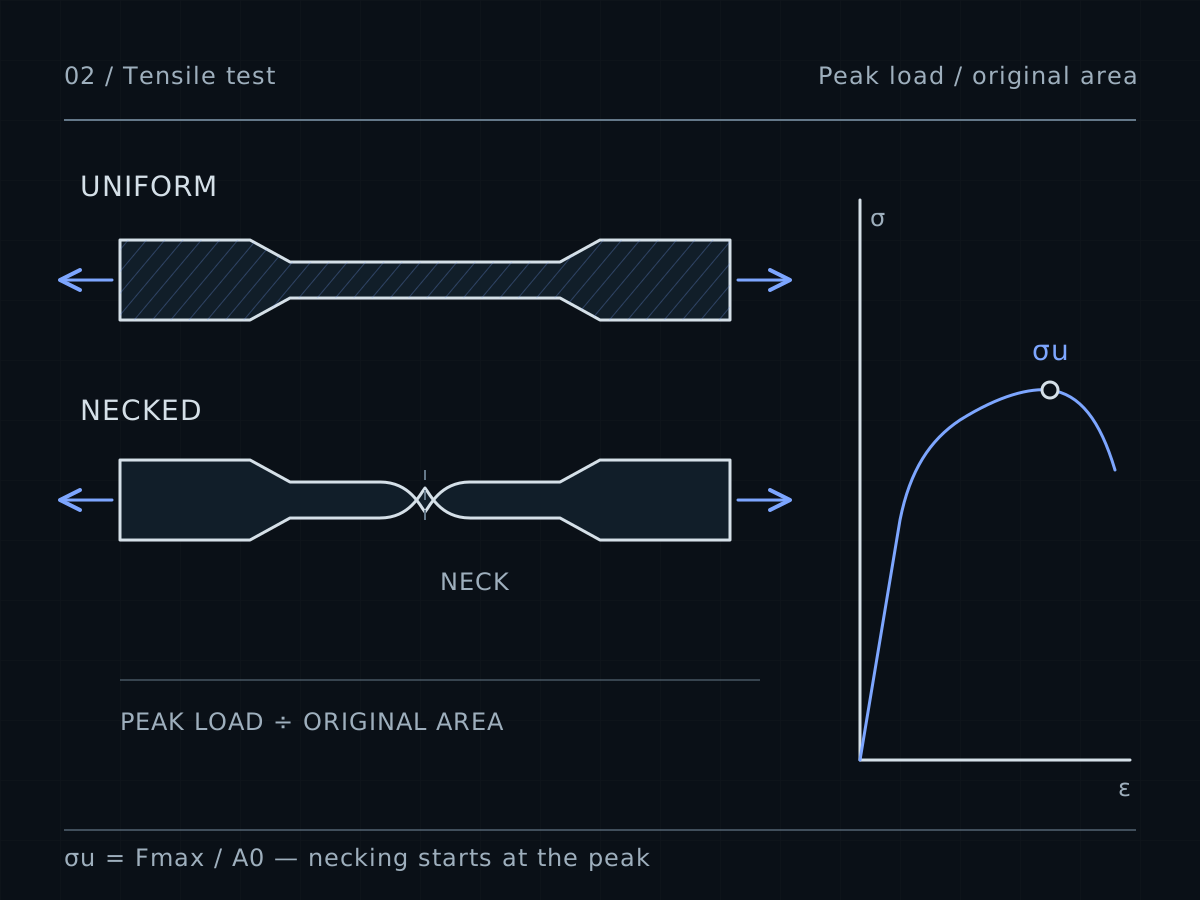
Note the A0: tensile strength is engineering stress, calculated on the original area. The true stress in the neck keeps rising right up to fracture. UTS is the useful design number because it tells you the largest load a given cross-section can carry.
How it is measured.
UTS comes out of the same tensile test as yield strength — ASTM E8/E8M for metals, ASTM D638 or ISO 527 for plastics. The machine records the maximum force before fracture; divide by the starting cross-section and you have tensile strength.
Because it is a single peak, UTS is more repeatable than yield and easier to measure — it needs no extensometer. That is why mill test reports always list it and why some specifications, such as A36 at 58–80 ksi, give tensile strength as a range rather than a minimum.
Plastics and composites
For many plastics the "tensile strength" reported on a datasheet is the yield peak; for brittle plastics, glass-filled grades and composites it is the stress at break. Results depend strongly on test speed and temperature, and on build direction for 3D-printed parts — HP's MJF values, for example, are reported separately for XY and Z.
How materials compare.
The tensile chart has the same shape as the yield chart, but the bands sit higher and are compressed differently. Austenitic stainless is the striking case: 304 yields at about 215 MPa but reaches about 505 MPa before necking, so its UTS is more than twice its yield.
| Stocked grade | Tensile strength (MPa) | Tensile strength (ksi) | Process |
|---|---|---|---|
| AR500 | 1,724 | 250 | Laser cutting |
| 1095 spring steel, hardened | ~1,720 | ~249 | Laser cutting |
| 7075-T6 | 572 | 83 | Laser cutting, CNC machining |
| 316 | 517 | 75 | Laser cutting, Press brake bending |
| 304 | 503 | 73 | Laser cutting, Press brake bending |
| Corten (weathering) | 483 | 70.1 | Laser cutting, Press brake bending |
| A36 HR pickled & oiled | 400–550 | 58–79.8 | Laser cutting, Press brake bending |
| A36 mill finish | 400–550 | 58–79.8 | Laser cutting, Press brake bending |
| HSLAS Grade 50 | 448 | 65 | Laser cutting |
| 6061-T6 | 310 | 45 | Laser cutting, Press brake bending, CNC machining |
| G90 galvanized | 310 | 45 | Laser cutting, Press brake bending |
| A1008 cold rolled | 303 | 43.9 | Laser cutting, Press brake bending |
| A1008 electro-galvanized | 303 | 43.9 | Laser cutting, Press brake bending |
| 5052-H32 | 228 | 33.1 | Laser cutting, Press brake bending, CNC machining |
| MIC-6 cast plate | 165 | 23.9 | Laser cutting, CNC machining |
| 1100-H14 | 110 | 16 | Laser cutting, Press brake bending |
| PA-11 (HP MJF) | 52 | 7.54 | MJF 3D printing |
| PA-12 (HP MJF) | 48 | 6.96 | MJF 3D printing |
| PA-12 glass bead (HP MJF) | 30 | 4.35 | MJF 3D printing |
How engineers use it.
The yield-to-tensile ratio
Divide yield by tensile strength. The ratio tells you how much the material hardens after it starts to yield:
Huge work hardening. Stretches a long way after yield, deep-draws well, and gives plenty of warning before it fails.
Very little reserve. Once it yields, it is close to necking — one reason T6 tempers need generous bend radii.
Structural codes use the ratio too: steels with a low ratio can redistribute load after local yielding, which is what allows plastic design of steel frames.
Fasteners and joints
Bolts, rivets, welds and press-in hardware are rated against tensile and shear strength because their job is to not break. Shear strength of ductile metals is commonly estimated at about 0.6 × UTS. Hardware pull-out and torque-out values, such as those for PEM-style self-clinching fasteners, are tested numbers for a given sheet hardness and thickness, not something to derive.
Fatigue and hardness
For steels, the endurance limit is roughly half the tensile strength (lower for rough or notched surfaces); aluminum has no true endurance limit. And because tensile strength correlates with hardness, a quick Brinell or Rockwell test on a part can estimate its UTS — see the hardness guide.
What it means in fabrication.
- Press force. Air-bending tonnage formulas are written in terms of tensile strength: force rises in proportion to UTS and with thickness squared. Stainless at the same gauge needs roughly 1.5× the force of mild steel.
- Laser cutting. UTS has little to do with laser cutting speed — that is set by thickness, absorption and thermal properties. A 1,700 MPa AR500 plate cuts at about the same speed as A36 of the same thickness.
- Tooling and punching. Hard, high-UTS sheet wears punches and dies faster and limits the smallest hole that can be punched (laser cutting avoids that).
- Edge cracking. Grades with a high yield ratio are more likely to crack on the outside of tight bends or at sheared edges.
Common mistakes.
- Using UTS as the working stress. A part that reaches tensile strength is necking. Design to yield with a safety factor; use UTS for fracture checks and fastener sizing.
- Comparing numbers from different tests. Plastic tensile values swing with test speed, temperature and print orientation. Compare like with like.
- Assuming strength survives welding. Heat-treated aluminum loses a large share of its tensile strength in the heat-affected zone; welded 6061-T6 is usually designed to the as-welded strength in AWS D1.2.
Common questions.
Is ultimate tensile strength the same as breaking strength?
Not quite. UTS is the peak stress, reached when necking begins. For ductile metals the stress at fracture is lower, because the load falls as the neck thins. For brittle materials the two coincide.
Why does 304 stainless have such a low yield but high tensile strength?
Austenitic stainless work-hardens strongly — some of its structure even transforms to harder martensite as it is strained. It yields early but keeps getting stronger, so its tensile strength is more than twice its yield.
How do I convert tensile strength from MPa to ksi?
Divide MPa by 6.895. For example, 310 MPa is 45 ksi.
Sources & standards.
Values on this page are typical figures for comparison, drawn from the same data as our materials library. Design to the minimums in the governing specification, and ask for mill test reports when the number matters.
- ASTM E8/E8M — Tension Testing of Metallic Materials
Test method for tensile and yield strength, elongation and reduction of area.
- ASTM D638 / ISO 527 — Tensile properties of plastics
Plastics test methods; strength depends on speed, temperature and specimen type.
- ASTM A370 — Mechanical Testing of Steel Products
Includes the approximate hardness-to-tensile conversion tables for steel.
- AWS D1.2 — Structural Welding Code, Aluminum
As-welded strengths for heat-treated aluminum alloys.
Related guides and tools.
Choosing between two materials?
Send the part and the property that matters — weight, stiffness, heat, conductivity — and we will tell you which stocked grade fits and what it does to the price.
Start a quote ↗