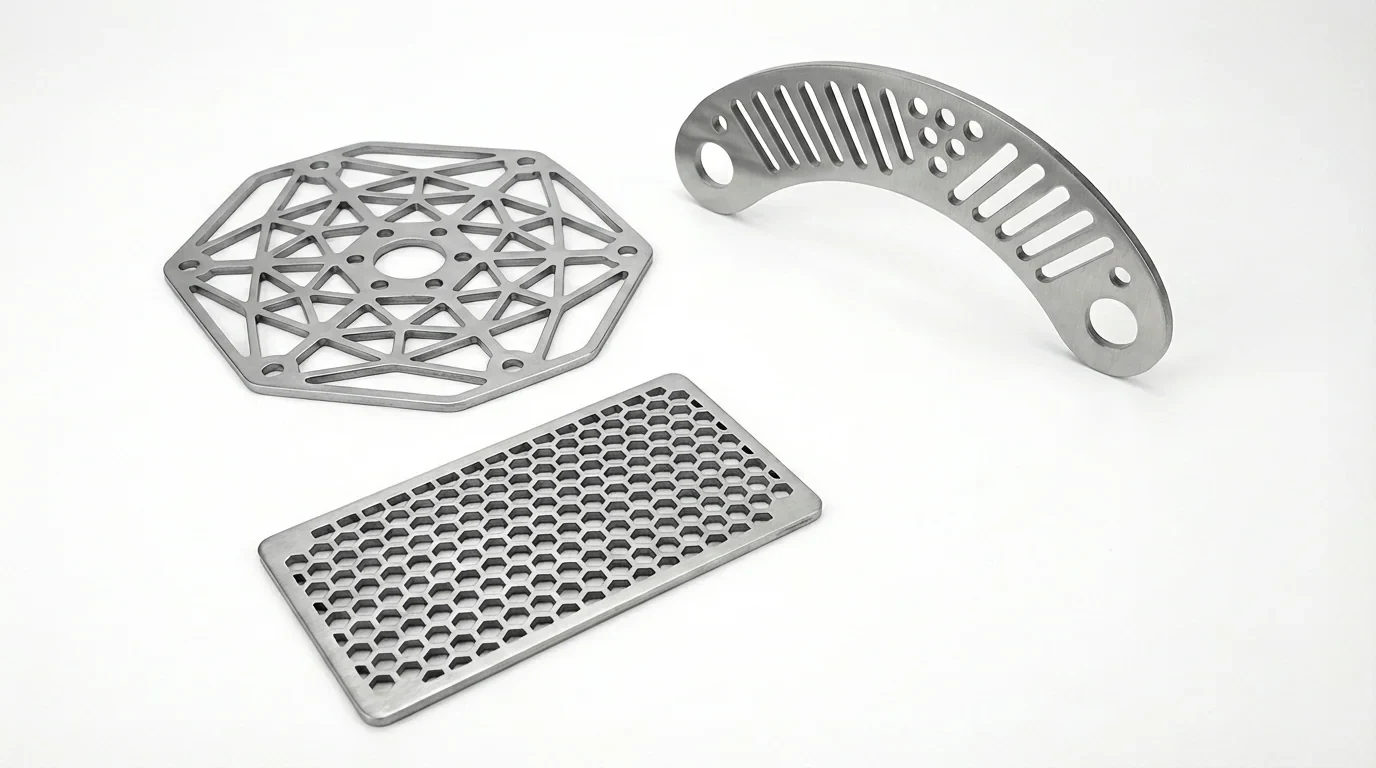
A family of alloys.
A system of tradeoffs.
A grade number connects the part to a specific material response. Change the grade and you can change how it survives, how it forms, and how it must be manufactured.
Stainless steel relies on a chromium-rich passive surface film. Under suitable conditions, that film provides corrosion protection. It can also break down locally. The relevant question is whether the selected alloy and finished surface will remain suitable in the actual service environment. Outokumpu / Corrosion resistance ↗
For sheet metal, selection has four connected inputs: exposure, geometry, processing, and required properties. A purchasing decision made from appearance alone omits all four. This guide organizes common grades around those inputs so the material callout can support the finished part.
Read the family first.
Microstructure explains much of the behavior. These five selection groups provide a useful starting map; precipitation-hardening grades are grouped by strengthening mechanism.
Austenitic
304 · 316 · 301A broad family for forming and corrosion resistance. Cold work can substantially change strength.
Ferritic
430A chromium-based family with a magnetic response. Grade selection still depends on exposure and processing.
Duplex
2205Austenite and ferrite together. High strength with a distinct fabrication envelope.
Martensitic
420Heat treatment develops hardness. Wear and edge performance can drive selection.
Precipitation hardening
17-4 PHAlloy chemistry and aging condition work together to establish the final properties.
The grade changes
the part.
Explore six common selection paths. These are application starting points; stock thicknesses, product forms, and processing capabilities must be confirmed for the job.
304 / 304L
Common designation / UNS S30400 · S30403
The fabrication baseline.
304 combines corrosion resistance with good formability and weldability. It is a useful starting point for general-purpose fabricated sheet: covers, housings, and equipment panels where the service environment supports its use.
304L limits carbon to reduce susceptibility to intergranular corrosion associated with welding. The L addresses a specific metallurgical mechanism; it does not make the alloy immune to every form of corrosion.
Decision to resolve ↳ Establish exposure and the welding route before fixing the material callout. Specify the required grade and condition even when a supplier offers dual-certified stock.
Outokumpu / Core grades ↗316 / 316L
Common designation / UNS S31600 · S31603
More resistance to localized attack.
316 adds molybdenum to the chromium-nickel alloy system. It improves resistance to localized corrosion relative to 304 in many chloride-bearing environments. 316L is the low-carbon variant used to reduce intergranular-corrosion susceptibility after welding.
This makes 316L a candidate for more demanding washdown and process equipment. Temperature, concentration, deposits, and crevice geometry still matter. A chloride-exposed application can exceed the capability of 316L.
Decision to resolve ↳ Identify the actual process fluid and cleaning chemistry. “Marine grade” is a shorthand, not an exposure specification.
Outokumpu / Supra grades ↗Outokumpu / Corrosion resistance ↗430
Common designation / UNS S43000
A different balance for mild service.
430 is a chromium-bearing ferritic stainless used in mildly corrosive environments, including indoor trim and appliance components. It offers good formability and is magnetic. It cannot be hardened by conventional heat treatment.
Its value is application fit: an interior panel may have very different requirements from a welded washdown enclosure. A shared surface appearance does not make the two parts equivalent material-selection problems.
Decision to resolve ↳ Confirm the exposure, cosmetic standard, and joining requirements. Evaluate the complete fabrication route before substituting it for a 300-series grade.
Outokumpu / Moda grades ↗Outokumpu / Stainless steel types ↗301
Common designation / UNS S30100
The temper is part of the design.
301 develops high strength through cold working and is available in a range of tempers. That behavior makes it useful for spring elements, retaining features, and clips.
An annealed blank and a hard-temper strip can have the same alloy designation but different strength and forming limits. Material already strengthened by cold work has less remaining ductility for a demanding bend sequence.
Decision to resolve ↳ Specify the temper and required mechanical properties. Evaluate bend geometry and the finished clip’s deflection and retention force together.
Ulbrich / 301 stainless steel data sheet ↗2205
Common designations / UNS S31803 · S32205
Strength changes the production route.
2205 combines austenitic and ferritic microstructures. It offers high strength, strong resistance to localized corrosion, and improved resistance to chloride stress-corrosion cracking compared with common austenitic grades.
Those benefits introduce process demands. Duplex forming requires attention to machine force, springback, and tool capability. Any proposed thickness reduction also needs checks for stiffness, buckling, joints, and service loads.
Decision to resolve ↳ Define the required UNS designation and product specification. Establish forming and welding procedures for the selected duplex material.
Outokumpu / Forta grades ↗Outokumpu / Forming ↗17-4 PH
Common designation / UNS S17400
Condition controls the outcome.
17-4 PH is a chromium-nickel-copper stainless that develops high strength through precipitation hardening. It pairs high strength and hardness with moderate corrosion resistance.
The heat-treatment condition changes the balance of strength and toughness. A drawing that specifies the alloy but omits its required condition leaves a consequential engineering decision unresolved.
Decision to resolve ↳ Specify both the supplied condition and the required final condition. Confirm product-form availability and plan processing around the required heat treatment.
ATI / 17-4 stainless steel ↗↳ When heat or hardness becomes the primary requirement.
321 and 347 use titanium and niobium stabilization, respectively, to address carbide-related corrosion concerns. They belong in a service-specific discussion of thermal exposure, welding, and required properties. A stabilized designation alone does not establish an allowable operating temperature. Outokumpu / Core grades ↗
420 is a martensitic route to hardness and wear performance. Its exact composition and heat treatment matter. It requires a different process plan from a general-purpose formed cover made from annealed austenitic sheet. Outokumpu / Dura grades ↗
Specify for the
operating environment.
“Better stainless” has no meaning until the failure mode is defined.
Start with what could make the part unacceptable: corrosion, permanent deformation, loss of spring force, distortion, or a damaged cosmetic surface. Then evaluate the candidate grade against the service and production requirements.
| Grade | Primary selection reason | Resolve before release |
|---|---|---|
| 304 / 304L | Balanced fabrication and corrosion performance | Exposure; welded condition; finished surface |
| 316 / 316L | Added resistance to localized corrosion | Chloride chemistry; temperature; crevices |
| 430 | Mild-service ferritic option | Joining route; appearance; environment |
| 301 | Strength developed through cold work | Temper; bend limits; functional deflection |
| 2205 | High strength and demanding corrosion service | Required UNS; forming forces; welding procedure |
| 17-4 PH | Strength and hardness through aging | Supplied and final heat-treatment conditions |
Summary of the manufacturer descriptions cited in the grade profiles. This table compares selection priorities, not qualified service limits.
↳ A magnet does not identify the grade.
Ferritic grades are magnetic. Some austenitic grades also develop a magnetic response through cold working. A magnet test cannot establish the alloy designation or prove that a part is unsuitable stainless. Use traceable material documentation and any verification required by the job. Nickel Institute / The nickel advantage ↗
↳ Strength is different from stiffness.
Stainless grades have broadly similar room-temperature elastic moduli, even when their yield strengths differ substantially. Higher strength can resist permanent deformation without proportionally reducing elastic deflection. Evaluate panel geometry and thickness when stiffness controls the design. Nickel Institute / The nickel advantage ↗
↳ Corrosion resistance has conditions.
Temperature, chlorides, stagnant deposits, and tight crevices can change the outcome. A grade that works on a clean, drained surface may behave differently in an inaccessible joint. Select against the assembled part’s exposure. Outokumpu / Corrosion resistance ↗
The alloy enters
the process plan.
↳ Revisit the bend setup after a material change.
Springback depends on grade, strength, and thickness. High-strength stainless can increase forming-force requirements and complicate shape control. A bend setup validated for one material condition should be reviewed when the grade or temper changes. Outokumpu / Forming ↗
↳ Separate grade, condition, and surface.
304L identifies an alloy. An annealed condition describes its material state. A 2B or No. 4 designation describes a surface finish. Each answers a different question; none replaces the others.
Where appearance matters, define the visible faces, directional finish, and acceptance criteria. Where function depends on roughness, specify a measurable requirement and inspection method. Follow the grade decision into the stainless fabrication guide for cutting, bending, welding, and surface-treatment considerations.
↳ Compare the finished-part cost.
Ask a quote to resolve the actual tradeoffs: available stock, material certification, forming steps, joining, heat treatment, surface work, and inspection. The meaningful comparison is the cost of achieving the required part through a feasible route.
Turn the grade into
a complete callout.
The drawing should carry the decisions that production must preserve.
Record the exact alloy designation, applicable product specification and revision, supplied condition, nominal thickness and tolerance, finish, and any final treatment. Link those requirements to the correct part revision.
- 01 / Material
- Grade + UNS designation + required product specification
- 02 / Stock
- Thickness + tolerance + supplied condition
- 03 / Surface
- Finish + direction + identified cosmetic faces
- 04 / Final state
- Required treatment + acceptance criteria + verification records
Complete these fields for the application. This is a specification structure, not a ready-to-release material instruction.
Choose the grade.
Define the condition.
Engineer the finished part.
Confirm available grades, thicknesses, and services for your project.
Evidence behind
the selection.
Researched September 13, 2026.
Manufacturer and industry references support the alloy descriptions. The decision framework and specification structure are Xeon’s engineering guidance. Listed grades describe selection options, not a claim that every grade and condition is stocked or processed by Xeon.
- Outokumpu / Corrosion resistance ↗Passivity, localized corrosion, and environmental effects.
- Outokumpu / Stainless steel types ↗Microstructure, material families, and mechanical behavior.
- Outokumpu / Core grades ↗304, 304L, and stabilized 321 and 347.
- Outokumpu / Supra grades ↗Molybdenum-alloyed 316 and 316L.
- Outokumpu / Moda grades ↗Ferritic 430 and mildly corrosive service.
- Ulbrich / 301 stainless steel data sheet ↗Cold working, temper, and forming response.
- Outokumpu / Forta grades ↗2205 duplex and its strength and corrosion properties.
- ATI / 17-4 stainless steel ↗Precipitation hardening and heat-treatment conditions.
- Outokumpu / Dura grades ↗Martensitic 420 and hardness-oriented applications.
- Outokumpu / Forming ↗Springback, tooling demands, and grade-dependent forming response.
- Nickel Institute / The nickel advantage ↗Cold-work magnetism and the distinction between strength and elastic stiffness.