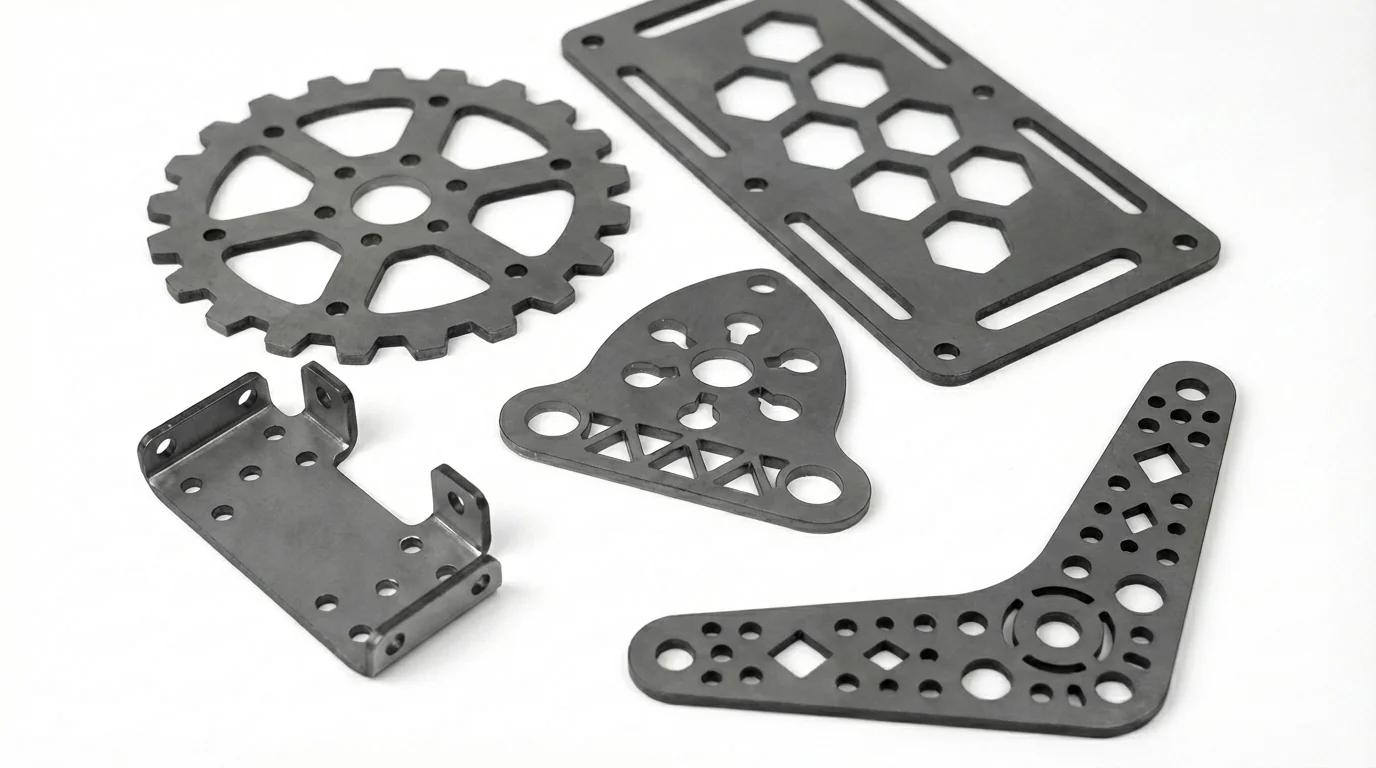
Start with the part.
Choose from the catalog.
The right steel connects the design to the way it will be cut, formed, joined, and finished.
A folded enclosure, a heavy bracket, a weathering panel, and a wear liner ask different things of the stock. The material decision should carry those requirements into production: the selected product, its thickness, its surface, and the services the part needs.
This guide follows the steel options in the Xeon NC catalog. It includes uncoated and coated sheet, both hot-rolled finishes, Grade 50, Corten, AR500, and spring stock. Some are distinct grades; others are coatings or supplied conditions. Each can change the manufacturing plan.
The radar uses six of the catalog’s existing feature ratings. Read them as a quick way to compare priorities, then open the material entry to check the actual specification, thickness, and services. The steel catalog includes carbon and low-alloy products; these entries do not all describe one chemistry. Explore the material catalog ↗
The grade.
The surface. The condition.
Choose the part’s job first. Then narrow the catalog selection by the manufacturing route and the environment.
Formed and coated parts
A1008 CRA starting point for panels, enclosures, and precision brackets.
Surface protection
A1008 EG / G90Compare the coating with joining and finishing requirements.
Frames and flat parts
A36 / A1011 / Grade 50Preserve the specification and select the supplied surface.
Weather, wear, or spring action
Corten / AR500 / SpringResolve the environment and final material condition.
↳ A finish is a material decision.
P&O and mill finish have matching catalog ratings. Their preparation requirements differ. A1008 electro-galvanized and G90 add zinc coatings that belong in the complete fabrication plan.
↳ A family name is not the purchase specification.
Confirm the supplied grade, standard, condition, and thickness. A36 / A1011 and A572 / HSLAS are catalog groupings; the job still needs a specific product callout. SSAB / ASTM A36 ↗ ASTM / Steel standards ↗
↳ A rating is not a listed service.
Material behavior and available operations are separate questions. The catalog lists Grade 50 and AR500 for flat cutting. Spring steel is cut-only. Check the exact entry before designing around a secondary operation.
See the strengths.
See the tradeoffs.
Compare two catalog options across strength, corrosion resistance, welding, forming, machining, and toughness. Read the material conditions alongside the shapes.
Catalog selection guide / 1–5 ratings. These are relative catalog assessments. Review the exact grade, finish, thickness, and available operations before specifying the part.
Compare individual attributes; polygon size is not an overall score.
Primary material
A1008 CR
Cold-rolled, uncoated
- Strengths
- The catalog’s strongest forming and welding ratings, with a smooth starting surface.
- Tradeoffs
- Bare steel needs an appropriate finish where corrosion matters.
Compare with
G90
Hot-dip galvanized sheet
- Strengths
- A higher catalog corrosion rating for parts exposed to weather or moisture.
- Tradeoffs
- Bending, joining, and exposed edges need a coating-aware process plan.
View catalog ratings and how to read the radar
These are Xeon’s qualitative catalog ratings, from 1 to 5. A higher category indicates a more favorable catalog assessment for that attribute. The chart plots those categories directly: 1 is the inner ring and 5 is the outer ring. It does not convert them into physical percentages or measured material properties.
| Catalog option | Strength | Corrosion resistance | Weldability | Formability | Machinability | Toughness |
|---|---|---|---|---|---|---|
| A1008 CRCold-rolled, uncoated | 3 | 1 | 5 | 5 | 3 | 5 |
| A1008 EGElectro-galvanized surface | 3 | 3 | 3 | 4 | 3 | 4 |
| G90Hot-dip galvanized sheet | 3 | 4 | 2 | 3 | 3 | 4 |
| A36 / A1011 P&OHot-rolled, pickled & oiled | 3 | 1 | 5 | 3 | 3 | 5 |
| A36 / A1011 MillHot-rolled, mill finish | 3 | 1 | 5 | 3 | 3 | 5 |
| CortenWeathering steel / A588 or A606-4 | 4 | 4 | 4 | 3 | 3 | 4 |
| Grade 50A572 / HSLAS catalog family | 4 | 1 | 4 | 2 | 3 | 4 |
| AR500Abrasion-resistant, hardened stock | 5 | 1 | 2 | 1 | 1 | 2 |
| Spring / 1095 hardenedRadar basis: hardened 1095 | 5 | 1 | 1 | 1 | 1 | 2 |
Equal ratings can hide meaningful differences. The P&O and mill-finish traces overlap because their catalog ratings match. The spring-steel trace represents hardened 1095; it does not describe the annealed 1075 option. Corrosion ratings depend on the coating or intended exposure, especially for weathering steel.
These scores are selection guidance, not design allowables, impact-test results, minimum bend radii, guaranteed corrosion life, or confirmation of a manufacturing service. Polygon area is not an overall material score. The numerical scales also differ from the aluminum article’s reference-data viewer.
For a released part, use the actual product specification and certification, and verify thickness-specific operations in the Xeon material catalog.
Choose the material.
Understand the process.
Select an option to update the radar and read its profile. Each profile links directly to its material entry.
A1008 CR
Cold-rolled, uncoated
Check the catalog entry for thickness-specific bending and services.
Start with the part you need to form.
A1008 cold-rolled steel is the catalog’s starting point for formed enclosures, panels, and precision brackets. It brings together a clean surface and a fabrication route that can include cutting, bending, welding, and powder coating.
Begin with the geometry: inside radii, flange lengths, hole positions, and finished dimensions. Then choose the exact thickness and check the material’s bend information. A favorable family rating does not make every bend possible.
Decision to resolve ↳Which thickness and bend geometry meet the part’s requirements before finishing?
View A1008 Cold-Rolled Steel ↗A1008 EG
Electro-galvanized surface
Check the catalog entry for thickness-specific bending and services.
Choose the surface as part of the material.
The electro-galvanized option pairs a cold-rolled base with an electro-deposited zinc layer. It belongs in the discussion when the part needs a smooth coated surface and a planned paint or powder-coat system.
Carry the coating requirement through fabrication. Review exposed edges, joining areas, preparation, and the final finish together. Substituting uncoated sheet changes that system even if the part’s outline remains identical.
Decision to resolve ↳How will the coating, fabrication operations, and final finish work together?
View A1008 Electro-Galvanized Steel ↗G90
Hot-dip galvanized sheet
Check the catalog entry for thickness-specific bending and services.
Bring corrosion protection into the stock choice.
G90 galvanized steel is a catalog option for applications such as ductwork and exterior brackets. G90 identifies the zinc coating designation; it does not by itself define the mechanical grade of the steel underneath.
Specify the full sheet designation, thickness, and finish requirements. Consider water traps, contact surfaces, cut edges, and any area affected by joining. Coated stock is the beginning of a protection plan, and the finished geometry must support it.
Decision to resolve ↳Does the completed part preserve the intended protection at its edges and joints?
View G90 Galvanized Steel ↗A36 / A1011
Hot-rolled, pickled & oiled
Check the catalog entry for thickness-specific bending and services.
Remove the scale. Define the finish.
Pickled and oiled hot-rolled steel removes mill scale and leaves an oiled surface. The catalog groups A36 / A1011 stock here for frames, brackets, and other fabricated parts. Confirm the exact product specification for the selected thickness.
The radar intentionally matches the mill-finish option. These two entries differ in their supplied surface; the catalog assigns them the same performance ratings. Choose the surface that fits the preparation and finishing operations your part will receive.
Decision to resolve ↳Which surface condition reduces preparation work for the intended finish?
View A36 / A1011 Hot-Rolled, P&O ↗A36 / A1011
Hot-rolled, mill finish
Check the catalog entry for thickness-specific bending and services.
Plan the preparation before the coating.
The mill-finish entry keeps the hot-rolled surface condition. It is worth evaluating for heavier brackets, plate work, and weldments when the planned route includes cleaning or blasting before the final coating.
Compare it with P&O on the complete job: preparation, handling, appearance, and finishing. Their overlapping radar traces are useful information. A surface decision can matter to production even when it does not change a catalog score.
Decision to resolve ↳Is the required surface preparation included in the production and finishing plan?
View A36 / A1011 Hot-Rolled, Mill Finish ↗Corten
Weathering steel / A588 or A606-4
Check the catalog entry for thickness-specific bending and services.
Design for the patina and the environment.
Corten weathering steel appears in the catalog for architectural panels, signage, and other parts designed around a changing surface. The catalog identifies A588 / A606-4 products; preserve the actual supplied specification on the job.
Weathering steel needs an appropriate environment. Alternating wet and dry exposure supports patina development; persistent moisture, trapped water, and aggressive exposure deserve specific review. Detail drainage and neighboring surfaces before making the patina part of the design.
Decision to resolve ↳Will the installation allow suitable weathering without trapped moisture or unwanted runoff?
View Corten Weathering Steel ↗Grade 50
A572 / HSLAS catalog family
Catalog: plan flat cutting; standard bending is not listed.
Use strength where the design needs it.
Grade 50 connects a higher-strength requirement to a structural steel product. The catalog groups A572 / HSLAS stock under this entry. Confirm the applicable plate or sheet specification instead of treating every Grade 50 designation as interchangeable.
Use it when the engineering requirement supports the choice. Review load, connections, stability, and deflection before reducing a section. Plan flat parts within the catalog’s listed capabilities, and confirm any additional process requirements before release.
Decision to resolve ↳Is the design governed by yielding, stiffness, or another requirement?
View A572 / HSLAS Grade 50 ↗AR500
Abrasion-resistant, hardened stock
Catalog: plan flat cutting; standard bending is not listed.
Choose for wear. Preserve the condition.
AR500 is the catalog’s abrasion-resistant option. Its role starts with a wear problem and a defined service environment. The designation describes a hardness class, so the purchased producer’s specification and certification remain part of the material decision.
Keep the supplied hardened condition in view when planning heat input or secondary operations. The catalog does not list standard bending or countersinking for this family. A high strength score cannot qualify a wear part for an unrelated structural or impact application.
Decision to resolve ↳What wear mechanism, stock condition, and fabrication route must the part accommodate?
View AR500 Abrasion-Resistant Steel ↗Spring steel
Radar basis: hardened 1095
Catalog: cut-only processing.
The temper belongs with the grade.
The spring-steel catalog entry includes 1075 annealed and 1095 hardened stock. These are distinct starting conditions. The radar follows the catalog’s hardened-1095 rating basis; it does not assign those ratings to annealed 1075.
Specify the exact grade and condition for a flat spring, shim, or strip. Resolve the final geometry, edge requirements, loading, and any treatment with the responsible designer. The catalog lists this family for cutting, without standard forming, welding, or hardware operations.
Decision to resolve ↳Does the selected SKU supply annealed 1075 or hardened 1095, and is that the intended condition?
View Spring Steel (1075 / 1095) ↗Let the part
set the priorities.
↳ For an enclosure, start with forming and finish.
Compare A1008 CR with the coated sheet options. Resolve bends, surface preparation, appearance, and exposure together. Review the selected SKU’s bend information and the finish required after cutting and joining.
↳ For a bracket or frame, preserve the product specification.
Compare the hot-rolled entries with Grade 50 where the design requires it. Define load, stiffness, connection details, and the exact product. A stronger grade does not automatically permit a thinner part or authorize the same bend geometry.
↳ For coated stock, specify the whole protection system.
G90 describes a zinc coating designation. The designation includes coating mass across both sides of the sheet, while the base-steel requirements remain separate. Account for exposed edges and areas affected by joining. American Galvanizers Association / G90 designation ↗
↳ For Corten, design the exposure.
Plan drainage and the surrounding surfaces. Weathering behavior depends on the environment; a high catalog corrosion rating cannot promise performance in continuous wetness or every atmosphere. SSAB / Weathering steel ↗
↳ For AR500 or spring steel, preserve the intended condition.
Choose the exact stock before planning secondary work. AR500 is a hardened wear material, while the spring entry includes both annealed and hardened products. The spring chart uses hardened 1095. Confirm which condition the selected SKU supplies. Admiral Steel / Spring steel conditions ↗
When a revision changes the material, revisit every operation and acceptance requirement that depends on it. Keep the drawing, quote, and catalog selection aligned.
Make the selection
complete.
A useful callout connects the catalog material to the finished part.
Specify the exact grade or product standard, thickness, supplied condition, finish, and required operations. Check the selected material’s catalog entry for thickness-specific information and process availability.
- Catalog option
- A1008 Cold-Rolled Steel
- Product + stock
- Required A1008 designation, nominal thickness, and tolerance
- Geometry + process
- Inside radii, flange dimensions, holes, and bend sequence
- Finish + release
- Surface preparation, coating, inspection, and approved revision
Illustrative structure. Complete the actual requirements; the catalog’s feature ratings are not acceptance limits.
Use the radar to narrow the decision. Use the material entry and the released requirements to define the job.
The grade changes the part.
The specification
makes it buildable.
Catalog inclusion does not guarantee every thickness is available for instant quoting. Confirm the material and requested services for your job.
Keep the selection
traceable.
Sources checked September 14, 2026. The viewer takes its ratings from the same catalog data used by Xeon’s material pages. External references explain specifications, coatings, and supplied conditions; they are not the source of the catalog scores.
- Xeon NC / Material catalog ↗Catalog families, six selected feature ratings, and process availability. Scores are qualitative guidance.
- SSAB / ASTM A36 ↗Carbon structural steel specification context.
- ASTM / Steel standards ↗Product specification scopes, including A1008 cold-rolled sheet.
- American Galvanizers Association / G90 designation ↗G90 is a zinc coating designation, with coating mass expressed across both sides.
- SSAB / Weathering steel ↗Patina development and exposure conditions.
- Admiral Steel / Spring steel conditions ↗Annealed and hardened spring-steel product distinctions.
- American Galvanizers Association / Corrosion protection ↗Zinc barrier and sacrificial protection.