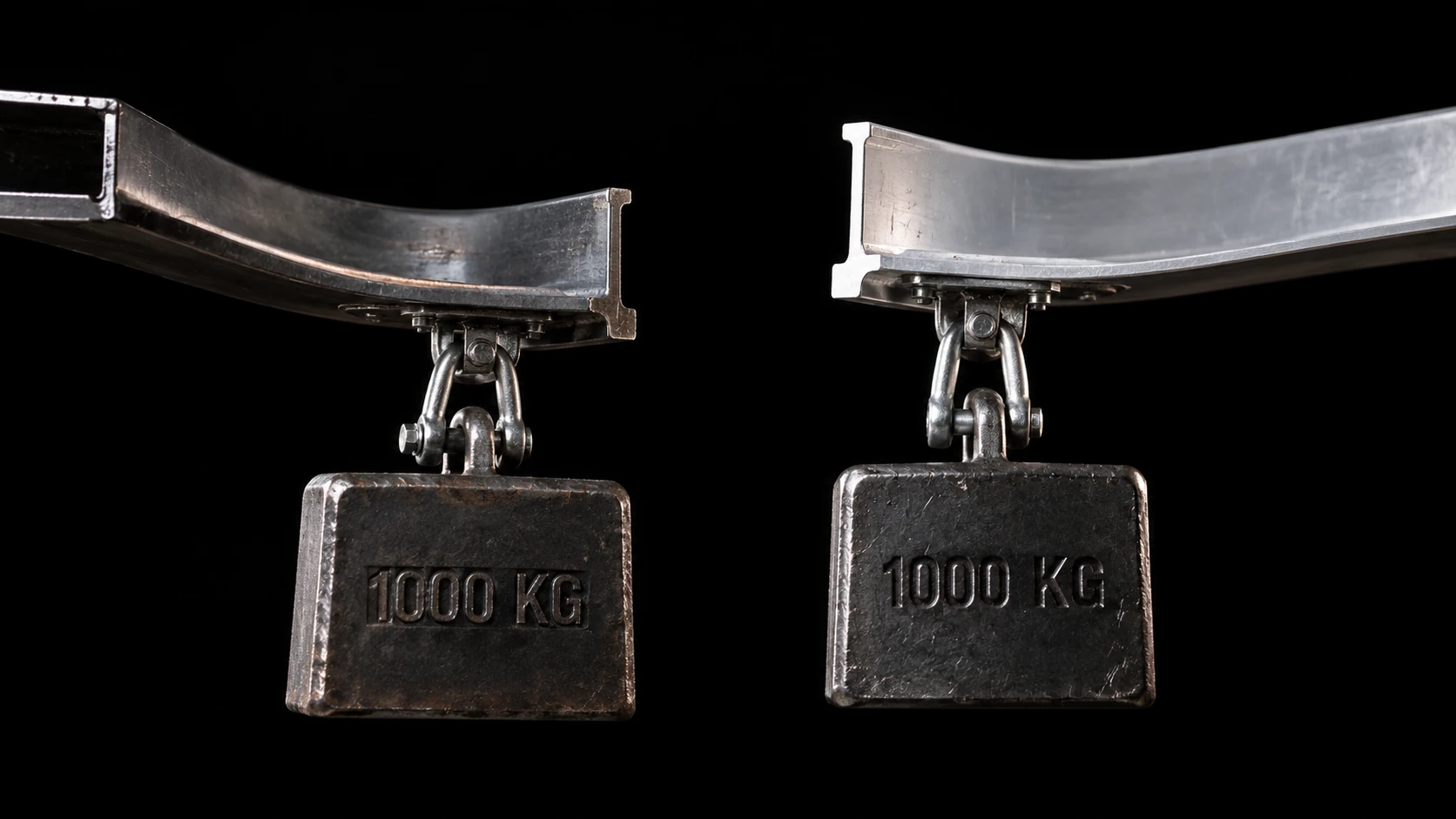
Specific Strength Explained: Strength-to-Weight Ratio and Lightweight Design
Strength per unit of weight.
Specific strength is a material's strength divided by its density. It answers a practical question: for a part that has to carry a given load, which material gets the job done with the least mass?
The unit kN·m/kg looks odd but has a neat meaning: it is the length of a hanging rod of that material that would break under its own weight, times gravity. Steel A36 comes out around 32 kN·m/kg, 6061-T6 around 102, Ti-6Al-4V around 199 and a carbon-fiber laminate several hundred. In imperial terms, divide ksi by lb/in³ and you get the "breaking length" in thousands of inches.
The materials library uses yield strength for metals and tensile strength for polymers and composites, which have no distinct yield point. Some sources use tensile strength throughout; check which one a published figure uses before comparing.
How materials compare.
Specific strength reshuffles the strength chart. Mild steels drop to the bottom of the metals because they are both modest in strength and heavy. Magnesium jumps up because it is so light. Titanium alloys and carbon fiber lead the field.
Two results surprise people. First, AR500 and hardened spring steel sit right alongside 7075-T6 — high-strength steel is not "heavy" for its strength. It loses on stiffness per weight and on the thickness it would need to avoid buckling, not on strength. Second, engineering plastics like PEEK and nylon 6/6 reach about twice the specific strength of mild steel, which is part of why they replace metal in lightly loaded brackets and housings.
| Stocked grade | Specific strength (kN·m/kg) | Process |
|---|---|---|
| 1095 spring steel, hardened | 185 | Laser cutting |
| 7075-T6 | 179 | Laser cutting, CNC machining |
| AR500 | 176 | Laser cutting |
| 6061-T6 | 102 | Laser cutting, Press brake bending, CNC machining |
| 5052-H32 | 72 | Laser cutting, Press brake bending, CNC machining |
| PA-11 (HP MJF) | 49.5 | MJF 3D printing |
| PA-12 (HP MJF) | 47.5 | MJF 3D printing |
| HSLAS Grade 50 | 43.9 | Laser cutting |
| Corten (weathering) | 43.9 | Laser cutting, Press brake bending |
| MIC-6 cast plate | 38.1 | Laser cutting, CNC machining |
| 1100-H14 | 35.8 | Laser cutting, Press brake bending |
| A36 HR pickled & oiled | 31.6 | Laser cutting, Press brake bending |
| A36 mill finish | 31.6 | Laser cutting, Press brake bending |
| G90 galvanized | 29 | Laser cutting, Press brake bending |
| 304 | 26.8 | Laser cutting, Press brake bending |
| A1008 cold rolled | 26.3 | Laser cutting, Press brake bending |
| A1008 electro-galvanized | 26.3 | Laser cutting, Press brake bending |
| 316 | 25.9 | Laser cutting, Press brake bending |
| PA-12 glass bead (HP MJF) | 23.1 | MJF 3D printing |
How engineers use it.
For tension members, use it directly
A rod, strap, cable or tie carrying a tension load F needs a cross-section A = F·SF / σy. Its mass per unit length is A × ρ, which is proportional to ρ / σy — the inverse of specific strength. The material with the higher specific strength makes the lighter member, full stop.
For bending and buckling, the index changes
Most real parts are loaded in bending, and then shape enters the equation. Ashby's method gives the index to maximise for each case:
| Part and load | Strength-limited | Stiffness-limited |
|---|---|---|
| Tie in tension | σy / ρ | E / ρ |
| Beam in bending, depth free | σy2/3 / ρ | E1/2 / ρ |
| Panel in bending, thickness free | σy1/2 / ρ | E1/3 / ρ |
| Column in buckling | — | E1/2 / ρ |
The lower the exponent on the property, the more density dominates — so for panels, low-density materials win even when their strength is modest. That is why an aluminum enclosure lid comes out so much lighter than a steel one: in a panel, low density counts for more than high strength.
Reading the Ashby chart
On a log–log plot of strength against density, each index becomes a straight line with a fixed slope: slope 1 for σ/ρ, 1.5 for σ2/3/ρ, 2 for σ1/2/ρ. Slide the line toward the upper left and the materials it touches last are the best candidates. Try it on the strength-vs-density chart, with both axes on log scale.
What it means in fabrication.
- The cost of the lightest option. High specific strength usually means 7075, titanium or carbon fiber — more expensive per pound and harder to form. 7075-T6 is a flat-part material here, and Ti-6Al-4V is usually hot formed.
- Joining eats the advantage. Welding heat-treated aluminum drops its local strength toward the annealed value, so a welded 6061 frame is designed to a fraction of the T6 figure. Mechanical fasteners, rivets and adhesives keep more of it.
- Thin sections buckle. A strong, light material sized purely for tension can end up too thin to resist local buckling or denting. Flanges and beads recover it at little weight cost.
Common mistakes.
- “Stronger than steel” without a basis. Per unit weight, against which steel? Carbon fiber beats mild steel by a factor of ten and hardened steel by much less.
- Applying the tension index to a bending part. Use the index for the actual load case; it can reverse the ranking.
- Ignoring stiffness. A part that is strong enough can still flex too much. Check E/ρ or its bending equivalent alongside strength.
Common questions.
What material has the highest strength-to-weight ratio?
Among common engineering materials, carbon-fiber composites lead, followed by titanium alloys such as Ti-6Al-4V and high-strength aluminum such as 7075-T6. Hardened steels are competitive with aluminum on strength per weight but not on stiffness per weight.
Is aluminum stronger than steel for its weight?
It depends on the grades. 6061-T6 has about three times the specific strength of A36 mild steel. Against a high-strength steel such as AR500, 7075-T6 is roughly equal.
How do you calculate specific strength?
Divide strength by density. In MPa and g/cm³ the result is in kN·m/kg: for example, 276 MPa ÷ 2.70 g/cm³ = 102 kN·m/kg for 6061-T6.
Sources & standards.
Values on this page are typical figures for comparison, drawn from the same data as our materials library. Design to the minimums in the governing specification, and ask for mill test reports when the number matters.
- M. F. Ashby, Materials Selection in Mechanical Design
Derivation of the performance indices and the use of property charts for selection.
- Aluminum Association, Aluminum Standards and Data; ASTM B209
Strength and density of wrought aluminum sheet.
- ASTM B265 — Titanium and Titanium Alloy Strip, Sheet and Plate
Strength of CP and Ti-6Al-4V sheet.
Related guides and tools.
Choosing between two materials?
Send the part and the property that matters — weight, stiffness, heat, conductivity — and we will tell you which stocked grade fits and what it does to the price.
Start a quote ↗