Thermal Expansion Explained: CTE, Growth, Mismatch and Thermal Stress
Growth per degree.
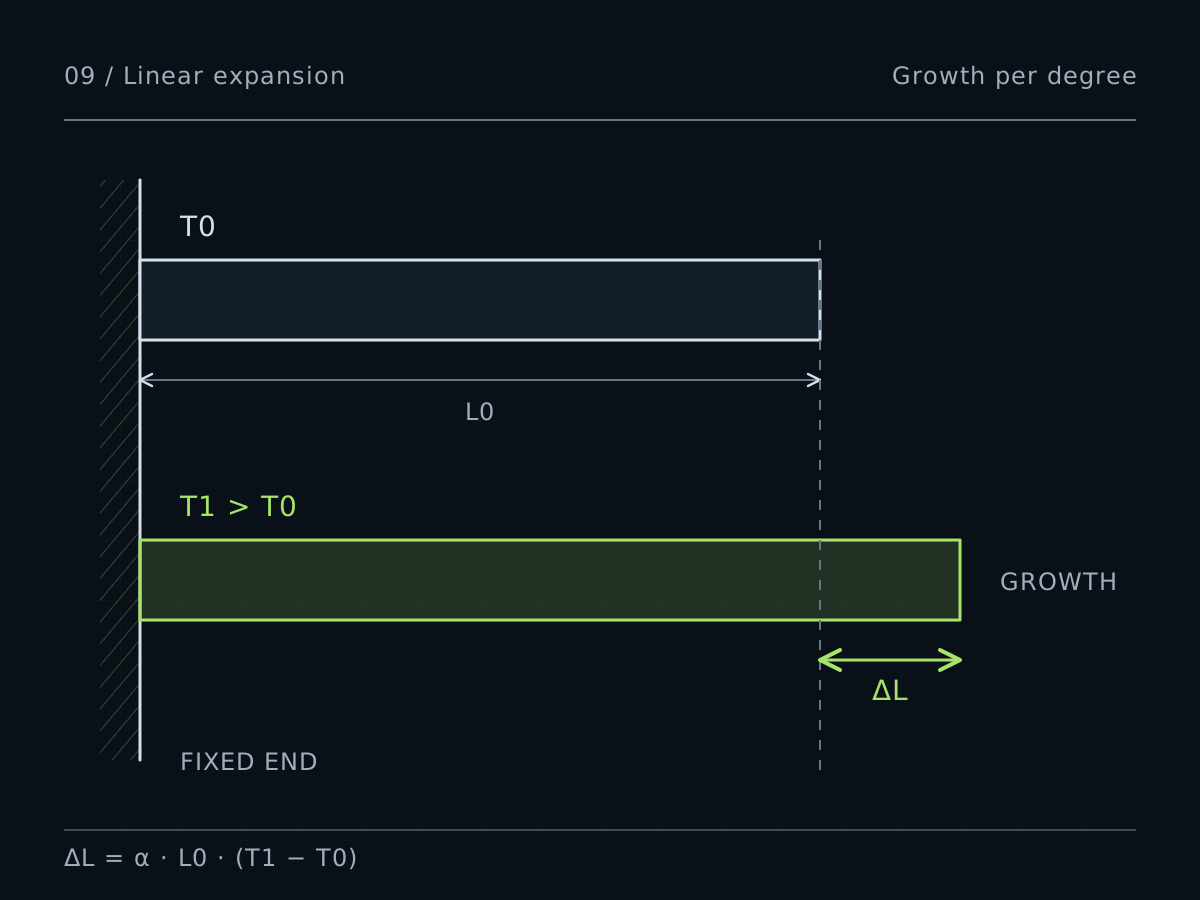
Almost every material gets bigger as it warms up. The coefficient of thermal expansion, α (or CTE), says by how much: the fractional change in length for each degree of temperature change.
The numbers look small, but lengths and temperatures multiply them. 5052 aluminum at 23.8 µm/m·K grows about 0.063″ over 48″ for a 100 °F rise. Carbon steel grows about half that. Area grows by roughly 2α and volume by roughly 3α.
Expansion comes from the shape of the bond between atoms: it is easier to pull neighbours apart than to push them together, so as atoms vibrate harder with temperature, their average spacing increases. Loosely bonded materials expand more — which is why plastics (50–200 µm/m·K) expand far more than metals, and why materials with strong bonds and high melting points tend to expand least.
α is a mean over a temperature range and rises gradually with temperature. Datasheets usually quote it for 20–100 °C; for large temperature swings, use the value for the actual range.
How it is measured.
A push-rod dilatometer (ASTM E228) heats a sample slowly in a furnace and measures its length change through a rod connected to a displacement sensor. Thermomechanical analysis (ASTM E831) does the same on small samples and is standard for plastics and composites. For composites and rolled products, CTE can differ by direction, so results are reported per axis.
How materials compare.
Titanium (8.6) expands least of the common metals, carbon steel sits at 11–12, ferritic stainless 430 at about 10, austenitic 304 and 316 at 16–17, copper alloys at 17–21, and aluminum at 23–24. Magnesium is higher still. Plastics start around 45 (PEEK) and run past 100.
Notice that 304 stainless expands about 50% more than carbon steel even though both are "steel". Austenitic stainless has a different crystal structure, and it is one of the reasons stainless distorts more when welded.
| Stocked grade | Thermal expansion (µm/m·K) | Thermal expansion (µin/in·°F) | Process |
|---|---|---|---|
| 5052-H32 | 23.8 | 13.2 | Laser cutting, Press brake bending, CNC machining |
| 1100-H14 | 23.6 | 13.1 | Laser cutting, Press brake bending |
| 6061-T6 | 23.6 | 13.1 | Laser cutting, Press brake bending, CNC machining |
| 7075-T6 | 23.6 | 13.1 | Laser cutting, CNC machining |
| MIC-6 cast plate | 23.6 | 13.1 | Laser cutting, CNC machining |
| 304 | 17.3 | 9.61 | Laser cutting, Press brake bending |
| 316 | 15.9 | 8.83 | Laser cutting, Press brake bending |
| A1008 cold rolled | 12.2 | 6.78 | Laser cutting, Press brake bending |
| A1008 electro-galvanized | 12.2 | 6.78 | Laser cutting, Press brake bending |
| G90 galvanized | 12.2 | 6.78 | Laser cutting, Press brake bending |
| HSLAS Grade 50 | 12 | 6.67 | Laser cutting |
| Corten (weathering) | 12 | 6.67 | Laser cutting, Press brake bending |
| A36 HR pickled & oiled | 11.7 | 6.5 | Laser cutting, Press brake bending |
| A36 mill finish | 11.7 | 6.5 | Laser cutting, Press brake bending |
| 1095 spring steel, hardened | 11 | 6.11 | Laser cutting |
No tabulated value for AR500, PA-12 (HP MJF), PA-11 (HP MJF), PA-12 glass bead (HP MJF).
How engineers use it.
Mismatch between materials
The common problem is not growth itself but different growth. An aluminum panel bolted to a steel frame, a stainless cover on an aluminum chassis, a plastic part screwed to a metal plate — each pair moves apart as the temperature changes.
For 48″ of 5052 on A36 over a 100 °F swing, that is about 0.032″ (0.8 mm). If the fasteners sit in tight round holes at both ends, the difference turns into bowing, fastener shear or loosening. The fixes are standard: locate the part with one tight hole and use slots or oversize holes elsewhere, keep clamped lengths short, or use a compliant joint.
Thermal stress
If a part is prevented from growing, it is effectively compressed by the amount it wanted to grow. The stress that results is:
For carbon steel fully restrained over a 50 °C rise: 200,000 MPa × 11.7 × 10⁻⁶ × 50 ≈ 117 MPa — about half of A36's yield strength, from temperature alone. Aluminum's higher α is partly offset by its lower modulus: about 81 MPa under the same conditions. Thermal cycling repeats that stress, which is how solder joints, welds and bonded seams fail by fatigue.
Measurement and tolerances
Dimensions are defined at a reference temperature of 20 °C (68 °F) per ISO 1. A 24″ aluminum part measured 20 °F warm reads about 0.006″ long — enough to fail a tight tolerance. Parts fresh off a laser or out of a powder-coat oven need time to come back to room temperature before inspection.
Using expansion on purpose
Shrink fits heat a hub (or chill a shaft) so it slides on and grips when temperatures equalise. Bimetal strips bend with temperature because two bonded metals expand differently — the basis of many thermostats.
What it means in fabrication.
- Weld distortion. The weld and the metal next to it expand while hot, yield in compression and then shrink as they cool, pulling the part out of shape. Higher α and lower conductivity both make it worse, which is why 304 stainless distorts more than mild steel. Balanced weld sequences, tacks and fixtures control it.
- Laser cutting. Local heating and cooling at the kerf can release and rearrange residual stress, especially in dense cut patterns on thin sheet. See laser-cut warping.
- Powder coating. Parts and racks grow in the cure oven. Masking plugs, tight-fitting hardware and assemblies with mixed materials should be checked for clearance at temperature.
- Printed nylon. PA-12 expands many times more than metals; a printed part fastened to a metal plate across a long span needs room to move.
Common mistakes.
- Treating all steels as one CTE. Austenitic stainless is about 50% higher than carbon steel.
- Locating with two tight holes across a long, mixed-material joint. Use one datum hole and slots.
- Inspecting warm parts. Let parts stabilise, or correct the measurement to 20 °C.
- Using room-temperature CTE for a large swing. α rises with temperature; use the mean value for the actual range.
Common questions.
What is the thermal expansion coefficient of aluminum and steel?
Aluminum alloys are about 23–24 µm/m·K (13 µin/in·°F); carbon steel about 11–12 µm/m·K (6.5 µin/in·°F); 304 stainless about 17 µm/m·K (9.6 µin/in·°F).
How do I calculate thermal expansion?
Multiply the coefficient by the length and the temperature change: ΔL = α × L × ΔT. For 48 inches of aluminum at 13.2 µin/in·°F and a 100 °F rise, ΔL ≈ 0.063 inch.
Why does stainless steel warp more than mild steel when welded?
Austenitic stainless expands about 50% more per degree and conducts heat about a third as well, so the weld zone gets hotter, expands more and shrinks more on cooling.
Sources & standards.
Values on this page are typical figures for comparison, drawn from the same data as our materials library. Design to the minimums in the governing specification, and ask for mill test reports when the number matters.
- ASTM E228 — Linear Thermal Expansion of Solid Materials with a Push-Rod Dilatometer
Standard method for metals.
- ASTM E831 — Linear Thermal Expansion of Solid Materials by Thermomechanical Analysis
Standard method for plastics and composites.
- ISO 1 — Geometrical product specifications, standard reference temperature
Sets 20 °C as the temperature at which dimensions are defined.
- AWS Welding Handbook, Vol. 1 — Residual stresses and distortion
How expansion and contraction drive weld distortion.
Related guides and tools.
Choosing between two materials?
Send the part and the property that matters — weight, stiffness, heat, conductivity — and we will tell you which stocked grade fits and what it does to the price.
Start a quote ↗