Electrical Conductivity Explained: % IACS, Bus Bars, Grounding and Temper Checks
Measured against copper.
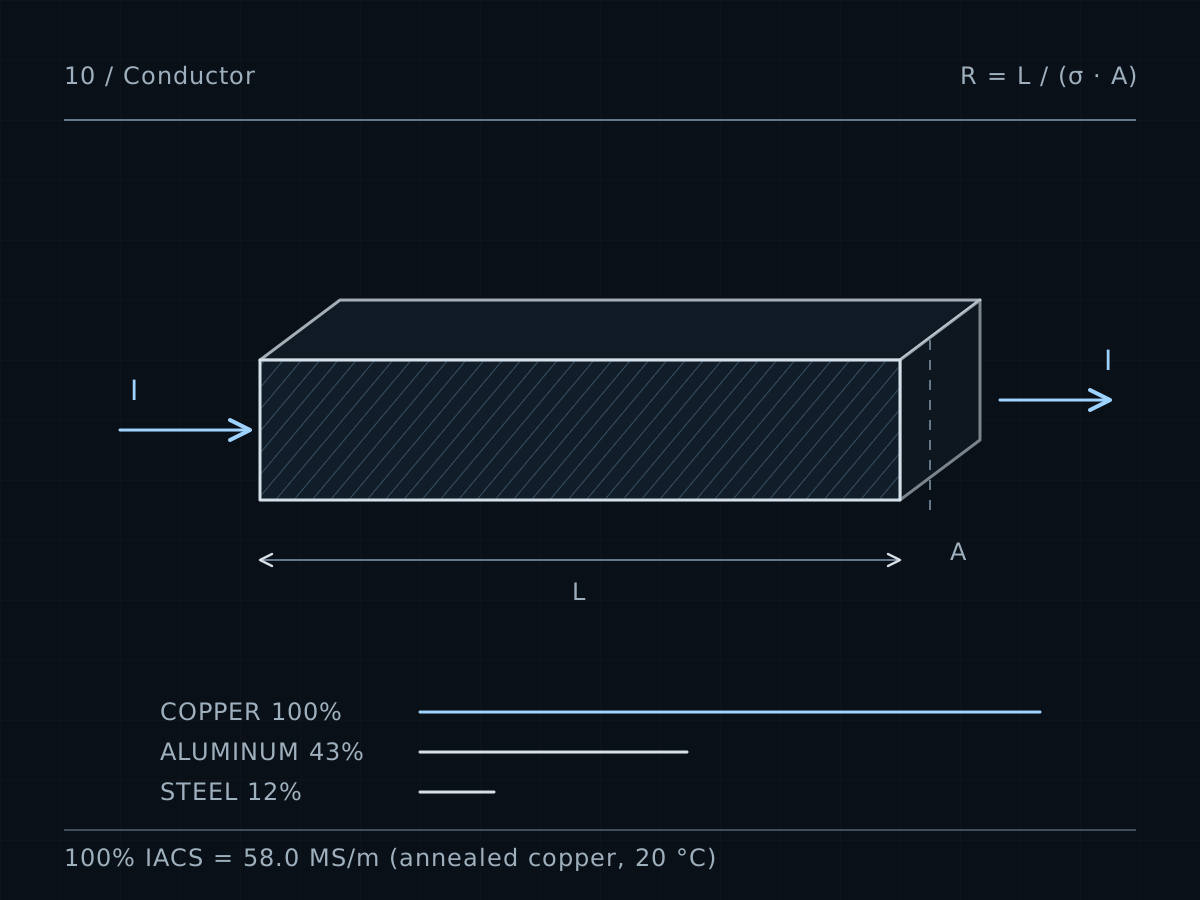
Electrical conductivity, σ, is how easily a material lets current flow. Its inverse is resistivity, ρ. For a bar of length L and cross-section A:
In metalworking it is usually expressed as % IACS — a percentage of the International Annealed Copper Standard, adopted in 1913. 100% IACS is a conductivity of 58.0 MS/m (a resistivity of 1.7241 µΩ·cm) at 20 °C. Modern high-purity copper actually tests slightly above 100%, which is why C110 is listed at about 101%.
The physics is the same as for heat: current is carried by free electrons, and anything that scatters them — alloying atoms, precipitates, crystal defects, higher temperature — raises resistance. That is why the ranking of metals by electrical conductivity closely follows their ranking by thermal conductivity, and why pure metals beat their alloys. Plastics and most ceramics have almost no free electrons; they are insulators, with conductivities lower than copper by a factor of 10²⁰ or more.
How it is measured.
The direct method is resistance: pass a known current through a strip or wire and measure the voltage drop over a known length with a four-wire (Kelvin) connection — ASTM B193 for conductor materials.
The everyday method in aluminum shops and aerospace inspection is eddy current (ASTM E1004). A probe induces circulating currents in the surface and reads conductivity directly in % IACS in a few seconds, without damaging the part. Because conductivity changes with heat treatment, the test is used alongside hardness to confirm temper: 7075-T6 and 7075-T73 have similar hardness but different conductivity, and an aluminum part that has been overheated in service or in a fire shows up as a conductivity shift.
How materials compare.
The spread among metals alone is about a hundredfold, so the chart is logarithmic.
Copper leads, followed by pure aluminum (1100 at about 59%), the heat-treatable aluminum alloys at 30–45%, brass at about 26–28%, magnesium, carbon steel near 12%, and then stainless steel, titanium and nickel alloys in the low single digits. Inside each family, the purer and softer grade conducts best.
| Stocked grade | Electrical conductivity (% IACS) | Process |
|---|---|---|
| 1100-H14 | 59 | Laser cutting, Press brake bending |
| 6061-T6 | 43 | Laser cutting, Press brake bending, CNC machining |
| 5052-H32 | 35 | Laser cutting, Press brake bending, CNC machining |
| 7075-T6 | 33 | Laser cutting, CNC machining |
| A1008 cold rolled | 12 | Laser cutting, Press brake bending |
| A1008 electro-galvanized | 12 | Laser cutting, Press brake bending |
| 304 | 2.4 | Laser cutting, Press brake bending |
| 316 | 2.3 | Laser cutting, Press brake bending |
No tabulated value for MIC-6 cast plate, G90 galvanized, A36 HR pickled & oiled, A36 mill finish, HSLAS Grade 50, Corten (weathering), AR500, 1095 spring steel, hardened, PA-12 (HP MJF), PA-11 (HP MJF), PA-12 glass bead (HP MJF).
How engineers use it.
Bus bars and conductors
A bus bar is sized so its resistive heating, I²R, keeps it within a temperature rise — often 30–50 °C above ambient by the governing standard. Copper gives the smallest bar for a given current. Aluminum needs about 1.6–1.7× the cross-section for the same resistance, but at about 30% of copper's density, an 1100 or electrical-grade aluminum bar carries about twice the current per pound. Resistance rises with temperature — about 0.39% per °C for copper — so a hot bar loses more.
Joints matter as much as the bar
Every bolted joint adds contact resistance. Aluminum forms a hard, insulating oxide film instantly, so aluminum joints need cleaning, joint compound and hardware that maintains clamp force as the joint heats and cools. Plated contact areas (tin, silver) are common on both copper and aluminum bars.
Grounding and bonding enclosures
An enclosure is often part of the ground path or EMI shield, so the conductivity that matters is at the surfaces where parts touch. Powder coat and paint are insulators; anodizing is a thin but insulating oxide. Ground studs and bonding points need masking before finishing, or a conductive finish such as chromate conversion coating. Plan these on the drawing — see our powder coating and anodizing pages for masking options.
Shielding
For high-frequency electromagnetic interference, a continuous conductive enclosure — aluminum or steel — reflects most of the energy, and seams and openings are the weak points. For low-frequency magnetic fields, steel's magnetic permeability matters more than conductivity.
What it means in fabrication.
- Laser cutting copper and brass. High electrical conductivity comes with high optical reflectivity and thermal conductivity — the three travel together. Copper alloys need a fiber laser, more power and slower speeds than steel. See the copper sheet metal guide.
- Resistance welding. Spot welding relies on the part's resistance to generate heat. Aluminum and copper conduct so well that they need much higher currents and careful electrode maintenance; steel spot welds easily.
- Finishing for conductivity. Masking ground points before powder coat or anodize, or specifying a conductive finish, has to be on the drawing to happen.
- Cold work and heat treatment. Bending and cold working lower conductivity slightly; heat treatment changes it measurably — useful for inspection, irrelevant for most enclosures.
Common mistakes.
- Using pure-metal conductivity for alloys. 6061 is about 43% IACS, not the 60%+ of electrical-grade aluminum.
- Grounding through a coating. An anodized or powder-coated contact face will not carry a reliable ground.
- Sizing a bar at room temperature. Resistance rises as the bar heats; size for the operating temperature.
- Mixing copper and aluminum in a wet joint. The galvanic couple corrodes the aluminum. Use bimetallic connectors or plated contact faces.
Common questions.
What does % IACS mean?
Percent of the International Annealed Copper Standard. 100% IACS is the conductivity of standard annealed copper at 20 °C, 58.0 MS/m. A material at 50% IACS conducts half as well.
Is aluminum a good electrical conductor?
Yes. Pure and electrical-grade aluminum reach about 60% IACS, and because aluminum is about 30% as dense as copper, it conducts roughly twice as well per pound. Structural alloys such as 6061 and 5052 are lower, about 35–45% IACS.
Why is stainless steel a poor electrical conductor?
Its chromium and nickel scatter conduction electrons. 304 stainless is about 2.4% IACS — roughly a fifth of carbon steel and a fortieth of copper.
Sources & standards.
Values on this page are typical figures for comparison, drawn from the same data as our materials library. Design to the minimums in the governing specification, and ask for mill test reports when the number matters.
- ASTM E1004 — Determining Electrical Conductivity Using the Electromagnetic (Eddy Current) Method
Non-destructive conductivity measurement in % IACS.
- ASTM B193 — Resistivity of Electrical Conductor Materials
Four-wire resistance measurement.
- IEC 60028 — International standard of resistance for copper
Defines the annealed copper standard behind % IACS.
- Copper Development Association, Copper for Busbars
Bus bar sizing, temperature rise and joint design.
Related guides and tools.
Choosing between two materials?
Send the part and the property that matters — weight, stiffness, heat, conductivity — and we will tell you which stocked grade fits and what it does to the price.
Start a quote ↗