Melting Point Explained: Solidus, Liquidus, Glass Transition and Service Temperature
One temperature, or a range.
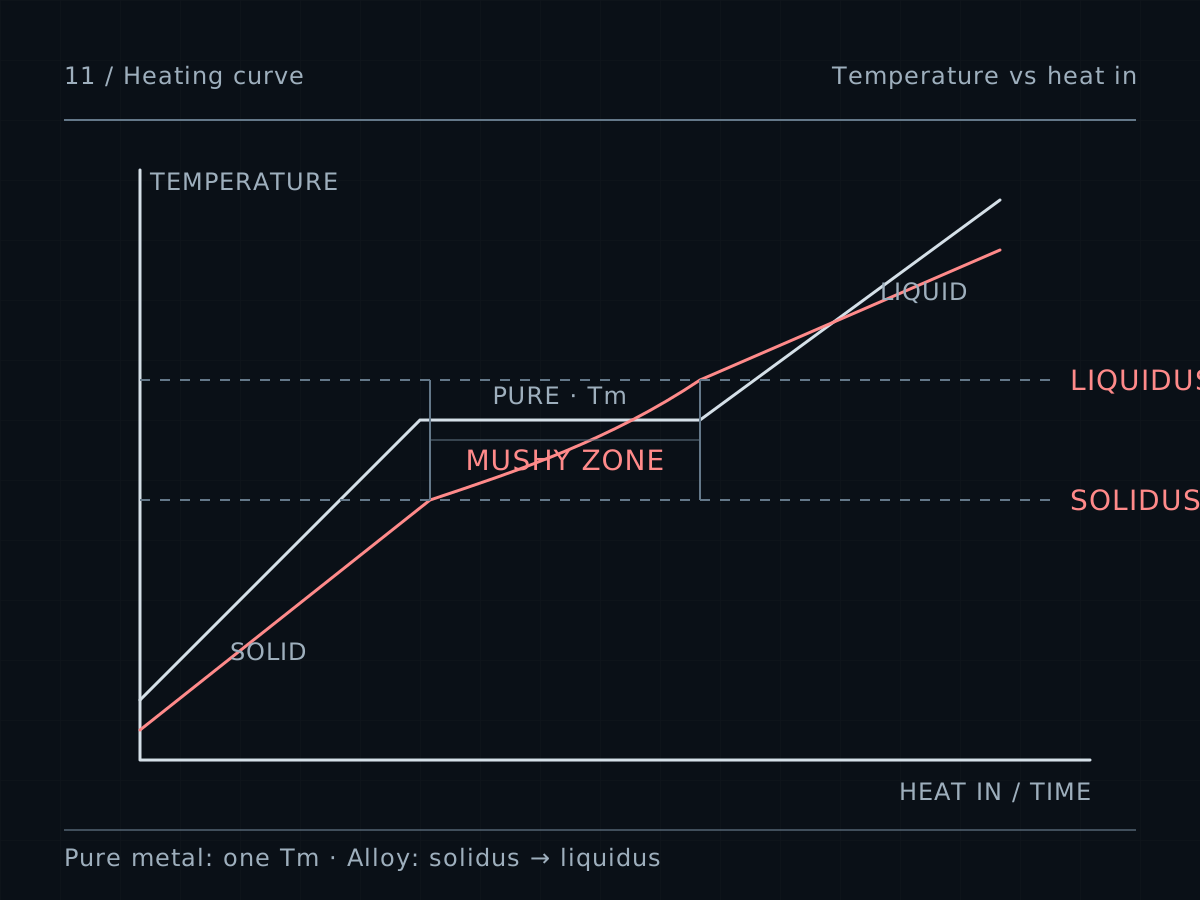
A pure metal melts at a single, sharp temperature: heat it and its temperature stops rising while it melts, then climbs again once it is all liquid. Alloys do not. They start to melt at one temperature and finish at another.
- Solidus — the highest temperature at which the alloy is entirely solid. Above it, liquid starts to form, usually along grain boundaries.
- Liquidus — the lowest temperature at which it is entirely liquid.
Between them is the "mushy zone", a mix of solid crystals and liquid. For engineering purposes the solidus is the number that matters: it is the temperature at which the material stops being a reliable solid. The library lists solidus for alloys — 6061 at about 582 °C, 7075 at about 477 °C, 304 stainless at about 1,400 °C.
Plastics: Tm and Tg
Semi-crystalline plastics — nylon, acetal, PEEK, PTFE, polyethylene — have a melting point, Tm, where their crystals melt. Amorphous plastics — ABS, polycarbonate, acrylic — have no crystals and no melting point. Instead they soften over a glass transition temperature, Tg, from a rigid solid to a rubbery one. Semi-crystalline plastics have a Tg too, below their Tm, where stiffness drops. Thermosets and composite resins do not melt at all; they char and decompose.
How it is measured.
Differential scanning calorimetry (DSC) heats a small sample beside an empty reference and records how much extra heat the sample absorbs. Melting shows as a peak; a glass transition as a step. ASTM E794 covers melting and crystallisation temperatures by thermal analysis, and ASTM D3418 is the standard for polymers. For metals, solidus and liquidus come from thermal analysis or phase diagrams; alloy data books publish them per alloy.
How materials compare.
The families separate cleanly by melting range: plastics from about 135 °C (UHMW) to 343 °C (PEEK); aluminum and magnesium between about 475 and 645 °C; copper alloys between about 885 and 1,085 °C; nickel alloys around 1,290 °C; stainless and carbon steel around 1,375–1,500 °C; titanium about 1,600–1,670 °C.
| Stocked grade | Melting point (°C) | Melting point (°F) | Process |
|---|---|---|---|
| A1008 cold rolled | 1,500 | 2,732 | Laser cutting, Press brake bending |
| A1008 electro-galvanized | 1,500 | 2,732 | Laser cutting, Press brake bending |
| G90 galvanized | 1,500 | 2,732 | Laser cutting, Press brake bending |
| A36 HR pickled & oiled | 1,495 | 2,723 | Laser cutting, Press brake bending |
| A36 mill finish | 1,495 | 2,723 | Laser cutting, Press brake bending |
| 304 | 1,400 | 2,552 | Laser cutting, Press brake bending |
| 316 | 1,375 | 2,507 | Laser cutting, Press brake bending |
| 1100-H14 | 643 | 1,189 | Laser cutting, Press brake bending |
| 5052-H32 | 607 | 1,125 | Laser cutting, Press brake bending, CNC machining |
| 6061-T6 | 582 | 1,080 | Laser cutting, Press brake bending, CNC machining |
| 7075-T6 | 477 | 891 | Laser cutting, CNC machining |
| PA-11 (HP MJF) | 202 | 396 | MJF 3D printing |
| PA-12 (HP MJF) | 187 | 369 | MJF 3D printing |
| PA-12 glass bead (HP MJF) | 186 | 367 | MJF 3D printing |
No tabulated value for MIC-6 cast plate, HSLAS Grade 50, Corten (weathering), AR500, 1095 spring steel, hardened.
How engineers use it.
Service temperature is much lower
Melting point is the outer boundary, not the working limit. Metals lose strength and start to creep — deform slowly under constant load — at temperatures well below melting. A useful rule is the homologous temperature, T / Tm in kelvin: above about 0.4, creep becomes significant for long-term loads.
| Material | Solidus / Tm | Strength or creep becomes a limit around |
|---|---|---|
| 6061-T6, 7075-T6 aluminum | 477–582 °C | about 150 °C, as the aging precipitates coarsen |
| 5052-H32 aluminum | 607 °C | about 150–200 °C, as cold work recovers |
| Carbon steel (A36) | ≈ 1,495 °C | about 350–400 °C |
| 304 / 316 stainless | ≈ 1,375–1,400 °C | about 550–650 °C |
| Inconel 625 | ≈ 1,290 °C | above about 650 °C; used to ~980 °C |
| PA-12 nylon (MJF) | 187 °C | softens well below Tm; check heat deflection temperature |
For a real design, use elevated-temperature properties from the alloy's data sheet or the governing code, not these round numbers. For plastics, the datasheet's heat deflection temperature (HDT) and continuous-use temperature are the relevant limits.
Heat treatment works close to the solidus
Solution heat treatment of 6061 runs at about 530 °C, roughly 50 °C below its solidus. Overshoot and the grain boundaries start to melt, which ruins the part. That narrow window is why heat treatment is done in controlled furnaces, never with a torch.
Joining below the base metal
Soldering (below 450 °C) and brazing (above 450 °C) join parts with a filler metal that melts below the base metal's solidus, so the parts themselves never melt. Welding, by contrast, melts the base metal at the joint.
Process temperatures in the shop.
| Process | Temperature | What it means |
|---|---|---|
| Anodizing | Room temperature bath | No thermal effect on the aluminum. |
| Powder-coat cure | about 180–200 °C (350–400 °F), 10–20 min | Safe for metals; above PA-12's softening range, so printed nylon is dyed or vapor smoothed instead. |
| Hot-dip galvanizing | zinc bath about 450 °C | Zinc melts at 420 °C; welding or laser cutting G90 vaporises the coating locally (zinc boils at 907 °C) — ventilate and expect bare edges. |
| Solution heat treat 6061 | about 530 °C | About 50 °C below the solidus. |
| Laser cutting | above the liquidus at the kerf | The beam melts a narrow kerf and assist gas blows it out; with oxygen on steel, burning adds heat. |
| Arc welding | weld pool above the liquidus | Low-solidus alloys such as 7075 are prone to hot cracking as the mushy zone cools. |
Aluminum's low melting point does not make it easy to laser cut or weld. Its high reflectivity and thermal conductivity mean much of the energy is reflected or carried away, and its oxide skin melts at over 2,000 °C, far above the metal underneath.
Common mistakes.
- Using melting point as the service limit. Strength and creep resistance fall away far below it; design to elevated-temperature data.
- Quoting a single melting point for an alloy. Use the solidus.
- Looking up Tm for an amorphous plastic. ABS and polycarbonate soften at Tg and have no melting point.
- Running heat-treated aluminum hot. A T6 part held at 200 °C for long periods overages and loses strength permanently, even after it cools.
Common questions.
What is the melting point of aluminum and steel?
Pure aluminum melts at 660 °C; common alloys start melting between about 477 °C (7075) and 643 °C (1100). Carbon steel starts melting around 1,450–1,500 °C, and 304 stainless around 1,400 °C.
What is the difference between solidus and liquidus?
The solidus is the temperature at which an alloy first begins to melt; the liquidus is the temperature at which it becomes fully liquid. Between them it is part solid, part liquid.
Do plastics have a melting point?
Semi-crystalline plastics such as nylon, acetal and PEEK do. Amorphous plastics such as ABS, polycarbonate and acrylic do not — they soften at their glass transition temperature.
Sources & standards.
Values on this page are typical figures for comparison, drawn from the same data as our materials library. Design to the minimums in the governing specification, and ask for mill test reports when the number matters.
- ASTM E794 — Melting and Crystallization Temperatures by Thermal Analysis
Thermal-analysis method for melting temperatures.
- ASTM D3418 — Transition Temperatures and Enthalpies of Polymers by DSC
Tm and Tg of plastics.
- ASM Handbook, Vol. 2: Properties and Selection — Nonferrous Alloys
Solidus and liquidus temperatures for aluminum, copper, titanium and nickel alloys.
- AWS A3.0 — Standard Welding Terms and Definitions
Defines soldering and brazing by the 450 °C (840 °F) filler-metal boundary.
Related guides and tools.
Choosing between two materials?
Send the part and the property that matters — weight, stiffness, heat, conductivity — and we will tell you which stocked grade fits and what it does to the price.
Start a quote ↗