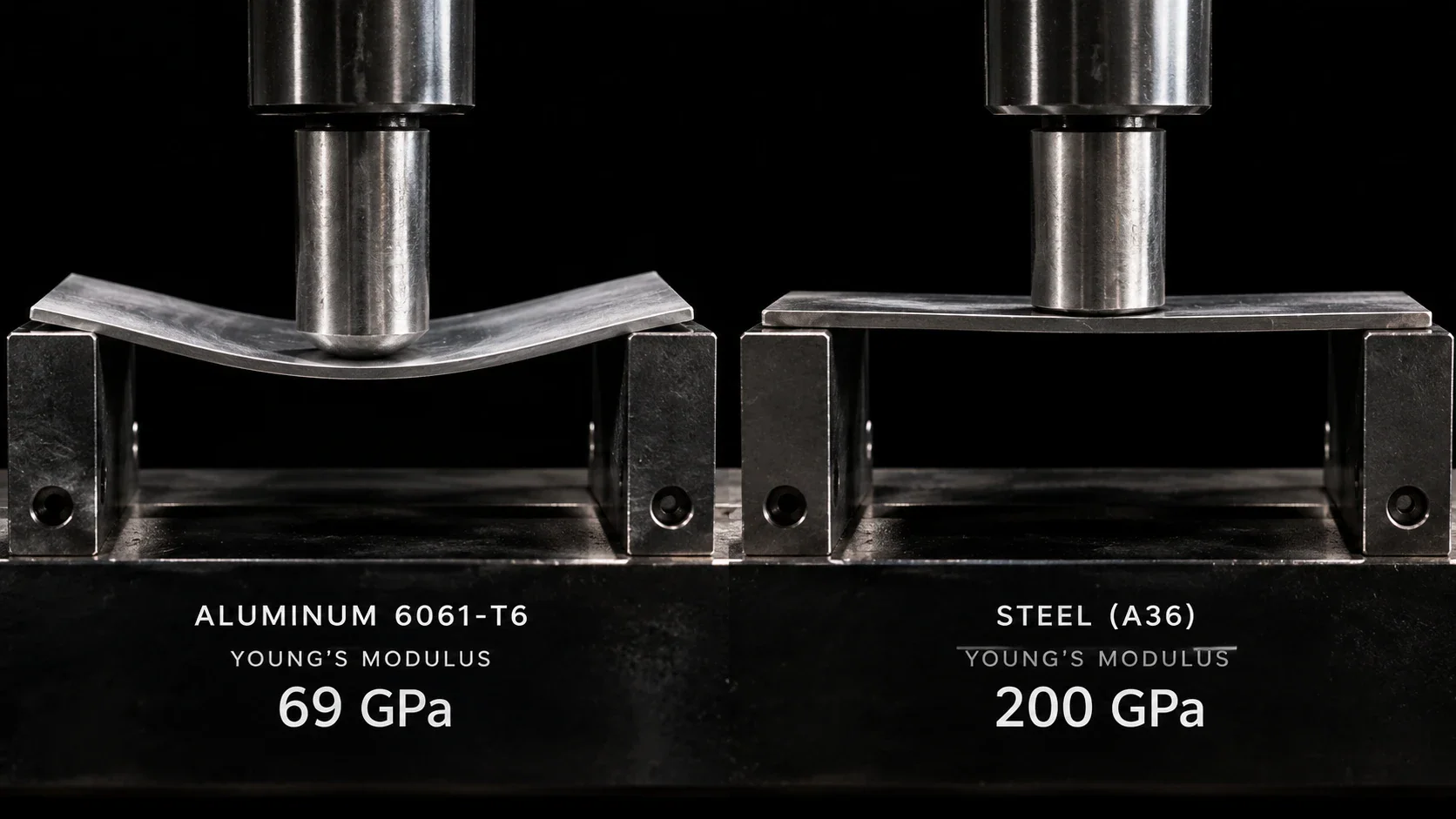
Young's Modulus Explained: Stiffness, Deflection and Why Strength Is Not Stiffness
Stress per unit of stretch.
Young's modulus — also called the elastic modulus, E — measures how stiff a material is: how much stress it takes to stretch it by a given amount, as long as it springs back afterwards.
Strain has no units, so E has the units of stress: gigapascals (GPa) or millions of psi (Msi). Steel's 200 GPa means a stress of 200 MPa stretches it by 0.1%. Aluminum, at 69 GPa, stretches about 0.29% under the same stress.
Modulus comes from the stiffness of the bonds between atoms — how sharply the force between neighbours rises as they are pulled apart. That is why it is fixed by the chemistry of the family. Every carbon steel from A1008 to AR500 sits at 200–205 GPa. Every aluminum alloy sits at 69–73 GPa. Heat treatment, cold work and temper do not change it.
Plastics are 20–100 times less stiff than metals because their chains are held together mostly by weak forces between molecules, and their modulus also falls with temperature and time under load (creep). Composites depend on the fibers and how they are laid up: a quasi-isotropic carbon laminate is about 50 GPa in the plane, while a unidirectional one is over 100 GPa along the fibers and much lower across them.
How it is measured.
The direct method is the start of a tensile test, measured carefully. ASTM E111 specifies how: a precise extensometer reads the strain at low loads, and the slope of the straight-line portion is the modulus. Because the elastic strains are tiny — about 0.1% for steel at its working stress — the extensometer matters more than the load cell.
Dynamic methods are often more accurate: ASTM E1876 rings a small bar and calculates the modulus from its natural frequency, and ultrasonic methods time a sound pulse through the material. For plastics, ASTM D638 tensile modulus and D790 flexural modulus are both common and give somewhat different numbers.
How materials compare.
On a log scale, modulus separates the families cleanly. Metals cluster at 45–210 GPa, composites at 15–100+, engineering plastics at 1–4, and soft polymers below 1.
Pair modulus with density and you get one of the most famous Ashby charts — open it in the library. Steel, aluminum and titanium land on almost the same line of E/ρ, which is why none of them wins on tension stiffness per unit weight; aluminum and magnesium pull ahead in bending, where the index is E1/3/ρ.
| Stocked grade | Young's modulus (GPa) | Young's modulus (Msi) | Process |
|---|---|---|---|
| 1095 spring steel, hardened | 203 | 29.4 | Laser cutting |
| A1008 cold rolled | 200 | 29 | Laser cutting, Press brake bending |
| A1008 electro-galvanized | 200 | 29 | Laser cutting, Press brake bending |
| G90 galvanized | 200 | 29 | Laser cutting, Press brake bending |
| A36 HR pickled & oiled | 200 | 29 | Laser cutting, Press brake bending |
| A36 mill finish | 200 | 29 | Laser cutting, Press brake bending |
| HSLAS Grade 50 | 200 | 29 | Laser cutting |
| Corten (weathering) | 200 | 29 | Laser cutting, Press brake bending |
| AR500 | 200 | 29 | Laser cutting |
| 304 | 193 | 28 | Laser cutting, Press brake bending |
| 316 | 193 | 28 | Laser cutting, Press brake bending |
| 7075-T6 | 72 | 10.4 | Laser cutting, CNC machining |
| MIC-6 cast plate | 71 | 10.3 | Laser cutting, CNC machining |
| 5052-H32 | 70 | 10.2 | Laser cutting, Press brake bending, CNC machining |
| 1100-H14 | 69 | 10 | Laser cutting, Press brake bending |
| 6061-T6 | 69 | 10 | Laser cutting, Press brake bending, CNC machining |
| PA-12 glass bead (HP MJF) | 2.5 | 0.363 | MJF 3D printing |
| PA-12 (HP MJF) | 1.8 | 0.261 | MJF 3D printing |
| PA-11 (HP MJF) | 1.8 | 0.261 | MJF 3D printing |
How engineers use it.
Deflection
Every beam and plate deflection formula has E in the denominator. For a cantilever with an end load:
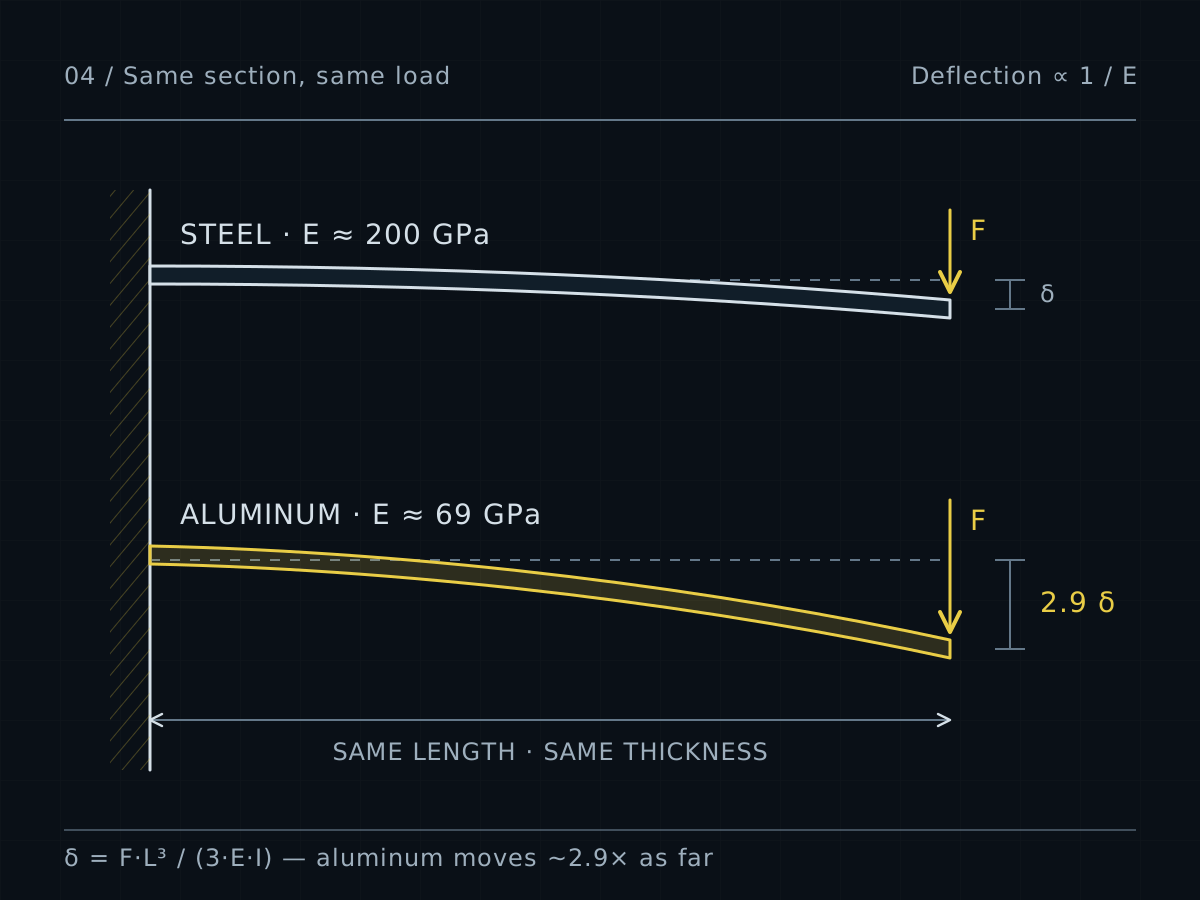
Swap steel for aluminum and, with nothing else changed, the deflection rises by 200 / 69 ≈ 2.9×. Change 5052 for 7075 and it barely changes at all — the stronger alloy is no stiffer.
Matching stiffness across materials
Because I grows with thickness cubed, a stiffness gap can be closed with a modest change in gauge. For a plate in bending, E·t³ must match:
Going from 0.060″ A1008 steel to 5052 aluminum gives 0.060 × (200 / 70)1/3 ≈ 0.085″ — so 0.090″ stock. That panel is about half the weight of the steel one. The calculator does the same for any pair.
Shape beats material
The stiffness of a section is E × I, and I is where the leverage is. A single 90° flange on the edge of a flat panel can raise its bending stiffness about that axis by an order of magnitude — far more than any material change. The stiffness design guide works through flanges, channels and hems.
Springback
After a bend, the elastic part of the strain recovers. That recovery scales with yield strength divided by modulus, σy / E. Aluminum's low modulus is why 6061-T6, with a similar yield to mild steel, springs back noticeably more — and why stainless, with its high work hardening, needs more overbend than its yield alone suggests.
Thermal stress and vibration
Modulus also converts a constrained thermal strain into stress (σ = E·α·ΔT — see thermal expansion), and with density it sets natural frequency: frequency scales with √(E/ρ), which is why stiff, light panels ring at higher pitch and are easier to keep away from motor and fan frequencies.
What it means in fabrication.
- Springback and angle control. Low-modulus, high-yield combinations spring back the most. Our TRUMPF brake's angle measurement corrects for it bend by bend — see the ACB laser guide.
- Flatness after cutting. Thin, low-stiffness sheet is more easily distorted by the residual stress released when a laser cuts a dense pattern; see laser-cut warping.
- Handling and fixtures. Large thin aluminum blanks sag under their own weight more than steel blanks of the same thickness, which matters for machining fixtures and for measuring flatness.
- Plastics. PA-12 at 1.8 GPa is about one-hundredth as stiff as steel. Printed brackets need ribs and depth, not just wall thickness.
Common mistakes.
- Upgrading the alloy to fix flex. 7075-T6 is 2.6× stronger than 5052-H32 and has the same modulus. If a part deflects too much, the alloy is not the problem.
- Confusing stiffness and strength. Stiffness decides how far a part moves under load; strength decides whether it stays bent. A part can be stiff and weak (glass) or flexible and strong (spring steel in thin section).
- Forgetting that plastic modulus changes. Polymers soften with temperature, absorb moisture (nylon) and creep over time. Use the value at the service temperature and duration.
Common questions.
What is Young's modulus of steel and aluminum?
Carbon and low-alloy steels are about 200–205 GPa (29–30 Msi); 300-series stainless about 193 GPa (28 Msi); aluminum alloys about 69–72 GPa (10–10.4 Msi).
Does heat treatment change stiffness?
No, not measurably. Heat treatment changes yield and tensile strength, hardness and ductility, but the elastic modulus is fixed by atomic bonding and stays within a few percent.
Is elastic modulus the same as stiffness?
Modulus is a material property. Stiffness is a property of a part: it combines modulus with geometry (E × I for bending, E × A / L for tension). A thin steel strip can be less stiff than a thick aluminum one.
Sources & standards.
Values on this page are typical figures for comparison, drawn from the same data as our materials library. Design to the minimums in the governing specification, and ask for mill test reports when the number matters.
- ASTM E111 — Young's Modulus, Tangent Modulus and Chord Modulus
Static measurement of the elastic modulus of structural materials.
- ASTM E1876 — Dynamic Young’s Modulus by Impulse Excitation of Vibration
Resonant-frequency method; high precision on small samples.
- ASTM D638 and D790 — Tensile and flexural properties of plastics
Tensile and flexural modulus for polymers.
- W. C. Young & R. G. Budynas, Roark’s Formulas for Stress and Strain
Beam and plate deflection formulas used above.
Related guides and tools.
Choosing between two materials?
Send the part and the property that matters — weight, stiffness, heat, conductivity — and we will tell you which stocked grade fits and what it does to the price.
Start a quote ↗