Metal Density Chart: Aluminum, Steel & Stainless Steel
Mass in a fixed volume.
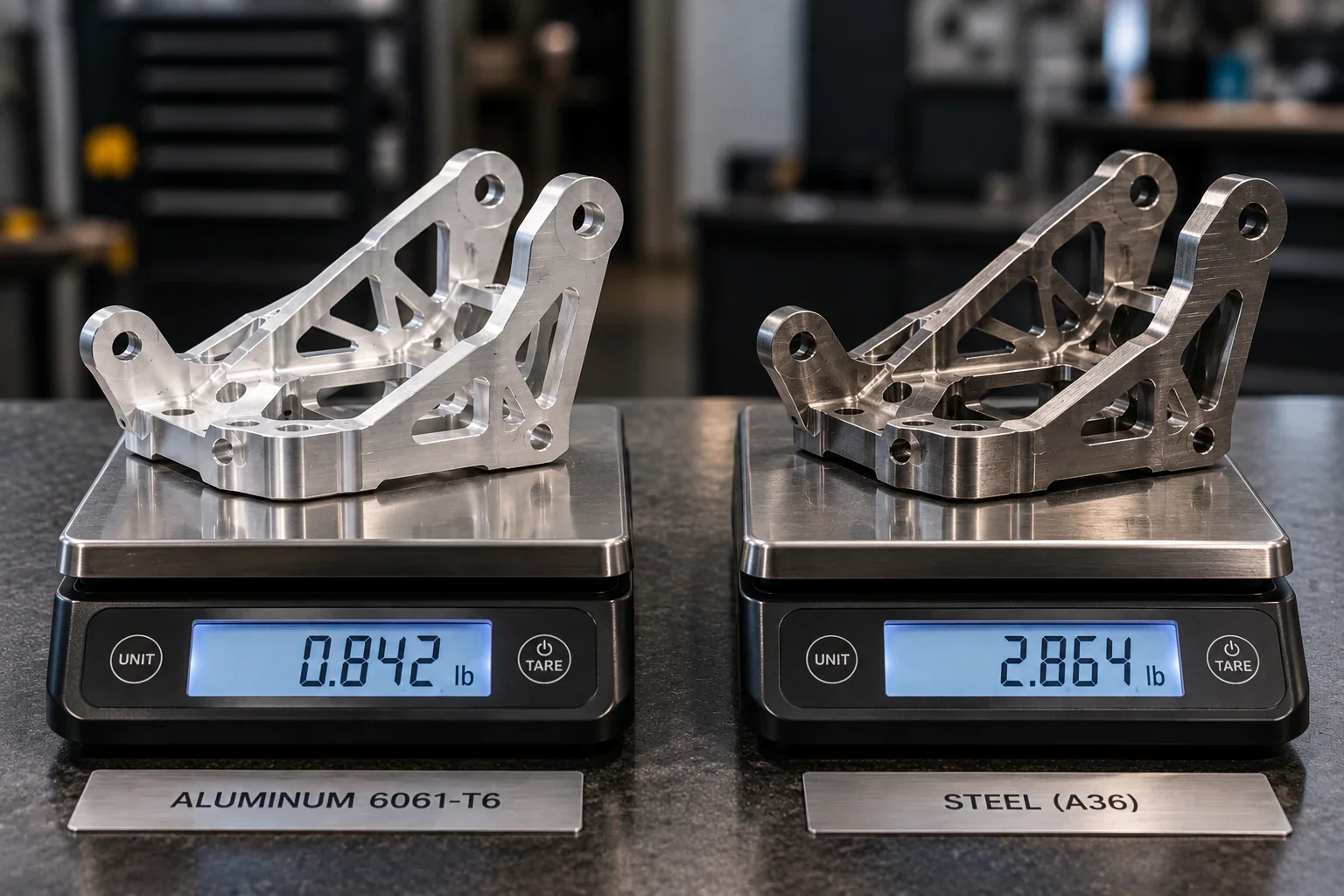
Density is how much mass fits in a given volume. It is the reason a sheet of steel and a sheet of aluminum the same size feel so different in the hand.
For a quick comparison, aluminum alloys are around 2.7 g/cm³, carbon steel around 7.85 g/cm³, and 300-series stainless around 8.0 g/cm³. Use the metal density chart for individual grades and values in lb/in³, or jump to the part-weight calculation. These are typical comparison values; use the specified grade and actual dimensions for your part.
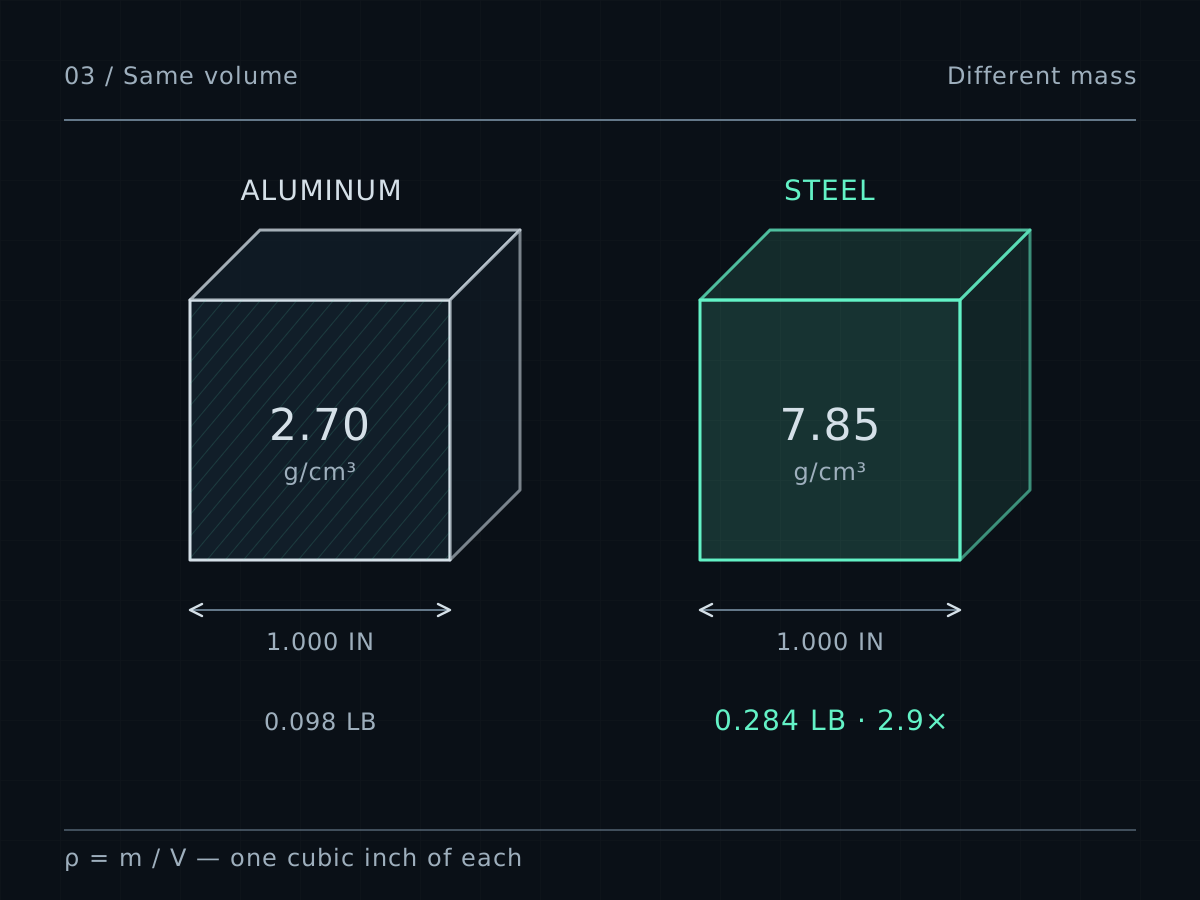
Two things set it: how heavy the atoms are and how tightly they pack. Iron atoms are about twice as heavy as aluminum atoms and pack a little closer, so steel comes out at roughly 2.9 times the density of aluminum. Polymers are long chains of light carbon, hydrogen, oxygen and nitrogen atoms with space between them, so they sit near 1 g/cm³ — about the density of water.
Because it depends on the atoms, density hardly changes with processing. Cold rolling, annealing, quenching and tempering move a steel from 250 to 1,400 MPa of yield strength while its density stays within about 1%. Alloying changes it slightly: lithium makes some aerospace aluminum lighter; zinc and copper make 7075 a little heavier than 6061.
You will also see specific gravity: density relative to water. It has no units, and for practical purposes equals density in g/cm³.
Metal density chart: aluminum, steel and stainless steel.
On a density chart, families collapse into narrow bands. That is the most useful single fact about density: to change a part's weight substantially, you change family, not grade.
Titanium sits between aluminum and steel at about 4.5 g/cm³; copper alloys are the heaviest common metals at 8.5–8.9. PTFE is the dense outlier among plastics at about 2.2, because its fluorine atoms are heavy.
| Stocked grade | Density (g/cm³) | Density (lb/in³) | Process |
|---|---|---|---|
| 304 | 8 | 0.289 | Laser cutting, Press brake bending |
| 316 | 8 | 0.289 | Laser cutting, Press brake bending |
| A1008 cold rolled | 7.87 | 0.284 | Laser cutting, Press brake bending |
| A1008 electro-galvanized | 7.87 | 0.284 | Laser cutting, Press brake bending |
| G90 galvanized | 7.87 | 0.284 | Laser cutting, Press brake bending |
| A36 HR pickled & oiled | 7.85 | 0.284 | Laser cutting, Press brake bending |
| A36 mill finish | 7.85 | 0.284 | Laser cutting, Press brake bending |
| HSLAS Grade 50 | 7.85 | 0.284 | Laser cutting |
| Corten (weathering) | 7.85 | 0.284 | Laser cutting, Press brake bending |
| AR500 | 7.85 | 0.284 | Laser cutting |
| 1095 spring steel, hardened | 7.85 | 0.284 | Laser cutting |
| 7075-T6 | 2.81 | 0.102 | Laser cutting, CNC machining |
| 1100-H14 | 2.71 | 0.098 | Laser cutting, Press brake bending |
| 6061-T6 | 2.7 | 0.098 | Laser cutting, Press brake bending, CNC machining |
| MIC-6 cast plate | 2.7 | 0.098 | Laser cutting, CNC machining |
| 5052-H32 | 2.68 | 0.097 | Laser cutting, Press brake bending, CNC machining |
| PA-12 glass bead (HP MJF) | 1.3 | 0.047 | MJF 3D printing |
| PA-11 (HP MJF) | 1.05 | 0.038 | MJF 3D printing |
| PA-12 (HP MJF) | 1.01 | 0.036 | MJF 3D printing |
How it is measured.
The usual method is Archimedes' principle: weigh a sample in air, weigh it again submerged in water, and the difference gives its volume. ASTM B311 covers this for powder-metal and other metals; ASTM D792 for plastics. For a simple machined block, measuring the dimensions and weighing it works too.
For 3D-printed and cast parts the measured density can be below the material's theoretical value because of porosity. HP quotes MJF PA-12 parts at about 1.01 g/cm³ — essentially solid nylon 12 — so a print that weighs noticeably less than its volume predicts is a sign of incomplete fusion or internal voids.
How engineers use it.
Weight estimates
The everyday use is simple: volume × density. A 24″ × 12″ × 0.125″ blank of 5052 is 36 in³, which at 0.0968 lb/in³ is about 3.5 lb. In steel it would be about 10.2 lb. Weight drives shipping cost, handling, the size of the hardware holding it and — for anything that moves — the energy and force needed to move it. The calculator below does the arithmetic; our material weight calculator handles full sheets and stock shapes.
Lightweighting: never density alone
Swapping steel for aluminum does not make a part 65% lighter unless strength and stiffness do not matter. Aluminum has a third of steel's stiffness, so a panel that has to stay as stiff needs to be thicker. The right comparison is a performance index — a property divided by density:
| Part must… | Compare | Steel → aluminum result |
|---|---|---|
| carry a tension load | σy / ρ (specific strength) | depends on grade — 6061-T6 beats A36 by ~3× |
| resist stretching | E / ρ | about equal |
| resist bending as a plate | E1/3 / ρ | aluminum about 2× better |
| resist bending as a beam | E1/2 / ρ | aluminum about 1.7× better |
This is why aircraft skins, vehicle panels and enclosure lids go to aluminum: for a flat panel loaded in bending, the thicker aluminum part is still about half the weight of the steel one. See specific strength and Young's modulus for the details.
What it means in fabrication.
- Price per part. Metal is bought by weight, so density converts a price per pound into a price per part. Stainless and copper are expensive per pound and heavy.
- Handling. A 4 × 10 ft sheet of 0.25″ steel weighs about 408 lb; the same sheet in aluminum about 141 lb. Weight decides whether a sheet goes on the laser by hand or by loader.
- Laser cutting. Density is one of the factors in how much energy it takes to melt a given kerf, but reflectivity and thermal conductivity matter more — aluminum is lighter yet harder to cut than steel at the same thickness.
- Shipping. Freight is priced by weight and size; for large flat parts, switching to aluminum can cut freight as much as material.
Common mistakes.
- Assuming the same gauge number means the same thickness. Gauge tables differ between steel, galvanized and aluminum; weight-per-area tables tied to gauge are material-specific. Work in decimal thickness — see the gauge chart.
- Using bulk density for printed or cast parts. Porosity and infill lower the real figure.
- Lightweighting by density alone. A lighter material that has to be twice as thick may save nothing — compare the performance index for the load case.
Common questions.
What is the density of aluminum and steel?
Aluminum alloys are about 2.7 g/cm³ (0.098 lb/in³); carbon steel about 7.85 g/cm³ (0.284 lb/in³); 300-series stainless about 8.0 g/cm³ (0.289 lb/in³).
Does heat treatment change density?
Only negligibly. Heat treatment and cold work change strength and hardness by large amounts but density by well under one percent.
How do I calculate the weight of a sheet metal part?
Multiply length × width × thickness to get volume, subtract cutouts, and multiply by the density in matching units. In inches, use lb/in³: 0.098 for aluminum, 0.284 for steel.
Sources & standards.
Values on this page are typical figures for comparison, drawn from the same data as our materials library. Design to the minimums in the governing specification, and ask for mill test reports when the number matters.
- ASTM B311 — Density of Powder Metallurgy Materials
Archimedes method for metals; the principle applies to any solid sample.
- ASTM D792 — Density and Specific Gravity of Plastics by Displacement
Standard method for plastics.
- Aluminum Association, Aluminum Standards and Data
Published densities for wrought aluminum alloys.
- M. F. Ashby, Materials Selection in Mechanical Design
Origin of the performance indices (E/ρ, E^1/2/ρ, E^1/3/ρ) used for lightweight design.
Related guides and tools.
Choosing between two materials?
Send the part and the property that matters — weight, stiffness, heat, conductivity — and we will tell you which stocked grade fits and what it does to the price.
Start a quote ↗