Xeon NC / Technical thesis / AI + sheet-metal manufacturing
The bottleneck is the time between decisions.
A material substitution can arrive in one sentence. Its consequences can span the entire factory.
Change a sheet-metal enclosure from one stock thickness to another and the engineering problem propagates: bend development, flange geometry, hardware selection, assembly clearance, nesting, tooling, price, and delivery. Each decision depends on a different representation of the same part. The delay accumulates as people reconcile those representations.
This is where advanced reasoning models could change manufacturing. Their most consequential role would be to carry an engineering change across systems, identify which assumptions it invalidates, and assemble the evidence required for the next decision.
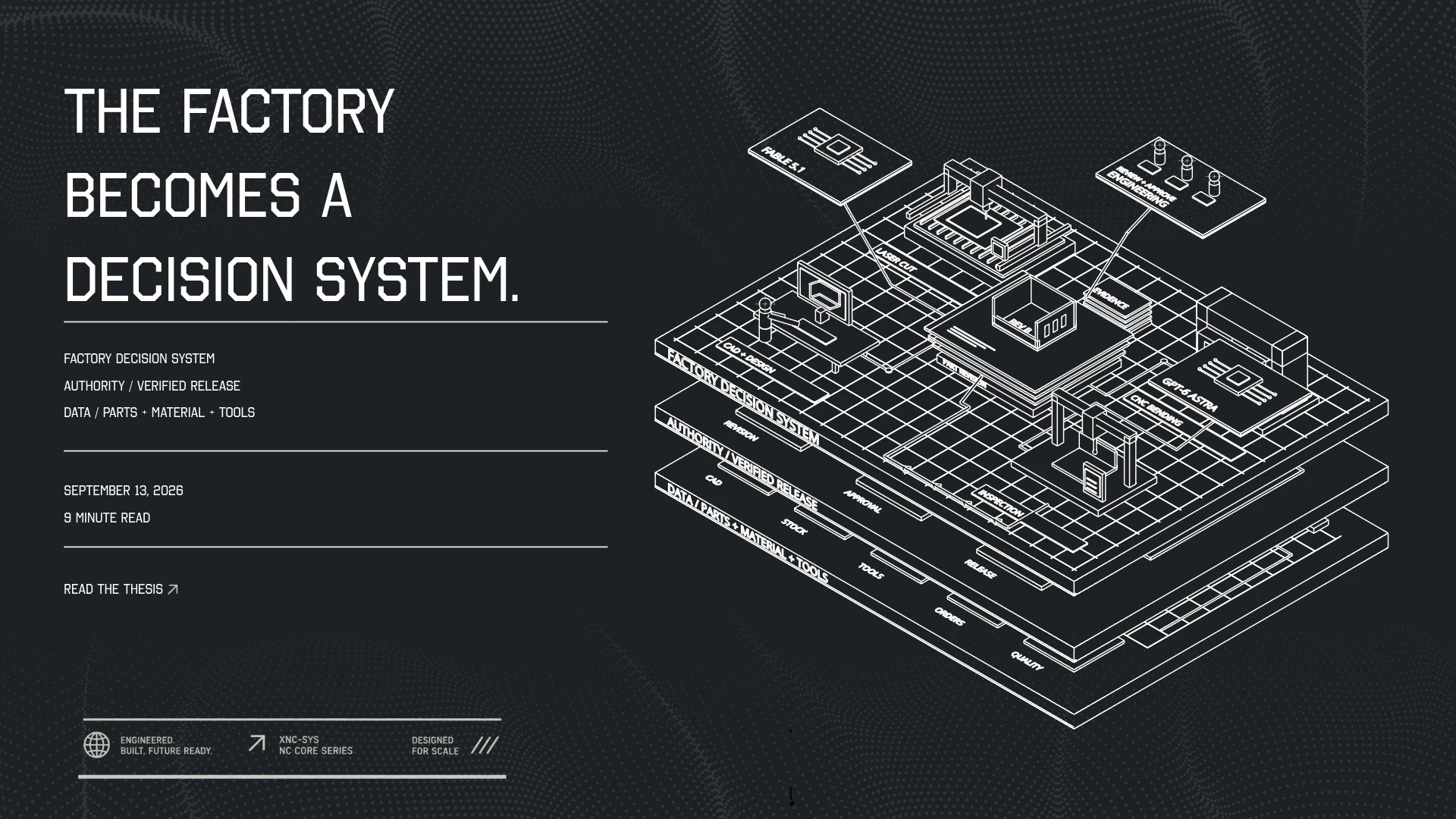
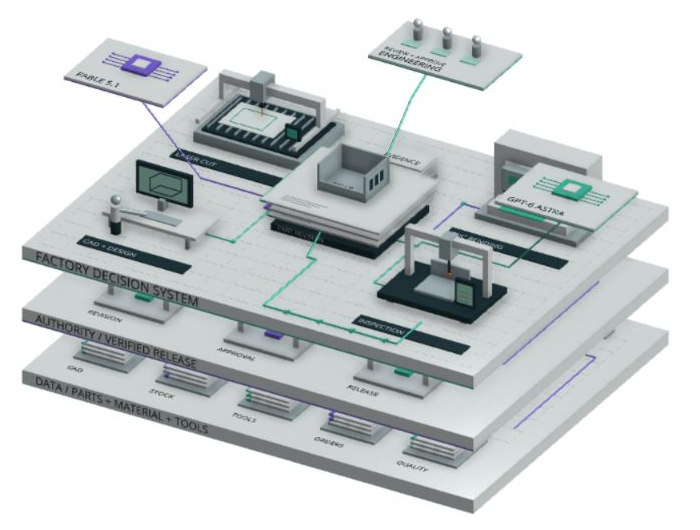
Our thesis is that sheet-metal production will increasingly operate through a shared, revision-controlled decision system. AI would interpret intent and coordinate work. Engineering tools would evaluate geometry and process constraints. Defined release controls would determine which changes can reach production.
This article describes a proposed architecture and a conditional path toward it. The model capabilities cited below are documented today; the integrated manufacturing workflow is the future system we are examining.
Reasoning becomes a layer in the production stack.
Anthropic describes Claude Fable 5.1 as a model for demanding reasoning and long-horizon agentic work, including extended coding and research tasks. OpenAI positions GPT-6 Astra for complex work involving reasoning, coding, computer use, and tools. Those capabilities create a foundation for software that can investigate a problem, operate engineering applications, and work through dependent tasks. Anthropic model documentation · OpenAI model documentation.
A manufacturing application would have to supply the connections: CAD operations, stock records, tooling libraries, quoting logic, production schedules, and inspection results. OpenAI’s tool guidance makes this division explicit: the application executes tool calls and manages the work they initiate. GPT-6 Astra tool guidance.
The important interface is therefore a set of typed engineering actions: regenerate a specified part revision, evaluate a tooling configuration, compare a flat export, or prepare an inspection plan. Each action needs defined inputs, units, permissions, and a result that distinguishes a passed check from an incomplete one.
A language model can propose a bend sequence. CAD and forming tools can evaluate that proposal within their modeled assumptions. The resulting evidence still needs to be matched to the stock, tools, and process that will actually be used.
Give every part an explicit manufacturing contract.
The core object in this architecture is a part revision linked to its requirements and production dependencies. Call this its manufacturing contract: the information that must remain consistent for a job to be released.
| Domain | Required definition |
|---|---|
| Product | Part identity, revision, units, formed geometry, datums, tolerances, and mating interfaces. |
| Material | Alloy, temper, thickness specification, grain requirements, and permitted substitutions. |
| Process | Cut and mark geometry, bend inputs, candidate tools, operation sequence, hardware, and finish requirements. |
| Execution | Quantity, approved route, capacity assumptions, released files, and authorization record. |
| Evidence | Check results, tool and rule versions, source provenance, inspection method, and measured outcomes. |
NIST’s Extended Digital Thread work identifies precise, computer-interpretable product information as a foundation for integration across design, production, and use. An AI workflow depends on that same foundation. Ambiguous source data leaves the reasoning system without a reliable basis for action. NIST — Extended Digital Thread.
The result should be inspectable by an engineer. Every proposed change needs an answer to three questions: what changed, what depends on it, and which evidence remains valid?
Treat a material change as a dependency event.
Consider an illustrative enclosure revision: a designer proposes changing 5052-H32 sheet from 1.5 mm to 2.0 mm while retaining specified external dimensions and mating-hole locations. These are scenario inputs, not a recommendation for a particular enclosure.
The agent would first resolve the design intent. Holding the outside envelope fixed may require the internal space or feature construction to change. It would then regenerate a candidate revision and invalidate checks that relied on the previous thickness.
- Recompute the blank.Re-evaluate the bend inputs and developed geometry using the selected material and process data.
- Check forming access.Reassess flange support, tool clearance, openings near bends, and intermediate forming positions.
- Resolve the assembly.Check internal clearance, fastener grip, hardware compatibility, and specified mating interfaces.
- Rebuild the production proposal.Update stock availability, nesting, setup assumptions, operation time, cost, and the inspection plan.
The useful output is a comparison of feasible alternatives with unresolved items exposed. One option might retain the envelope with revised internal features. Another might preserve the original stock specification and accept a different delivery date. Neither should become an approved substitution without the required design authority.
This is the operational value of reasoning across tools: keeping the implications of a decision together long enough for someone to evaluate them.
Make release a verified state transition.
A proposed workflow would move through explicit states: proposed, regenerated, checked, approved, released, and measured. Each transition would require evidence. A failed or unavailable check would leave the affected transition unresolved.
Before release, the application should confirm that the part revision, tool configuration, rule set, and export identifiers still match the inputs used for validation. A stock substitution or geometry edit during review must invalidate the affected approval. The release package then records exactly which files and assumptions were authorized.
The system also needs failure semantics. If a connection drops after a release request, retrying must first establish whether that request already succeeded. A unique operation identifier and an auditable status record help prevent duplicate work orders or inconsistent releases.
Authority belongs in application permissions and workflow rules. Supplier documents and drawing notes supply engineering data; instructions embedded in them cannot grant new system privileges. Machine control, guarding, and interlocks remain within their engineered control systems, with approved production instructions crossing a defined interface.
A visible feature can be absent from the manufacturing output.
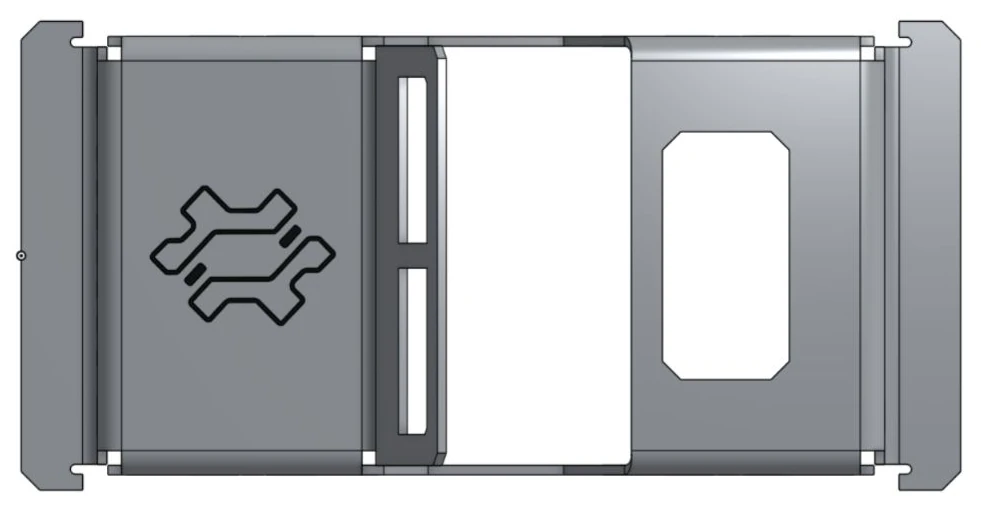
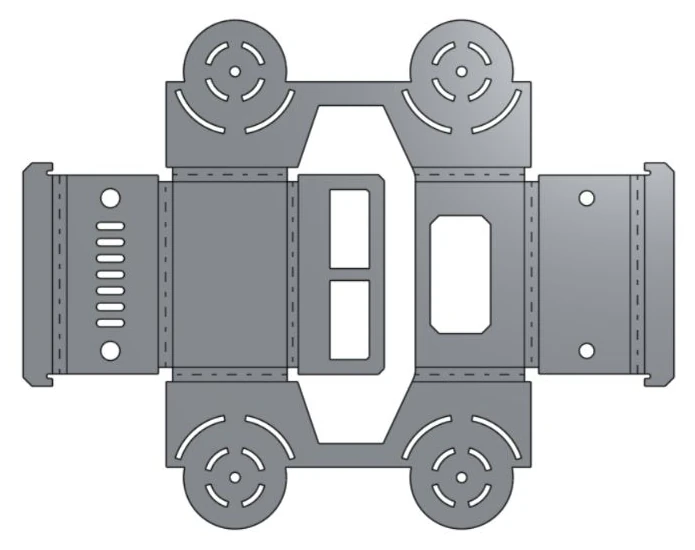
Our sheet-metal Jeep study contains a small example with large implications. The aluminum model has one connected part and nine native bends. Its hood logo was added after the sheet-metal model was finished, so the visible marking operation does not appear in the native flat pattern.
A workflow looking only at the formed view could consider the design complete. A release check comparing the cut geometry, marking definition, feature history, and exported files would identify the missing manufacturing instruction.
The same issue appears in less visible forms: an old DXF beside a new model, a drawing with an outdated thickness, or a quote based on a superseded route. Completeness is a relationship between artifacts. An AI manufacturing system should verify those relationships before presenting the job as ready.
The Jeep is documented CAD evidence. It illustrates the checks a future workflow should perform; it is not a demonstration of autonomous factory production.
Close the loop between the quote and the measured part.
In this architecture, a quote would be the commercial projection of a candidate manufacturing route. Material availability, nest yield, setup count, forming access, finishing, and inspection effort would remain linked to the revision being priced.
Optimization could evaluate cost and delivery across feasible alternatives, with quality requirements treated as constraints. The model could explain tradeoffs and coordinate the analysis; scheduling, nesting, and costing tools would calculate their respective results. Any delivery estimate would retain the capacity and supply assumptions behind it.
After production, inspection would connect the measured part to its revision, stock lot, machine setup, tool configuration, and measurement method. That context is what makes a dimensional deviation useful for future decisions.
A recurring flange-length deviation might justify investigating bend compensation. It could also reflect thickness variation, setup, or measurement practice. The system should preserve competing explanations and measurement uncertainty, then propose a controlled process-data update for validation. One discrepant part should not silently rewrite a universal bend rule.
Over time, this could turn shop knowledge into versioned process knowledge: a rule with an operating range, evidence, an owner, and a record of when it was revised.
Evaluate the system on manufacturing consequences.
The relevant comparison between Fable, Astra, or a future model is how reliably each performs a defined manufacturing task with the same tools and evidence. General model benchmarks cannot establish that a proposed release workflow is suitable for a specific shop.
A representative evaluation set should include successful jobs, rejected geometries, stale exports, incomplete drawings, conflicting units, material substitutions, and interrupted tool operations. Measure outcomes that expose failure:
- False acceptance: known release-blocking defects incorrectly accepted.
- Constraint coverage: required checks completed with traceable evidence.
- Revision integrity: stale or mismatched artifacts correctly detected.
- Review burden: engineering time needed to verify and correct a proposal.
- Production outcome: first-article conformity, rework, and delivery performance under documented conditions.
Promotion to a wider scope should depend on observed results. Model, prompt, tool, or rule changes require renewed evaluation of the affected tasks. Having a second model review the first can add scrutiny, but shared mistakes remain possible; independent geometry checks and physical inspection still carry their own evidentiary role.
Expand autonomy where the process is understood.
The first practical stage is preparation: agents assemble requirements, find contradictions, draft CAD operations, and prepare review packages. The next stage is supervised execution across connected applications, with engineers authorizing consequential changes.
Bounded autonomy becomes a plausible later stage for validated part families, materials, tooling, and routes. The system could process routine variations within that operating range and escalate exceptions with the relevant geometry, evidence, and alternatives already assembled.
For the designer, the interface could become a technical conversation with the production system: retain these interfaces, compare these materials, explain this forming constraint, and show the cost of each feasible revision. For the shop, the result could be fewer unresolved assumptions arriving at the machine.
For Xeon, this is a direction worth building toward: connect the reasoning to the actual part, make the process constraints inspectable, and preserve the evidence behind every release. Engineers and operators would define and improve the rules that make that system dependable.
The competitive advantage will belong to manufacturers that can turn an engineering decision into a verified production state—and learn from the part that comes back.
Sources & scope.
Researched September 13, 2026. Vendor documentation supports the model-capability descriptions. The manufacturing architecture, material-change scenario, release logic, and deployment stages are Xeon’s analysis. They do not represent a tested comparison of the two models or a claim that this full workflow is deployed at Xeon.
- Xeon — Factory decision architecture in Onshape
Original layered CAD model for this article: data, authority, execution, AI tools, and measured feedback. Existing document permissions apply.
- Anthropic — Claude Fable 5.1
Official model overview; reasoning and long-horizon agentic work.
- OpenAI — GPT-6 Astra
Official model documentation; reasoning, coding, computer use, and supported tools.
- OpenAI — Using GPT-6 Astra
Tool orchestration, structured outputs, and the application’s role in executing tool calls.
- NIST — Extended Digital Thread
Interoperable, computer-interpretable product information across the manufacturing lifecycle.
- Xeon — One blank. Nine bends. A Jeep.
The documented Onshape revision, bend table, native flat, and separate hood-marking operation.
The cover artwork was supplied for this article and compressed without cropping. The factory architecture is an original conceptual model built in Onshape; the image in the model section is a direct CAD capture, framed and compressed for the web. The Jeep images are direct Onshape captures reused from the linked design study.
Follow the decisions into the part.
Start with a defined part.
Bring your model, material, thickness, quantity, and critical requirements. Give the manufacturing decision the information it needs.
Start a quote ↗