What are standard sheet metal sizes?
In U.S. fabrication, 48 × 96, 48 × 120 and 60 × 120 inches are familiar stock formats. The economical choice depends on the exact material you need.
These are the 4 × 8, 4 × 10 and 5 × 10 foot sheets that appear throughout sheet-metal purchasing. They are useful starting points for a design, but the word standard describes a commonly supplied format—not a guarantee that every alloy, thickness and finish is available in it.
| Trade size | Inches | Exact conversion to mm | Area |
|---|---|---|---|
| 4 × 8 ft | 48 × 96 | 1,219.2 × 2,438.4 | 32 ft² |
| 4 × 10 ft | 48 × 120 | 1,219.2 × 3,048 | 40 ft² |
| 5 × 10 ft | 60 × 120 | 1,524 × 3,048 | 50 ft² |
All three formats occur in Xeon’s published material catalog; selected examples appear below. Metric values here are conversions of inch stock, not separate metric stock sizes. Nominal dimensions are subject to the purchased material’s dimensional requirements.
Smaller widths and larger sheets also exist. Architectural copper, for example, has established 30- and 36-inch sheet widths. Plate mills can produce much larger rectangles. The relevant question is which format your supplier routinely carries in the required grade and condition, and which of those formats your fabricator can process.
Start with the material definition: alloy or grade, temper where applicable, thickness, surface finish and any coating or protective film. Then check the sheet size. “Aluminum, 4 × 8” leaves too much of the purchasing decision unresolved.
The same material family can have different stock sizes.
Sheet formats follow the production route and the inventory a supply chain supports. Changing thickness or finish can change the available parent stock even when the part geometry stays identical.
| Material | What determines the useful format |
|---|---|
| Carbon steel | Check cold-rolled, hot-rolled, pickled-and-oiled or coated stock separately. A preferred size for one thickness and surface condition may differ from another. |
| Aluminum | Alloy, temper, thickness and product form matter. Rolled sheet, heat-treated plate and cast tooling plate should each be checked against their own stock listing. |
| Stainless steel | Match the grade and finish as well as thickness. Availability of #1 plate does not establish availability of a thin 2B or brushed sheet in the same dimensions. |
| Architectural copper | The Copper Development Association lists 30- and 36-inch sheet widths with 96- and 120-inch lengths. These architectural formats do not describe every copper alloy or product. |
| Heavy or specialty plate | Confirm the mill or distributor’s size range, thickness, condition and handling requirements. A plate that is available to buy may still exceed the fabricator’s machine capacity. |
Copper dimensions: Copper Development Association, Copper in Architecture Design Handbook (2024), Table 1.2A. Rolled and cast product formats must be verified separately; see the Aluminum Association’s explanation of rolled sheet and plate.
Examples from Xeon’s published catalog
These entries show why a design should follow the selected material item instead of a generic sheet assumption. Dimensions below are normalized to width × length.
| Material item | Listed standard sheet |
|---|---|
| A1008 cold-rolled steel, 0.090 in | 48 × 96 in |
| A1008 cold-rolled steel, 0.060 in | 48 × 120 in |
| 5052-H32 aluminum, 0.063 in | 48 × 120 in |
| 5052-H32 aluminum, 0.100 in | 60 × 120 in |
| 304 stainless, #1 finish, 0.500 in | 60 × 120 in |
| MIC 6 cast aluminum plate, 0.250 in nominal | 60 × 120 in |
Source: Xeon’s material catalog data, reviewed September 12, 2026. These are published stock-format examples, not a live inventory check. A larger listed maximum is a separate option; confirm it for the order. Items without a confirmed format require review.
For the full material selection and applicable cutting envelope, use our material size limits guide. A drawing revision that changes alloy, thickness or finish should trigger a fresh stock-size check.
Coil width and sheet length come from different operations.
The incoming coil has a defined strip width. Slitting can divide it into narrower widths.
A cut-to-length line feeds the strip, levels it as required and cuts it across its width.
The selected cut length turns a continuous strip into individual flat blanks.
The American Iron and Steel Institute glossary distinguishes slitting, which makes narrower strip, from cut-to-length processing, which uncoils material and cuts individual lengths. Changing the cut length does not make the incoming coil wider.
That distinction has a practical consequence: a custom length may be possible from an available coil, while a wider part may require a different coil width altogether. Both choices still depend on the line’s thickness, width and length capabilities. Read our coil-leveling article for how processing affects flatness.
Plate is a separate purchasing question
“Plate” does not automatically mean one fixed rectangle or one manufacturing route. Discrete rolled plate is produced as individual plates, while some steel plate is supplied through coil processing. Nucor’s plate-mill data lists different dimensional ranges for hot-rolled coil, cut-to-length plate and discrete plate. Those are mill capabilities, not Xeon cutting limits.
The Aluminum Association describes rolling as the basis for aluminum sheet and plate production. Cast tooling plate follows a different route. Specify the required product and condition; substituting a similarly sized sheet or plate is not automatically an equivalent material choice.
An uncommon size can cost more—even when it uses less metal.
Material cost includes the work required to make a particular format available.
A regularly stocked size can move through an established purchasing and handling routine. An unusual width or length may need a dedicated conversion run, a larger minimum purchase, a different supplier or special transport. Those costs can outweigh a small reduction in sheet area.
- Processing and setup. Slitting, leveling, shearing and packaging may add charges when material must be converted specifically for an order.
- Minimum quantity. A processor may quote a minimum lot or coil commitment larger than the immediate job needs. Unused stock still ties up money and space.
- Availability and lead time. A familiar alloy in an unfamiliar format may require another stocking location or a scheduled production run.
- Handling and freight. Longer or wider stock can require different pallets, equipment or transport arrangements.
- Actual yield. A larger sheet can be economical if it produces enough additional acceptable parts. A smaller sheet can be expensive if the geometry leaves unusable strips.
There is no reliable universal surcharge for a nonstandard sheet. Compare quotations for the same grade, thickness, finish, quantity and delivered condition. A price per pound alone does not show how much material you must buy or how many useful parts you can make.
÷ acceptable parts produced
This is the material-and-supply contribution per part. A complete manufacturing comparison also includes cutting, forming, finishing, inspection and any verified remnant or scrap recovery.
Use custom lengths when the production case supports them.
At Xeon, we generally design and plan around commonly stocked sheets. We have stayed away from making special cut-to-length stock the default because custom runs generally add purchasing and processing cost at the quantities we are trying to serve.
The distinction is a special-order size. A standard 48 × 96 inch sheet may itself have come off a cut-to-length line. The fact that it was cut from coil does not, by itself, make it premium stock. The cost question is whether a supplier already carries the required format or must arrange an order-specific run.
A custom length can still make sense when a repeat program uses enough material, the geometry produces a substantial yield improvement, and the savings cover setup, minimum quantities and logistics. The same logic applies if a required part cannot be made efficiently from routine stock. Review the production case before committing the design to that format.
A simple break-even illustration
Suppose a hypothetical custom-stock program adds $600 in setup and handling, but a verified nest saves $2 in material per accepted part. It takes 300 parts to recover that fixed charge: $600 ÷ $2. Other costs could move the break-even point. These are illustrative numbers, not supplier prices or a Xeon quote.
For a prototype or a small batch, designing within a routine sheet often avoids that fixed-cost problem. For repeat production, review standard and custom formats using the planned quantity and replenishment schedule. The objective is a lower total cost for parts that satisfy the drawing.
Design the flat pattern inside the usable sheet.
A nominal 48-inch-wide sheet does not mean a 48-inch-wide part is ready to cut.
Allow room for the process around the perimeter and between parts. Xeon’s published size check reserves 0.5 inch at each sheet edge. Under that convention, a 48 × 96 inch sheet starts with a 47 × 95 inch usable rectangle. A 48 × 120 sheet gives 47 × 119; a 60 × 120 sheet gives 59 × 119, subject to the selected material and process.
The cutting machine, material stock and later operations all impose limits. Larger mill stock does not increase the machine’s working area. Our size limits guide evaluates the sheet and machine together and distinguishes confirmed material sizes from unconfirmed defaults.
Check the developed blank, not only the finished envelope
A folded enclosure may look compact in the assembly while its side walls, return flanges and bend development occupy a much larger flat pattern. Generate that pattern using the agreed material and forming assumptions, then check the entire outline against the usable stock.
Holes, reliefs and irregular edges also matter to nesting. A simple bounding rectangle is useful for an early fit check, but the production layout must account for the real outline. Leave sufficient separation for the cut process; do not assume adjacent part outlines can share a cut.
Preserve the required orientation
Rolling direction can matter to bending, and a brushed finish can impose a visible direction. Tell the fabricator when rotation or mirroring is restricted. An apparent nesting improvement is not useful if it changes the required material orientation or the assembled appearance.
Where function allows, review noncritical panel dimensions, flange lengths and the division of an assembly into parts. A small geometric adjustment can sometimes make an additional row fit. Preserve required strength, clearances and mating dimensions, and release any change through the normal design review.
Choose a sheet. See its dimensions.
Select a sheet size below to compare its overall width, length and area. The drawing keeps a common scale so the difference between formats stays visible.
4 ft × 8 ft sheet — 48 inches wide × 96 inches long.
All sheet outlines use the same drawing scale. Dimensions describe the full nominal sheet; confirm availability for the selected material, thickness and finish.
A 4 × 10 foot sheet adds length to the 4 × 8 format. A 5 × 10 foot sheet adds width to the 4 × 10 format. Check which dimension your design needs, then confirm that format for the exact material item.
West Virginia University’s guidance on sheet-metal nesting connects better layouts with reduced material waste and emphasizes planning around production needs. Once the stock format is selected, review how the parts will use it. Our gang-sheet and volume-pricing guide explains how part quantity and sheet utilization interact.
Make the stock decision part of design review.
- Define the material completely. State alloy or grade, temper, thickness, finish and coating requirements.
- Confirm the routine stock format. Ask which sizes are normally supplied for that exact item and which require a separate quotation.
- Check the developed geometry. Include every flange, tab and relief in the flat-pattern envelope, with the required edge clearance.
- Review the nest at the intended quantity. Include part spacing, permitted rotations and opportunities to combine compatible parts.
- Compare delivered cost per acceptable part. Include conversion charges, minimum buys, freight and downstream processing.
- Verify before committing to special stock. Confirm availability, machine fit, lead time and the economic case for repeat orders.
This principle has a long history in engineering practice. SLAC’s archived mechanical-drafting guidance recommends using commonly available material sizes and identifying the required material and stock. Apply that purchasing discipline alongside the current drawing and manufacturing requirements for your project.
Is 4 × 8 the standard size for every sheet metal?
No. It is a common U.S. format. The available width and length depend on material, thickness, finish, product form and supplier. Architectural copper and specialty plate show why one universal footprint is misleading.
Are custom cut-to-length sheets always more expensive?
No. A special run can add fixed costs and minimum quantities, but better material utilization at sufficient volume can offset those charges. Compare the complete production requirement.
Can my part use the exact nominal sheet dimensions?
Do not assume it can. Confirm edge margins, actual stock size, cutting requirements and machine limits. Xeon’s published early size check removes 0.5 inch from each edge.
Should I upload a pre-nested production sheet?
Provide the individual part files, quantities and any orientation requirements unless a different workflow has been agreed. The fabricator needs to review spacing, cutting strategy and the stock selected for the order.
Start with the sheet. Protect the function.
Choose a readily supplied material format, build the flat pattern inside its usable area, and review the nest before the design is fixed. That gives the part a practical route from stock to assembly.
Review stock size and part layout with Xeon →Sources and further reading.
University and national-laboratory guidance, industry associations and primary mill data support this article. References reviewed September 12, 2026. Purchasing analysis and numerical examples are Xeon editorial explanations, not quoted market prices or production guarantees.
- West Virginia University — Utilize Nesting in Sheet Metal Part Fabrication: material utilization and planning considerations.
- SLAC — General Drafting Instructions, Mechanical Design, section 8.2 (archived): material identification and commonly available stock sizes.
- American Iron and Steel Institute — Glossary of Steel Industry Terms: coil, slitting and cut-to-length terminology.
- The Aluminum Association — Sheet and Plate: the rolled-product manufacturing route.
- Copper Development Association — Copper in Architecture Design Handbook (2024), Table 1.2A: typical architectural copper sheet and strip dimensions.
- Nucor — Steel Plate Products and Mill Capabilities: different size ranges for coil, cut-to-length plate and discrete plate.
- Xeon NC — Material Size Limits: published stock formats, edge margins and machine-fit checks for the material catalog.
Continue with coil leveling and flatness, sheet-metal tolerances, or flat-pattern developed length.
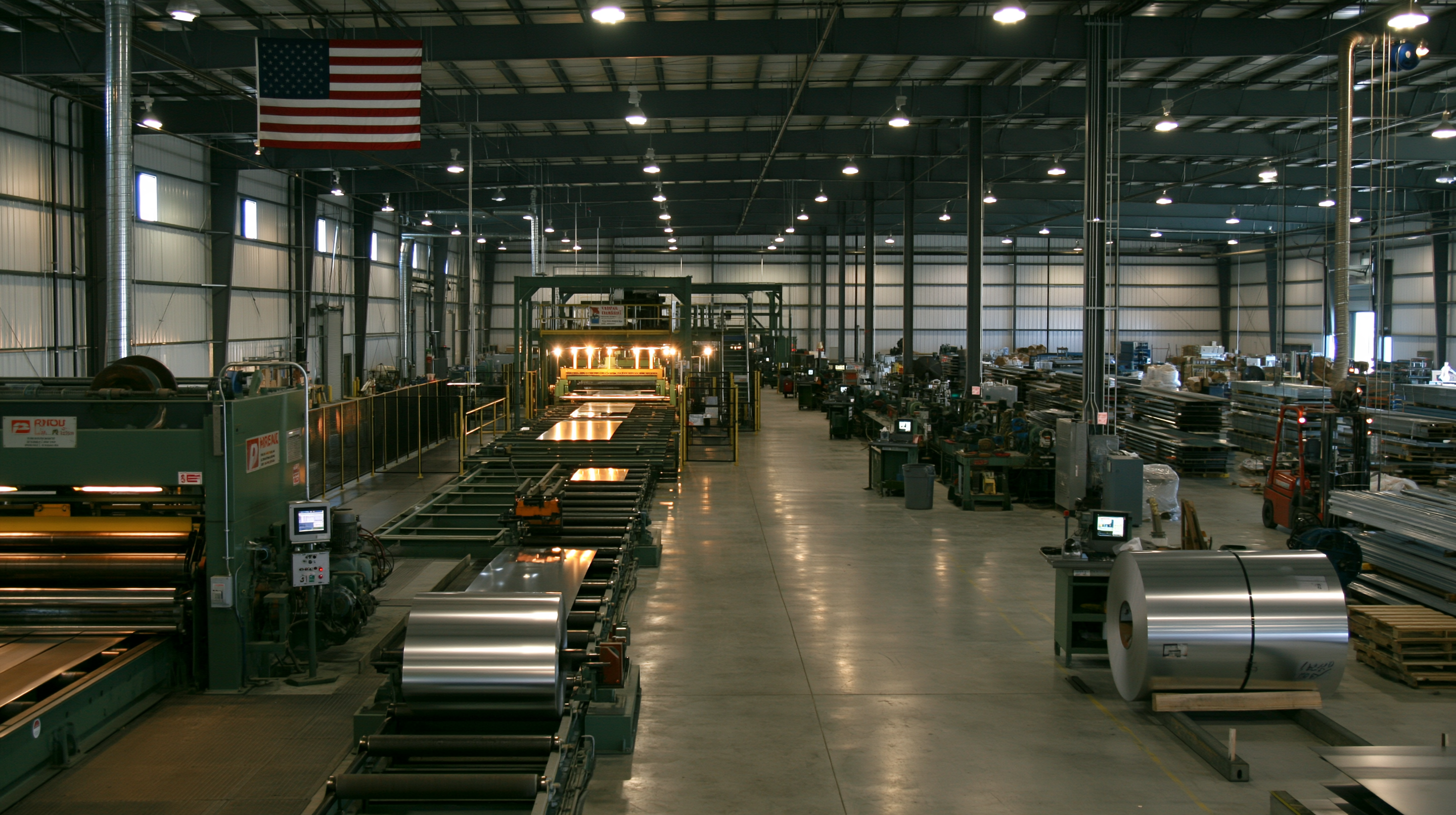
Cover image supplied by Xeon NC and used as an editorial illustration of coil and sheet processing. It does not identify a specific mill, service center or Xeon facility.