Why Powder Coating Flakes on Oxygen-Cut Steel
A steel bracket can hold its finish across the face and shed it around every bolt hole. Look at the cut edge before the part goes to powder.
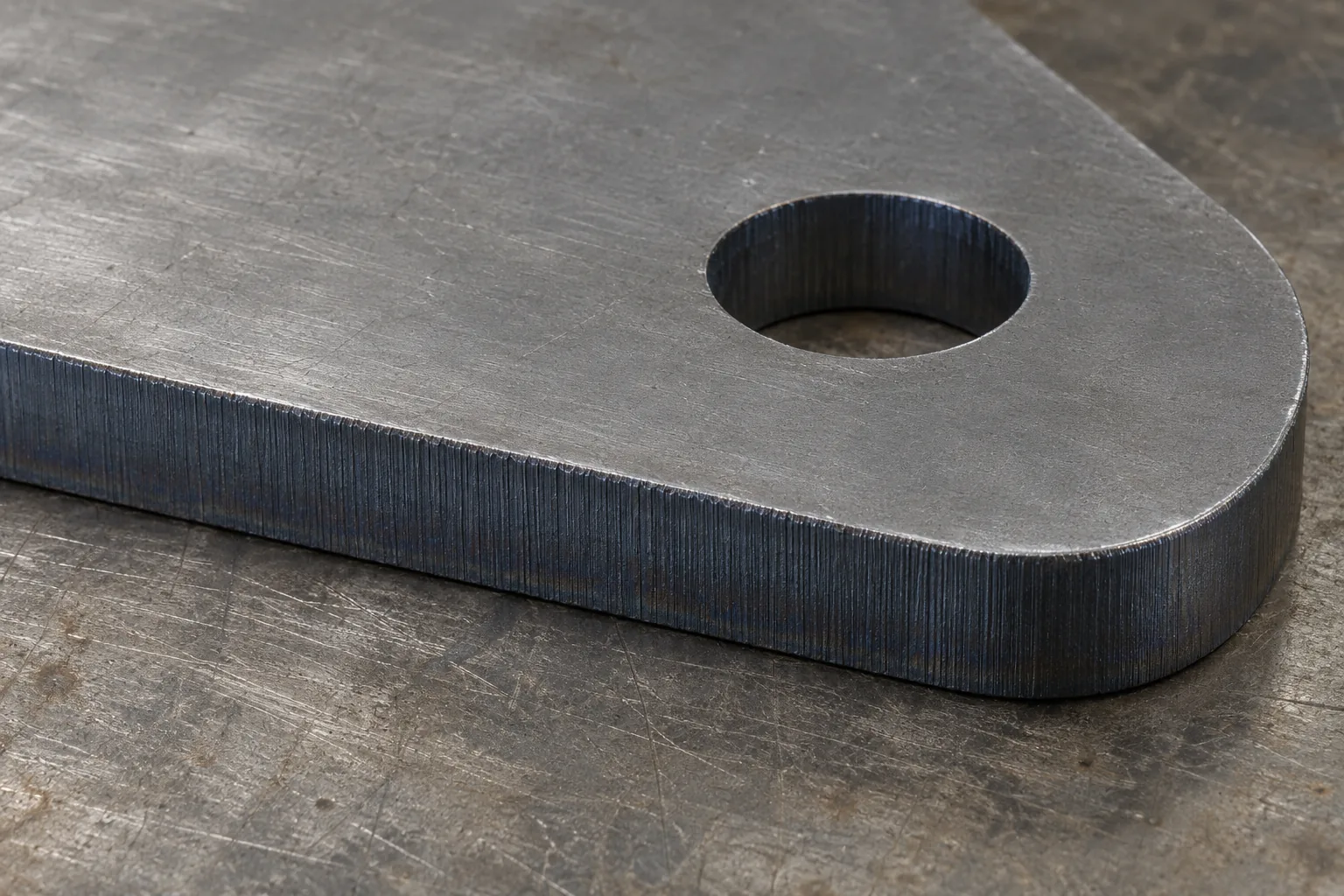
What comes off with the coating?
During oxygen-assisted laser cutting, oxygen reacts with hot iron along the cut. Some of that iron oxide stays behind as a thin, often blue-black skin. You’ll find it on the outside perimeter and down the walls of holes and slots, even when the broad faces of the sheet look clean.
Powder can cure over that skin. If the oxide lets go of the steel, a chip can carry away both the oxide and the coating over it. A knock from a bolt or a tool can reveal the weak layer. A failure that follows the cut outline is a useful clue. Widespread peeling across the faces calls for a separate check of cleaning, pretreatment and cure.
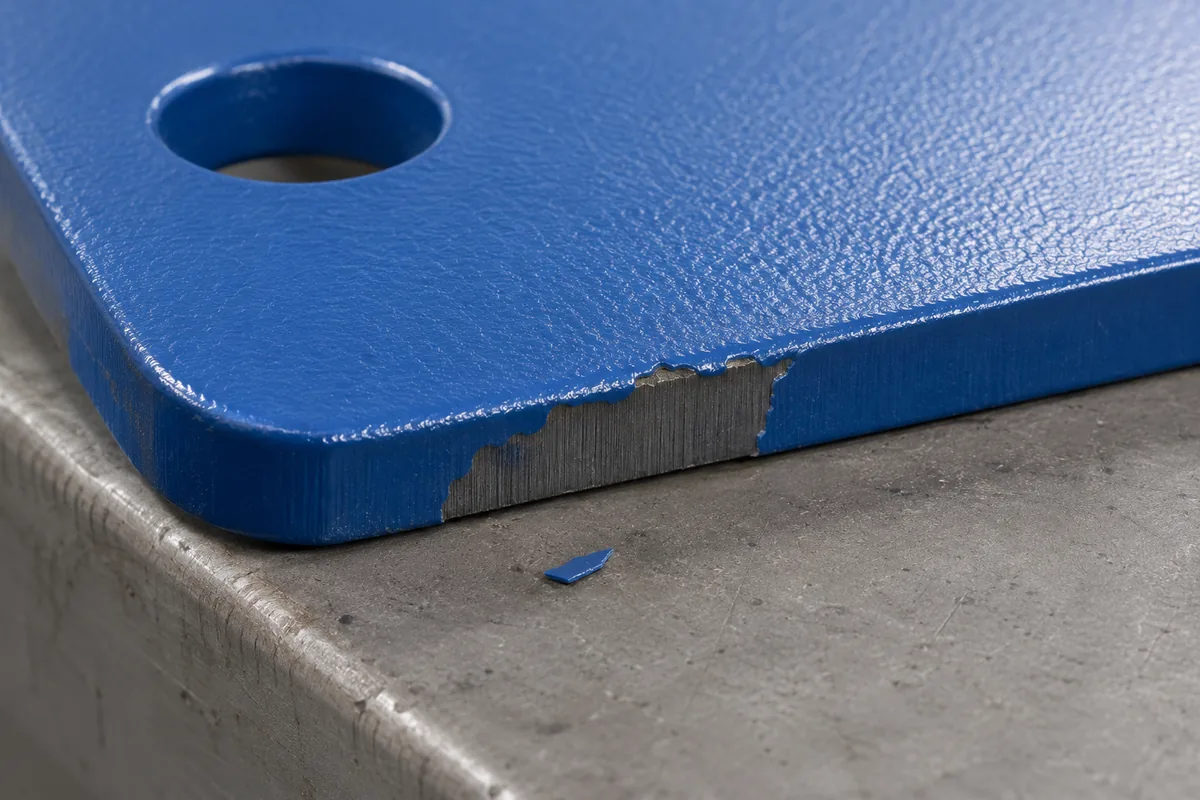
Mill scale and laser oxide can occur on the same part. Mill scale forms on the broad faces during hot rolling. Pickling removes that original scale, but cutting pickled-and-oiled steel with oxygen creates fresh oxide along the new edge.
Which steels do we cut with oxygen?
Nitrogen blows molten steel out of the cut while shielding the edge from oxygen. The laser has to supply the heat to melt the full thickness. Oxygen adds heat through its reaction with the steel, which helps the cut reach through heavier plate. The usable range depends on the laser, the steel and the cutting setup.
On Xeon’s 6 kW TRUMPF TruLaser 1040, our speeds-and-feeds sheet lists both gases for 5/16 in. hot-rolled mild steel. At 3/8 in., the listed process switches to oxygen. AR500 has its own entries and still has a nitrogen option at 3/8 in.
| Steel stock | Thickest listed with nitrogen | Listed with oxygen only |
|---|---|---|
| A36 / A1011 hot-rolled, mill finish | 5/16 | 3/8, 1/2, 5/8, 3/4 |
| A36 / A1011 hot-rolled, pickled & oiled | 5/16 | 3/8, 1/2 |
| A572 / A1018 HSLAS Grade 50 | 5/16 | 3/8, 1/2 (confirm stock) |
| AR500, mill finish | 3/8 | 1/2 |
From the Xeon NC Speeds and Feeds workbook, “Steel Cutting Speed” worksheet for the 1040-6k. Xeon’s standard Grade 50 catalog stops at 5/16 in. Confirm availability for thicker plate.
For A1008 cold-rolled sheet, the workbook lists nitrogen at every recorded thickness from 24 gauge through 10 gauge. Oxygen is also listed, so a thin part can still arrive with an oxidized edge. If a powder-coated edge is critical, include that requirement when you request the cut.
TRUMPF’s data for the TruLaser 1040 L94 with a TruDisk 6001 illustrate why the program matters. For uncoated mild steel, TRUMPF lists nitrogen up to 0.31 in. with NitroLine and 0.38 in. with Highspeed Eco. Use the Xeon table above when planning edge prep for our stock. TRUMPF Data Collection D1238en, July 2024, TableCollection p. 3.
How to prep the cut edge with Scotch-Brite
For a few parts with light oxide, a clean Scotch-Brite™ nonwoven abrasive hand pad is a practical starting point. Work the pad against the narrow cut wall through the full thickness of the plate. A pass across the top face can leave the oxide underneath untouched.
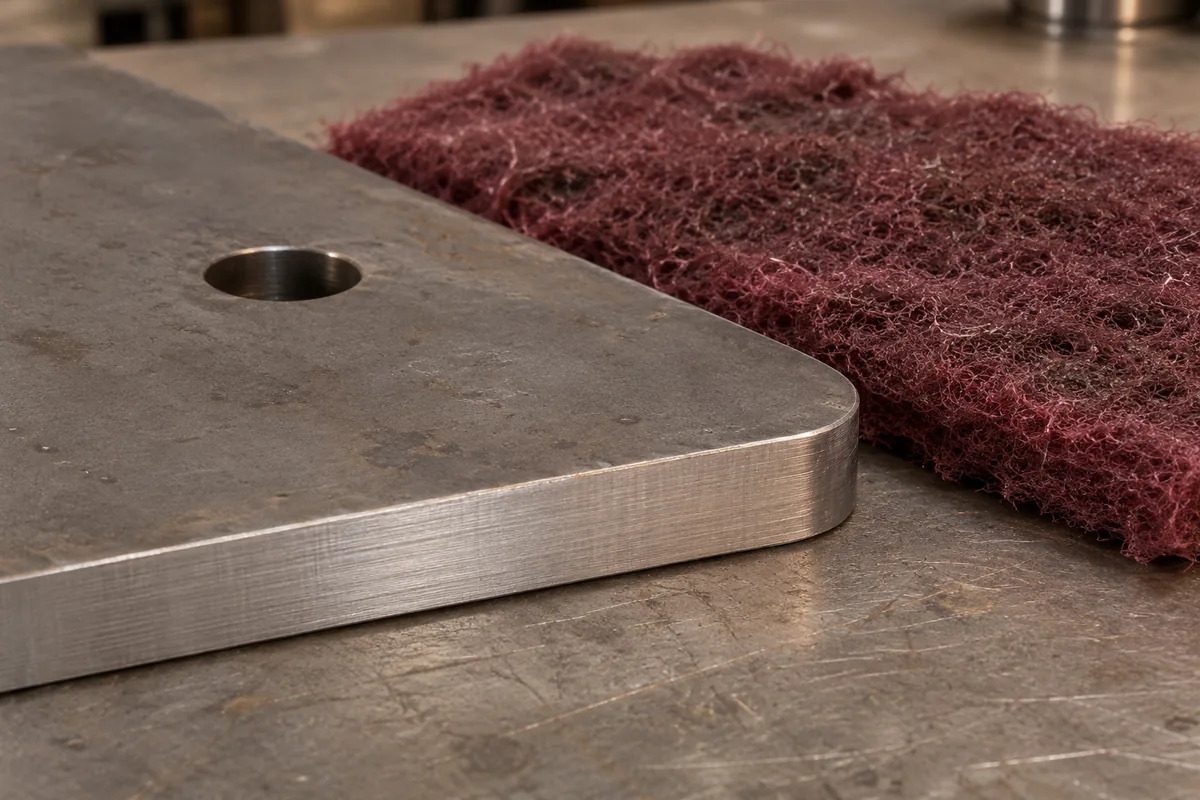
- Follow every contour. Work around the perimeter, then check the walls inside holes, slots and notches. Use a suitably sized abrasive for recesses that a folded pad cannot reach. Keep holes and fit-critical edges within the drawing tolerances.
- Check what the pad removed. Turn the part under good light. Look for a continuous band of exposed steel. Dark, glazed islands between the cut lines mean there is more work to do. If the pad only polishes the scale, use a suitable abrasive wheel or have the finisher blast the edges to the specified profile.
- Hand off a clean part. Remove abrasive dust and oil and follow the coater’s cleaning, pretreatment and drying sequence. Agree on the edge-prep method with the coater for production runs, especially when the finish has an adhesion requirement.
Further reading
- TRUMPF’s explanation of oxygen flame cutting and inert-gas fusion cutting.
- ChemQuest on powder adhesion and abrasive prep on laser-cut edges.
- Compare sheen, texture and wear in How to Choose a Powder Coat Finish for Your Part.
- Xeon’s powder coating guide and steel stock catalog.