How I Learned to Think About Manufacturing Decisions
When I first started working for my dad out of high school, I did not know very much about engineering.
I knew how to work. I knew how to make things. But I had not yet developed the mental framework for understanding why one manufacturing decision was better than another.
That came from the engineers around me. And one of the things that stayed with me was that the best designers rarely explained engineering as a collection of rules. They explained how they thought. That distinction mattered to me.
Because knowing that a part should be welded is useful. Understanding why someone chose welding over bending, bolting, machining, or redesigning the part entirely is much more useful.
That is the part of engineering I became interested in. Not just the answer. The decision process that produced the answer.
Good Design Is Usually a Chain of Decisions
A few of the engineers I worked around early on were very good designers. They also made something clear to me very quickly:
Engineering is almost never a straight line. You do not start with a problem, make five perfect decisions, and arrive at a finished design.
You move forward. You find a constraint. You move backward. You change the material. You change the geometry. You discover the new geometry cannot be manufactured the way you expected. You change the process. That change creates a problem somewhere else. Then you work through it again.
Sometimes an idea that looked excellent three hours earlier simply reaches a dead end. That is normal. The important thing is having enough understanding of the system to recognize why it failed and where to go next.
I think this is one of the biggest differences between simply knowing CAD and actually designing something that can be manufactured. CAD lets you create geometry. Engineering is deciding what that geometry should be.
Bend What You Do Not Want to Weld
One of the simplest lessons I remember hearing was something along the lines of:
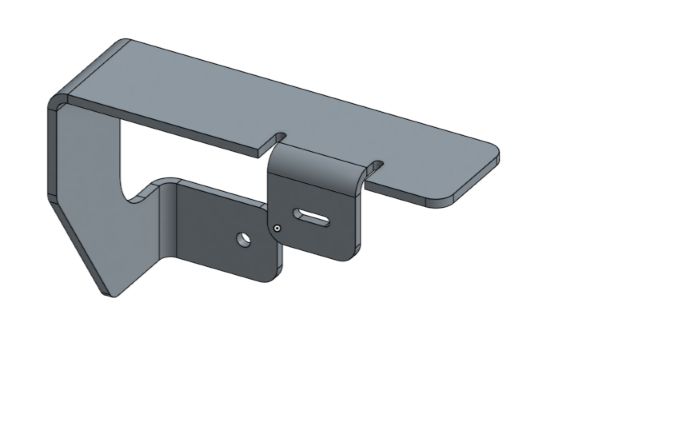
If we do not want to weld it, see if we can bend it.
That was not an absolute rule. It was a way to think.
If we could turn two welded pieces into a single bent component, we might eliminate:
- a part number,
- a fixture,
- a weld,
- some distortion,
- some grinding,
- some inspection,
- and some assembly time.
That could be a very good trade. But then another question would appear.
Can we actually bend it? Is the flange long enough? Can the tooling reach it? Will the bend interfere with another feature? Can the material tolerate the bend radius? Does the grain direction matter? Can we still assemble the product afterward?
One decision immediately creates another series of questions. That is the process.
Bolt What Does Not Need to Be Welded
We would think about hardware the same way. If something did not need to be permanently welded, maybe it could be bolted together.
That might make the part easier to manufacture. It might make the product easier to service. It might make replacement easier in the field. It might reduce welding and distortion.
But again, there was never a universal answer. Sometimes bolting added too many parts. Sometimes the joint was not rigid enough. Sometimes there was not enough access to install the hardware. Sometimes the assembly needed to carry loads that made welding the better choice. Sometimes a bolt created clearance problems somewhere else. So we would weld it.
The important lesson was not: Bolts are better than welds. Or: Bends are better than welds.
The lesson was that every manufacturing method solves certain problems while introducing others. Good design is learning to see both sides of that equation.
Material Selection Starts With Questions
Material selection was another area where I started to understand this. It is easy to treat material as something you select from a dropdown menu. Steel. Stainless steel. Aluminum. Maybe a specific grade.
But a good designer starts earlier than that. They start with questions.
Where is this part going? Is it inside? Is it outside? Will it see water? Salt? Chemicals? Heat?
Does corrosion matter? Does weight matter? Does cost matter?
Are we going to weld it? Are we going to bend it? Are we going to machine it? Does it need to be painted? Powder coated? Galvanized?
Does it need to remain dimensionally stable? How strong does it actually need to be?
Those questions narrow the manufacturing space. Because materials are not interchangeable.
Some materials weld extremely well and form poorly. Some form beautifully but are not appropriate for the environment. Some machine well and cost too much. Some are cheap but create problems downstream. Some require large bend radii. Some crack. Some move. Some corrode. Some are available everywhere. Others become a purchasing problem.
Material selection is not really about choosing a material. It is about deciding which set of constraints you are willing to accept.
Every Decision Reduces the Possible Manufacturing Paths
This became one of the more interesting ideas to me as I learned. Every design decision eliminates possibilities.
If I choose a certain material, I may eliminate certain forming processes. If I choose a certain thickness, I may eliminate certain tooling. If I put a feature too close to a bend, I may create a forming problem. If I close an assembly too early, I may eliminate access for a welder. If I place a fastener somewhere without thinking about installation, I may create a part that is technically correct but impossible to assemble.
Each decision changes what can happen next. I think of product design as a narrowing tree of manufacturing possibilities. Early in the project, you have a large number of options. As the geometry becomes more defined, the number of available options gets smaller.
That is why the early decisions matter so much. If you make them without understanding what happens downstream, eventually you can design yourself into a corner.
Tolerance Was Never Just a Number
Tolerancing was another constant conversation. And this was where real manufacturing started exposing the limitations of idealized CAD.
Steel did not always arrive at exactly the nominal thickness. Material from one mill might not behave exactly like material from another. A plate that was nominally one thickness could arrive slightly different and suddenly a slot that looked perfect in CAD was too tight. Or a stack-up that worked beautifully with one batch of material became difficult to assemble with another.
That was a valuable lesson. The CAD model represents nominal geometry. The factory has to survive actual geometry. Those are different things.
We had to design around variation wherever we reasonably could. Not because we did not care about precision. The opposite. We cared enough about the finished product to recognize where precision mattered and where clearance was necessary.
There is a big difference between a tight tolerance that serves a mechanical function and a tight tolerance that exists because somebody typed it into a drawing.
I Started Asking: What Happens When This Is Not Perfect?
That became one of the questions I learned to ask.
- What happens when this dimension is slightly different?
- What happens when the material is at the high end of its thickness range?
- What happens when this part is bent slightly differently?
- What happens when the weld pulls?
- What happens when the powder coat adds thickness?
- What happens when someone has to assemble this outside with gloves on?
- What happens if the bolt is difficult to reach?
- What happens if this part is upside down?
- What happens if the fabricator has never seen this assembly before?
Those are not edge cases. That is manufacturing. A product that only works when every component is mathematically perfect is not a robust product.
Good design needs tolerance for reality.
Our Goal Was to Solve Problems Before They Reached the Floor
We spent a lot of effort trying to push that thinking upstream. The goal was to do as much work as possible before the part reached the people building the equipment.
If someone on the shop floor had to grab a die grinder because two parts did not fit together, I did not see that as a normal manufacturing step. I saw that as information. Something upstream had failed.
Maybe the drawing was wrong. Maybe the tolerance was wrong. Maybe the material changed. Maybe the part had been modeled incorrectly. Maybe we had misunderstood the manufacturing process.
But if the same person had to grind that same interference every time, then eventually it was no longer a shop-floor problem. It was an engineering problem.
The goal was always to get the parts as close as reasonably possible to what the CAD model intended before they reached final fabrication and assembly.
The experts on the floor should be using their skill to build the product. Not fixing problems that could have been eliminated in the design office.
The Best Manufacturing Work Often Looks Boring
There is a strange thing about good manufacturing. When it is done correctly, a lot of it becomes uneventful.
The parts arrive. The holes line up. The bends are correct. The assembly fits. The hardware is there. The drawing makes sense. The fabricator understands the sequence. The product goes together.
Nobody talks about it. That is success.
The interesting stories usually happen when something went wrong. When somebody had to cut something apart. When a part was made twice. When the drawing was unclear. When the wrong material arrived. When a dimension was missing. When the assembly could not physically be built.
The goal of engineering is to eliminate as many of those stories as possible.
Information Is Part of the Product
This was another lesson I learned early. Manufacturing is not only about making good geometry. You also have to communicate it.
Part numbers have to be correct. Revisions have to be correct. Material has to be identified. The right dimensions have to be on the drawing. The datums have to make sense. The weld information has to be clear. The orientation has to be understandable. The assembly has to tell the fabricator what the designer intended.
We were always trying to improve that information flow. Because a perfect CAD model sitting on an engineer's computer is not useful to the person standing outside next to a partially assembled machine.
The information has to survive the trip from engineering to manufacturing.
That became part of the design problem itself.
The Standard I Always Liked
There was a standard I always thought was worth aiming for:
Could somebody walk up to the assembly, look at the drawings and part information, and understand what to do without having to come find the engineer?
Not because engineers should never talk to the shop. They should. But because the manufacturing documentation should stand on its own.
A fabricator should be able to identify the part. Understand its orientation. Know where it belongs. Know what it is made from. Understand the critical dimensions. Understand the datum structure. Understand how it interfaces with everything around it.
The closer you get to that point, the more scalable the manufacturing system becomes.
If every part requires an engineer to explain what they meant, then the drawing is incomplete. If every assembly requires tribal knowledge, the process is fragile. That lesson has stayed with me.
A Good Designer Thinks Downstream
This is probably the simplest way I can describe what I learned from those engineers.
Good designers think downstream.
They do not just ask whether a part works. They ask how it gets made. How it gets held. How it gets welded. How it gets bent. How it gets painted. How it gets transported. How someone reaches the fastener. How it gets inspected. How it gets replaced. How the next person knows what to do.
Every one of those questions can change the geometry.
And sometimes the best design is not the design that performs the absolute best in one category. It is the design that survives the entire manufacturing system with the fewest problems.
I Was Learning a Way of Thinking
Looking back, I do not think the most valuable thing those engineers taught me was any individual rule. It was the way they broke down a problem.
Should we weld it? Maybe. Can we bend it instead? Maybe. Can we bolt it? Maybe.
What material should it be? That depends. How tight does this tolerance need to be? What function does it serve?
What happens if the material comes in different? What happens when somebody has to build this?
That process can look indecisive from the outside. It is not. It is engineering.
You are continuously reducing uncertainty. Testing assumptions. Discovering constraints. Changing direction when the current path stops making sense.
And eventually, if you have done enough of the thinking upstream, something interesting happens downstream.
The parts show up. They fit. The fabricators understand them. The assembly resembles the CAD model. And nobody needs a die grinder to make the design work.
That is usually a sign that a lot of good decisions happened long before the part ever reached the shop floor.