Can we actually make this?
Design for manufacturability (DFM) asks whether a design can be made reliably with the material, equipment, and processes available.
Earlier in my career, I worked in an engineering group as an applications engineer.
A large part of my job was taking whatever a customer sent us and answering what sounds like a very simple question:
Can we actually manufacture this?
Sometimes we received a STEP file. Sometimes we received a technical drawing. Sometimes we received a PDF that had probably been exported from another PDF. Sometimes we were looking at an assembly with hundreds of dimensions and trying to reconstruct what the designer actually intended.
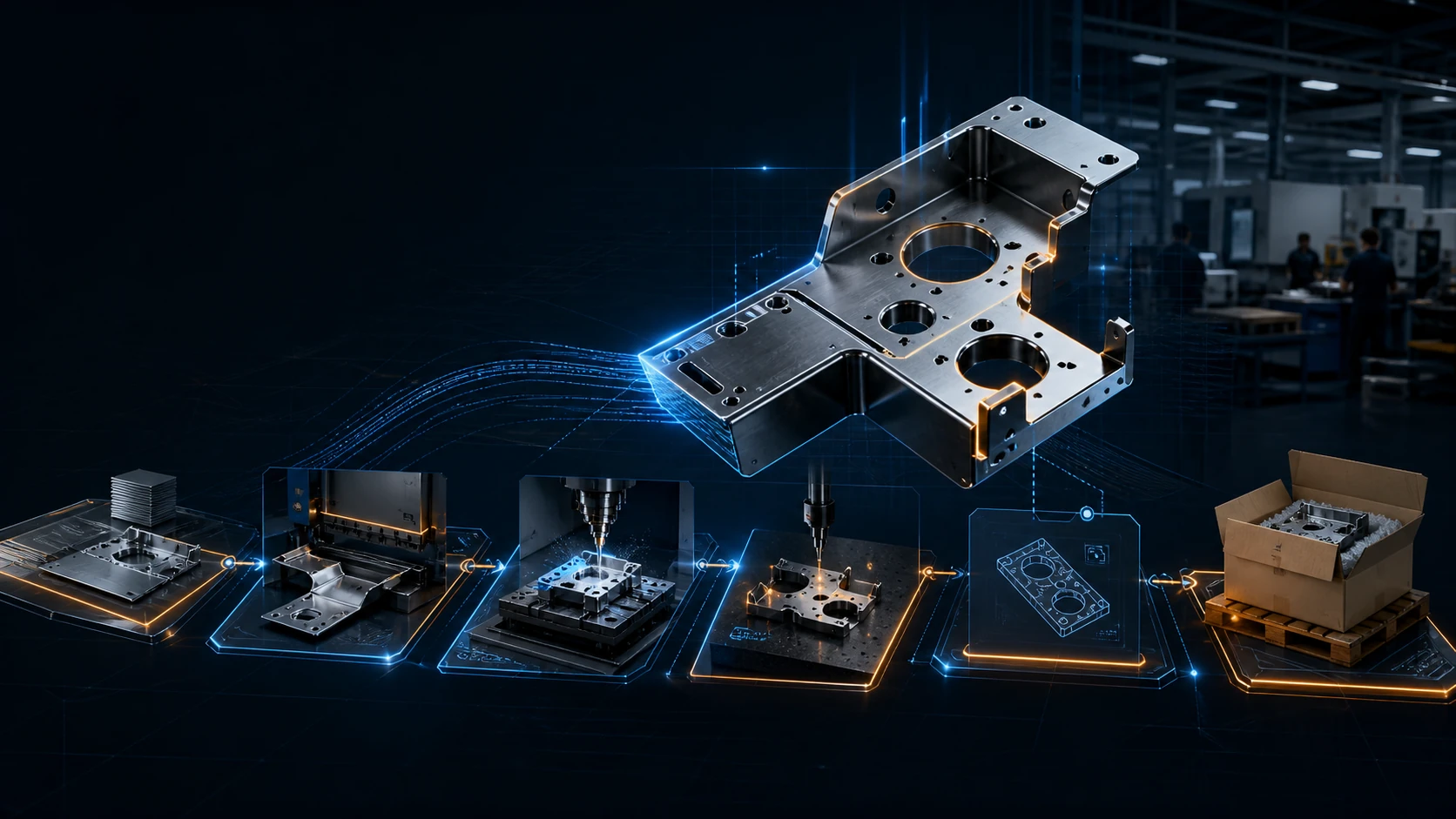
And then we were expected to quote it. Sheet-metal parts. Machined components. Large weldments. Fabricated assemblies. Utility vehicles. Parts that might need to be laser cut, bent, machined, welded, ground, painted, powder coated, assembled, and inspected before they ever reached the customer.
The assumption was that somebody with enough manufacturing experience could look at the drawing, understand the processes, calculate the cost, identify the problems, and confidently say: Yes. We can make this.
I learned pretty quickly that it is not that simple.
“We Have Had This Made Before”
There was one sentence I heard repeatedly: “Another shop has already made this exactly like this.”
That sentence was usually intended to settle the manufacturability question. Sometimes it did.
Other times we would look at the drawing and realize that something about the design simply did not make sense.
- A flange was too short for the tooling.
- A feature could not physically be reached.
- A hole was too close to a bend.
- A bend sequence trapped the part.
- A tapped hole did not have enough material.
- A countersink was deeper than the sheet was thick.
- A weld callout could not realistically be executed in the available space.
And the customer would insist:
Someone else is already making it.
Then occasionally we would get one of those existing parts in our hands. And suddenly the story changed.
The part was not actually being made exactly to the drawing. The previous supplier had modified something.
A bend was moved. A radius was larger. A hole was opened up. A feature was omitted. Something had been ground after forming.
Maybe the customer never noticed because the finished part still worked.
But the important distinction was that the print said one thing and the manufacturing process was doing another.
That creates a dangerous kind of knowledge.
The supplier knows what has to change to make the part. The customer may not. The drawing no longer represents the manufactured product.
And the next supplier is left trying to rediscover that information from scratch.
Manufacturability Is Harder Than It Looks
This was one of the things that surprised me most about applications engineering.
You could spend years around manufacturing and still come across parts where the correct answer was: I don't know yet.
I might understand sheet metal. I might understand the machine. I might understand our tooling.
But I would still walk out to the press brake department and talk to the operator who spent every day actually forming these parts.
We would look at the drawing together. Rotate the model. Talk about tooling. Look at the flange. Think through the bend sequence.
And sometimes even then the answer was:
It should work.
That word—should—carries a lot of weight in manufacturing.
Because sometimes the only way to know was to cut the part and put it into the brake.
Then you discover the punch interferes. Or the backgauge cannot reach. Or the part collides during the second bend. Or a flange that looked completely reasonable in CAD becomes impossible once the physical tooling is around it.
At that point you are not quoting anymore. You are discovering the manufacturing process with customer material and production time. That is expensive.
Human Experience Is Extremely Valuable
I want to be careful here because I do not think the conclusion is that humans are bad at DFM.
Quite the opposite.
Some of the best manufacturing knowledge I have ever seen exists inside experienced machinists, press brake operators, welders, programmers, and estimators.
They can look at something and see problems that are almost invisible on the drawing. They remember what happened the last time somebody tried something similar. They understand things that never made it into the engineering handbook.
That experience is incredibly valuable.
But there is a problem.
Human knowledge is inconsistent.
People get tired. People forget. People miss things. People interpret drawings differently. People have different levels of experience.
And whether we like admitting it or not, people are biased.
I know because I was one of them.
Sometimes I Just Didn't Want the Job
There were times when I was estimating a part and I knew exactly what it was going to take to manufacture it.
And I knew it was going to be painful.
Maybe it involved difficult setups. Maybe there was a lot of manual work. Maybe I knew that one operation would create problems for another. Maybe the quantities were not attractive. Maybe we were already overloaded.
And sometimes I would look at the job and effectively price us out of it.
Not because the part had somehow become more expensive according to physics. Because I did not particularly want the job.
That is a very human thing to do.
A different estimator might have looked at exactly the same part on exactly the same day and come back with a completely different price.
That should make us think.
Because from the customer's perspective, the geometry did not change. The material did not change. The manufacturing process did not change.
The estimator changed. And therefore the price changed. That is not a very deterministic system.
Quoting Can Hide Risk Inside Price
Manufacturers have to protect themselves.
If I am uncertain about a job, I have two options. I can decline it. Or I can put enough money into the quote to cover the uncertainty.
That uncertainty becomes margin.
Maybe I think the weldment will take eight hours. But it could take sixteen. I am going to protect myself.
Maybe I am uncertain whether the bend sequence will work. I am going to account for that.
Maybe I have never made the material before.
Maybe I think there will be rework. Maybe I suspect inspection will be difficult.
That risk gets priced somewhere. It has to.
A manufacturer cannot continually lose money on jobs and stay in business.
But that also means poor manufacturability information eventually becomes a customer problem.
If we consistently underestimate difficult work, we lose money. Then margins have to be recovered somewhere else. Better jobs subsidize worse ones.
Customers with clean, easy-to-manufacture designs may end up paying for the uncertainty created by designs that should have been caught earlier.
The better solution is not simply better estimating.
The better solution is to reduce the uncertainty.
Put the Rules Into the System
This is where my thinking started changing.
If a manufacturing rule is known, repeatable, and measurable, why are we depending entirely on a person to remember it?
Take minimum flange length.
We know the material thickness. We know the tooling. We know the V-die opening. We know the bend angle.
We can calculate whether the flange gives the tooling enough material to work with.
That should not require somebody to notice it manually every time.
The same applies to many other manufacturing conditions.
- Can this material thickness support this countersink?
- Is there enough wall thickness for the requested thread?
- Is the hole too close to the bend?
- Will the bend distort the feature?
- Is the requested bend radius realistic for the material?
- Can the specified hardware actually be inserted into this sheet thickness?
- Does this bend sequence create an obvious collision?
- Are two features occupying physically incompatible regions of the part?
- Does the selected finish make sense for the material?
These are manufacturing constraints. Some are straightforward dimensional checks. Others need tooling data, a process model, or a qualified engineer to assess the risk.
And manufacturing constraints can become software.
An established example: SOLIDWORKS describes configurable DFMXpress checks for holes, access, and sheet-metal features.
This Is Why the CAD Kernel Matters
An automated quoting system becomes much more powerful when it is not simply looking at a bounding box and calculating machine time.
The software needs to understand the part.
That means understanding geometry.
Faces, edges, and the relationships between them. From there, the application needs to recognize features such as holes, bends, slots, flanges, and countersinks, and connect them to material, tooling, and process requirements.
A CAD kernel provides the geometric and topological foundation. Feature recognition and manufacturing rules build on that foundation; a bare solid model does not necessarily contain thread specifications, tolerances, or manufacturing intent. Drawings, annotations, and process selections still matter.
Once the system has that information, the quoting system can start reasoning about the manufacturing process rather than simply pricing a file.
That is the part I find interesting.
The goal is not: Upload CAD → receive number.
The real goal is closer to this:
- 01 / Understand
Read the part.
Combine geometry with material, specifications, and the requested operations.
- 02 / Evaluate
Check the process.
Apply known constraints. Identify conflicts, missing inputs, and uncertainty.
- 03 / Decide
Return the result.
Explain what can be made, what needs to change, and what needs an engineer.
That is a much more difficult problem. But it is also far more valuable.
Technical foundation: Open CASCADE documents the geometry and topology that represent faces, edges, and solids. Manufacturing interpretation is the application layer built around that representation.
The Computer Does Not Get Tired
There is a particular advantage to this approach that is easy to overlook.
Software does not get tired at 4:45 on Friday afternoon. A repeatable check does not need to glance at the print and decide that a flange probably looks okay. It can evaluate the selected material, geometry, and tooling against the same defined conditions every time.
That does not make software automatically correct or unbiased. Bad assumptions, stale tooling data, missing inputs, and commercial choices can all be encoded into a system. The rules need validation, version control, and feedback from the shop.
If the rule says:
A flange of this length cannot be formed using the available tooling,
then the same inputs and the same validated rule should produce the same answer at noon on Monday and midnight on Sunday.
That consistency matters. It is better for the manufacturer. And I think it is better for the customer.
The Customer Should See the Problem Too
There is another benefit.
Traditional DFM often happens behind a wall.
The customer sends a part. An estimator reviews it. Someone in engineering notices a problem. An email gets sent. Maybe the customer gets a screenshot. Maybe someone draws a red circle around the feature.
Then there is a conversation. Then the customer updates the design. Then the file comes back. Then somebody has to check it again.
I would rather expose as much of that logic as possible directly to the designer.
Upload the part. Select the process. Then show:
- This flange is too short for the selected material and tooling.
- This countersink cannot be produced at the requested depth in this thickness.
- This tapped hole does not have sufficient thread engagement.
- This feature may distort during forming.
Now the engineer can make the decision immediately.
The manufacturing knowledge has moved upstream. That shortens the feedback loop enormously.
But We Are Still Not Simulating Manufacturing
This is where I think we still have a very long way to go.
A quoting system can check many rules without simulating the complete manufacturing process. A pass against those rules is not proof that every operation and interaction will work.
We can recognize geometry. We can apply rules. We can detect many known failure conditions.
But manufacturing is physical. And physical processes interact.
This becomes especially obvious when welding enters the picture.
The Part Was Flat in CAD
I remember parts where almost all of the welding occurred on one side of a large assembly.
In CAD, the part was beautiful. Flat. Straight. Every hole exactly where it should be.
Then we welded it.
Heat does not care what the CAD model looked like.
The welded side expands. Then it cools. Material contracts. Residual stresses build. And the entire part begins moving.
What started as a large flat component can turn into something that looks like a potato chip.
Now we have a problem that almost no quoting interface communicates well.
The geometry was manufacturable. Every individual weld was manufacturable. The fabrication sequence was technically possible.
But the combination of those processes created a finished geometry that was not acceptable.
That is a different level of DFM.
Why it happens: TWI explains how thermal expansion and contraction create stresses and how local plastic deformation can leave permanent distortion.
Sometimes the Recovery Process Became Absurd
We had cases where the manufacturing process created enough distortion that fixing it became its own manufacturing operation.
A large weldment might need to be stress relieved. Then we might have to put substantial tonnage into it just to bring the geometry back where it was supposed to be.
Think about what happened there.
We started with material that was reasonably straight. We cut it. Machined it. Fit it. Welded it. Introduced enough residual stress to distort it. Sent it through another process to relieve some of that stress. Then applied enormous mechanical force to correct the geometry.
Only then did we get the part we were trying to manufacture in the first place.
The drawing did not tell that story. The quote probably did not tell that story either.
But that was the manufacturing process.
DFM Eventually Needs Physics
I think this is where automated manufacturing systems ultimately need to go.
The rule-based DFM I am describing is a useful starting point. It catches a tremendous number of problems.
But eventually I want the software to understand more than whether a flange satisfies a minimum dimension.
I want it to understand process interaction.
- If I weld all of these joints on one side of this plate, what happens?
- Where is the heat going?
- How much distortion should I expect?
- Should this weld sequence change?
- Should the part be redesigned?
- Should the plate be thicker?
- Should I add symmetry?
- Should I machine this feature before welding or afterward?
- If I form this part, how will springback change with the selected material?
- If I remove a large amount of material during machining, what is the probability the part moves afterward?
Those problems are substantially harder.
They involve material behavior. Heat. Force. Residual stress. Tooling. Machine configuration. Sequence. Time.
But if we want digital manufacturing systems to become truly intelligent, that is the direction I think they have to move.
Rules. Physics. Judgment.
Check what we know.
Dimensions, clearances, material compatibility, and available tooling.
Model what interacts.
Heat, force, stress, sequence, and the way one operation changes the next.
Resolve the uncertain.
New situations, incomplete information, and decisions outside a validated model.
Feed the outcome back into the system. The next job should benefit from what this one taught us.
There Will Still Be a Human
I do not think the endpoint is removing manufacturing engineers.
I think it is changing where we use them.
An experienced press brake operator should not have to spend time checking the same minimum-flange rule on a thousand ordinary parts.
The system should know that.
A manufacturing engineer should not have to manually verify whether a standard countersink physically fits into 0.040-inch sheet every time it appears.
The system should know that.
People should be working on the difficult problems.
The unusual geometry. The strange material. The weldment nobody has made before. The process interaction the model cannot confidently predict. The exception.
That is where human experience becomes most valuable.
Automation should absorb the repetitive knowledge so that people can spend their time on the parts that actually require judgment.
DFM Should Be Institutional Knowledge
This is probably the biggest lesson I took away from applications engineering.
A manufacturer can know something without the manufacturing system knowing it.
The brake operator knows it. The welder knows it. The estimator knows it. The machinist knows it.
But if that knowledge only exists inside those people, then every new job depends on getting the right file in front of the right person at the right time.
That does not scale very well.
If the same manufacturability problem has been discovered fifty times, it should not need to be discovered a fifty-first time.
Put it into the system. Turn the lesson into a rule. Turn the rule into software. Make the software check every part.
Now the knowledge belongs to the organization instead of one person.
That is a much stronger manufacturing system.
The Goal Is Not to Replace Judgment
I spent years manually looking at parts and trying to determine whether we could manufacture them.
That experience made me appreciate human manufacturing knowledge. It also made me understand its limits.
The best estimator can miss something. The best engineer can misunderstand a process. The best press brake operator cannot know every possible geometry from a drawing.
And sometimes none of us know until we physically try it.
That is reality.
But there is a massive difference between saying: Manufacturing contains uncertainty. and accepting: Every job should depend on a human rediscovering the same known constraints.
It should not.
If we know the minimum flange length, check it automatically. If we know the tapping requirements, check them automatically. If we know the countersink will break through the material, say so immediately. If we know the hardware cannot be installed, stop the order before the material reaches the machine.
And when we encounter something the system does not understand, bring in the person who does.
That is the combination I want.
Not humans versus software.
Manufacturing knowledge encoded into software, with humans handling what remains uncertain.
Because ultimately the customer is not paying us to stare at their CAD file. They are paying us to make the part.
And the sooner we can determine—accurately, consistently, and with less dependence on individual bias—whether that part can actually be manufactured, the better the entire manufacturing system becomes.
Further reading.
The shop-floor stories are the author's experience. These references support the technical discussion of rules, CAD geometry, and weld distortion.
- Using DFMXpress — SOLIDWORKS, examples of configurable manufacturing checks.
- Modeling Data — Open CASCADE Technology, geometry and topology foundations.
- What causes distortion? — TWI, thermal stress and permanent deformation during welding.
References checked September 19, 2026.