Why we build.
In Idaho.
Manufacturing in Idaho
Boise / Nampa / Treasure Valley
A manufacturer’s view of the people, the place, and the opportunity to make things here.
Read the story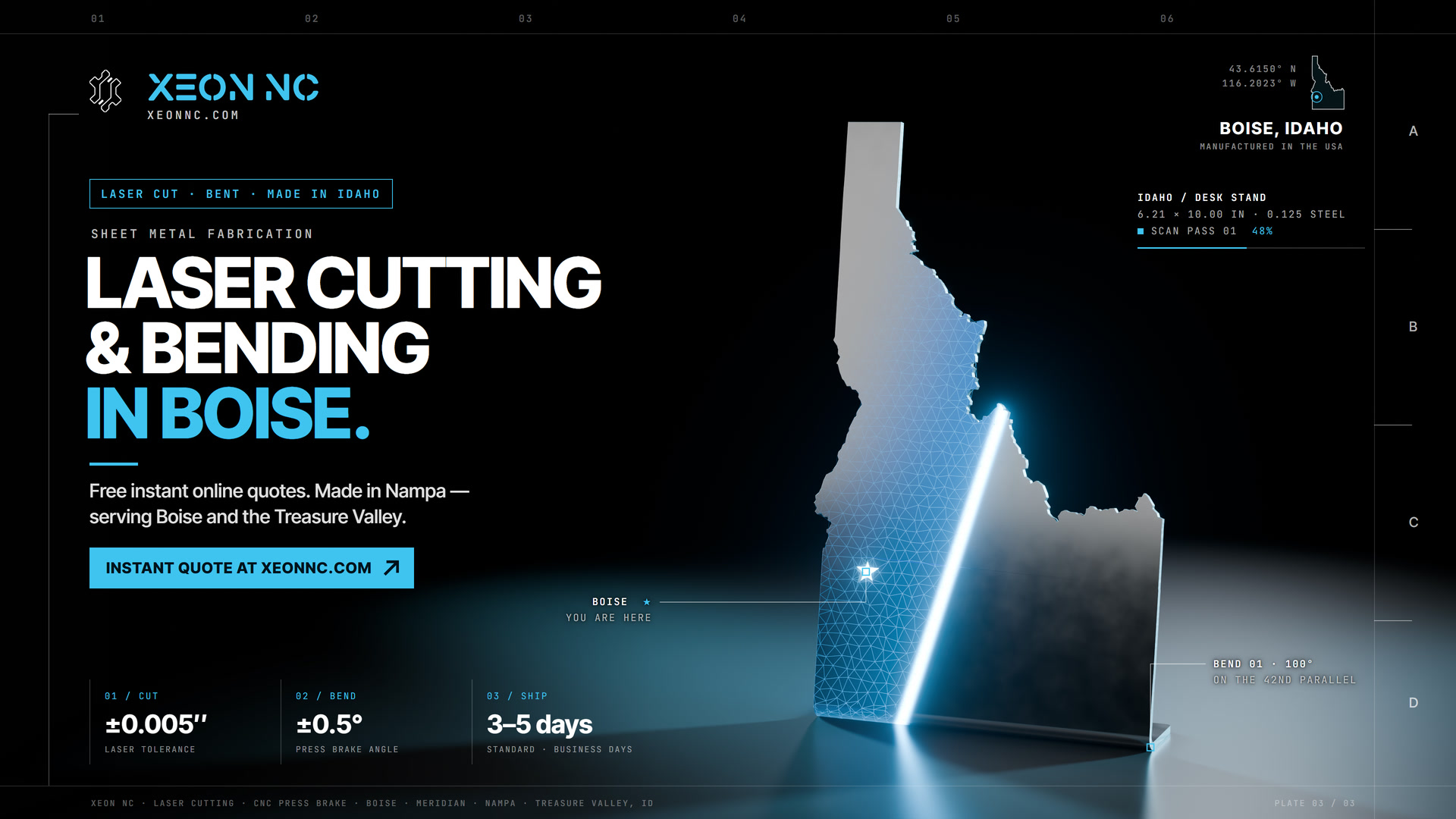
01 / The place behind the parts
A place to
make things.
After trying to make manufacturing work in Southern California and North Texas, I have developed a practical view of what makes a good place to build a manufacturing business.
You need a building you can afford to operate. You need people who can run equipment, solve problems, and take responsibility for the quality of their work. You need suppliers you can reach. And it helps when the people making local decisions understand why a manufacturing business matters.
We have found that combination in Idaho.
Our shop is in Nampa, serving Boise, the Treasure Valley, and customers across the country. The more we learn about the manufacturing community here, the more convinced I become that Idaho deserves greater recognition as a place to make things.
What California and Texas taught me.
In Southern California, building costs, regulatory requirements, and the overall expense of manufacturing made operating difficult. From my perspective as someone trying to build a business, the environment often felt unwelcoming to manufacturing.
That frustration was real. When the cost and complexity of operating consume too much of your attention, there is less capacity left for improving production, investing in equipment, and developing people.
North Texas presented a different challenge. We had a hard time finding the skilled help we needed. In the more rural area where we were operating, finding suitable suppliers was also difficult. The manufacturing resources available somewhere in a large state do not necessarily translate into resources within practical reach of your shop.
Those experiences taught me to look beyond a state’s reputation. The location has to work for the particular business you are building.
02 / A welcome for manufacturing
Opportunity
takes a place.
In Idaho, one difference I have appreciated is the enthusiasm we have encountered from local leaders.
There is an understanding that manufacturing can bring money and opportunity into a community: orders from outside the area, skilled employment, purchases from other businesses, and reasons for people to build careers locally.
For a manufacturer, that attitude matters.
The cost of keeping equipment running.
There are also concrete advantages worth examining. Electricity is one example. The U.S. Energy Information Administration reports these statewide industrial averages for 2025:
| State | Cents per kWh |
|---|---|
| Idaho | 7.88¢ |
| California | 20.96¢ |
| Texas | 6.35¢ |
Source: U.S. Energy Information Administration, 2025 electricity prices.
These are statewide averages, and an individual shop’s service classification and rate structure can differ. They show a substantial Idaho advantage over California on this measure, while Texas was lower still. Choosing a location requires looking at the whole operation.
The cost of the space itself.
A manufacturing business needs room for machines, material, and people. The price of buying or renting that space belongs alongside electricity in the operating-cost discussion.
These published industrial property reports give a sense of scale. They cover broader industrial markets, including warehouse space, rather than only buildings equipped for manufacturing. The reporting periods and property samples differ, so they are useful benchmarks for a search, not a precise comparison of equivalent factories.
| Market | Sale price per ft² | Asking rent per ft² / year, NNN |
|---|---|---|
| Boise / Treasure ValleyIdaho | $217.00Q1 2026 | $13.08Q3 2026 |
| Los Angeles marketSouthern California | $283.59Q3 2026 | $16.32Q3 2026 |
| Dallas–Fort WorthNorth Texas | $142.00Q3 2026 | $9.93Q3 2026 |
Sources: Lee & Associates, Boise Q1 2026 sale price; Colliers, Treasure Valley Q3 2026 rent; Kidder Mathews, Los Angeles Q3 2026; Lee & Associates, DFW Q3 2026.
Sale prices refer to existing properties, not new construction costs. Los Angeles and DFW report average sale prices; Lee labels Boise’s figure “Sale Price PSF” without defining it as a mean or median. Treasure Valley and Los Angeles rents are annualized from $1.09 and $1.36/ft²/month, respectively. DFW excludes flex properties and represents the metro, not our former rural North Texas location. These are market figures, not statewide averages.
What that means for a 10,000-square-foot shop: applying the Treasure Valley rent gives $10,900 a month in base rent, or $130,800 a year. Applying the earlier Boise sale-price figure to the same floor area gives $2.17 million to purchase. These are illustrative calculations, not quotes for a particular building.
Triple-net (NNN) rent is a starting point: property taxes, insurance, and operating or maintenance charges are generally additional. Utilities and improvements to make the space ready for production also need a budget. For a purchase, financing, closing costs, and improvements come on top of the property price.
For us, the case for Idaho combines the cost of the space with the people, suppliers, and support around the shop. Electrical capacity, the floor and layout, loading access, and whether a building can accommodate the work matter as much as its advertised price per square foot.
Budgeting for skilled people.
Machinists, welders, and CNC operators turn equipment into production capacity. Their wages belong in the comparison alongside the building and the power bill.
The Bureau of Labor Statistics’ May 2025 estimates let us compare the same occupations and the same measure across three metropolitan areas. The figures below are median hourly wages: half of workers in each occupation earn more, and half earn less.
| Occupation | BoiseIdaho | Los AngelesSouthern California | DFWNorth Texas |
|---|---|---|---|
| MachinistsSOC 51-4041 | $29.05 | $26.76 | $28.76 |
| Welders & related tradesSOC 51-4121 | $24.15 | $27.00 | $24.82 |
| CNC tool operatorsSOC 51-9161 | $23.76 | $26.44 | $23.07 |
Source: BLS Occupational Employment and Wage Statistics, May 2025, released May 15, 2026. Each wage links to its BLS data series. Median hourly wage series use measure 08.
Areas: Boise City, ID; Los Angeles–Long Beach–Anaheim, CA (Los Angeles and Orange counties); and Dallas–Fort Worth–Arlington, TX. These are metro benchmarks, not statewide figures or estimates for our former rural Texas location. Occupations include workers across industries and experience levels. The welding group includes welders, cutters, solderers, and brazers; the CNC group is Computer Numerically Controlled Tool Operators.
The comparison varies by occupation. Boise’s machinist median is higher than both Los Angeles and DFW. Its welding median is lower than both, while its CNC operator median falls between them. The numbers reinforce the need to budget for the particular skills a shop needs.
Wages are one part of labor cost. These figures measure straight-time gross pay and exclude overtime premiums, shift differentials, and employer benefits. Payroll taxes, insurance, benefits, recruiting, and training also affect the employer’s budget. A median wage does not tell us how quickly a qualified person can be hired or what a specific candidate will command. Read the BLS wage definitions.
A sustainable manufacturing business needs skilled people who can build a career with it. The value of a location includes the ability to find, develop, and retain those people.
The people and connections around the shop.
The support available to manufacturers also deserves attention. Idaho’s TechHelp offers supplier scouting that connects manufacturers with local, regional, and national suppliers. For a business trying to find a specialized process or solve a sourcing problem, having an organization dedicated to making those connections is useful. Explore TechHelp supplier scouting.
At the College of Western Idaho, the Advanced Mechatronics Engineering Technology program teaches skills in mechanics, electronics, robotics, automation, and industrial controls. That is relevant preparation for the increasingly technical work happening inside modern factories. Explore CWI’s mechatronics program.
These resources do not make hiring or running a shop effortless. They demonstrate that manufacturing has a place in the region’s plans.
03 / An industrial community, already here
More being made.
More to build.
One of my biggest surprises has been how much manufacturing already exists around Boise and the Treasure Valley. There is more happening here than I expected, and the numbers help put that impression into perspective.
Manufacturing jobs
Preliminary; not seasonally adjusted
Real manufacturing GDP growth
Calculated; inflation adjusted
The numbers in context
The Bureau of Labor Statistics estimated 31,300 manufacturing jobs in the Boise City metropolitan area in September 2026, up 2% from a year earlier. Those figures are preliminary and not seasonally adjusted. Growth has been uneven, including year-over-year declines earlier in 2026, but this is clearly an established industrial community. See the BLS metropolitan data.
Statewide, manufacturing contributed approximately $13.3 billion to Idaho’s economy in 2025. Adjusted for inflation, manufacturing value added grew approximately 3.4% from 2024, calculated from the Bureau of Economic Analysis figures. That provides evidence of actual production growth alongside the investment announcements. Current-dollar GDP · Inflation-adjusted GDP.
Investment in what comes next.
Micron’s expansion adds another dimension. The company plans two new manufacturing fabs in Idaho and expects the first to begin DRAM output in 2027. These are investments in future capacity; their expected production should not be counted as something already delivered. But they show the scale of the commitment being made here. Micron’s Idaho expansion plans.
For smaller manufacturers, the opportunity is to help build the wider industrial community: the shops, suppliers, technicians, and production capabilities that allow other businesses to turn designs into finished products.
04 / The ability to build
America needs
to make things.
I believe the United States needs to retain and expand its ability to manufacture.
Software is central to how we work. It helps us design parts, prepare production, quote jobs, and connect customers with equipment. Its value grows when it reaches the factory floor. NIST’s work on connecting manufacturing information identifies opportunities to strengthen the capacity and resilience of American supply chains through those digital connections. Read NIST’s manufacturing supply-chain roadmap.
But a design still has to become a physical object. Someone has to understand the material, choose the tooling, form the part, inspect it, and solve the problems that appear during production.
I want those skills—and the opportunity to learn them—to remain available here. A country that can design a product should also have people and businesses capable of building it, improving it, and producing it again when it is needed.
Our part starts in Nampa.
At Xeon NC, our contribution starts with laser cutting and sheet metal bending in Nampa. We connect digital ordering with physical production for builders in Boise, throughout Idaho, and across the United States.
Idaho has given us a place where that work feels understood and welcome. We intend to keep building on it.
Explore laser cutting and bending in IdahoContinue the story
From our home to your next partIdaho built.
Laser cutting & sheet metal bending
See how we turn CAD files into manufactured parts for Boise, the Treasure Valley, and beyond.
Read the Idaho article ↗Your file. Our floor. Your next part.
Let’s make
what’s next.
Laser cutting & CNC bending.
Made in Nampa, Idaho.