Can a fusion core
change the cost
of American steel?
A new source of electricity.
A familiar industrial ambition.
Fusion could become part of steelmaking’s future. The deciding test is whether it can deliver dependable electricity at a price a steel mill can use.
On September 27, 2023, Nucor and Helion announced plans to develop a 500 megawatt fusion power plant to supply a Nucor steelmaking facility. Nucor committed a $35 million direct investment in Helion. The announcement set an operating target of 2030, with a firm timeline still to be developed. [1] Nucor / The 500 MW fusion agreement ↗
The proposed connection is straightforward: the fusion plant would generate electricity; the steel mill would use that power in manufacturing. The “core” belongs to the power system. An electric-arc furnace still melts the metal.
That puts a practical question behind the science: could a domestic source of clean, reliable power help U.S. mills produce steel more competitively? The opportunity is substantial. The evidence still needs to progress from prototypes and project plans to sustained electricity delivery.
Power for a Nucor steelmaking facility.
Announced with the collaboration in 2023.
*A project target, subject to development.
The plan is from 2023.
The progress is current.
Reporting checked September 15, 2026. These updates show progress in technology, capital, and construction; each answers a different question.
Hotter plasma. More demanding tests.
Helion reports that Polaris operated with deuterium–tritium fuel and exceeded 150 million °C. These are company-reported experimental milestones. High temperature and fusion reactions alone do not establish a commercially useful net electrical output. [2] Helion / Series G funding and September update ↗[5] Helion / Polaris ↗
A $500 million funding round.
Helion announced an initial $465 million Series G on June 4. A September update on that announcement says the round closed at $500 million. The company describes the funding as support for manufacturing capacity and commercial deployment. [2] Helion / Series G funding and September update ↗
Orion moves through licensing.
Helion announced Washington radioactive-materials and air-emissions licenses for Orion in Malaga. Orion is the separate project intended to meet Microsoft’s 50 MW power agreement, with initial operations planned for 2028. Its construction progress should be read separately from the proposed Nucor plant. [3] Helion / Orion licensing update ↗[7] Helion / Orion ↗
The investment remains on the books.
Nucor reported a $61 million non-cash, pre-tax benefit from an increase in the value of its Helion investment after Helion’s financing round. This is a valuation update; it does not report electricity delivery or a completed steelmaking power plant. [4] Nucor / Second-quarter 2026 results ↗
Light nuclei.
Extraordinary energy.
Fusion joins light atomic nuclei and releases energy. Helion’s approach uses magnetic fields and repeated pulses to turn that energy into electricity.
Video unavailable. Open the film directly ↗
Bring the fuel together.
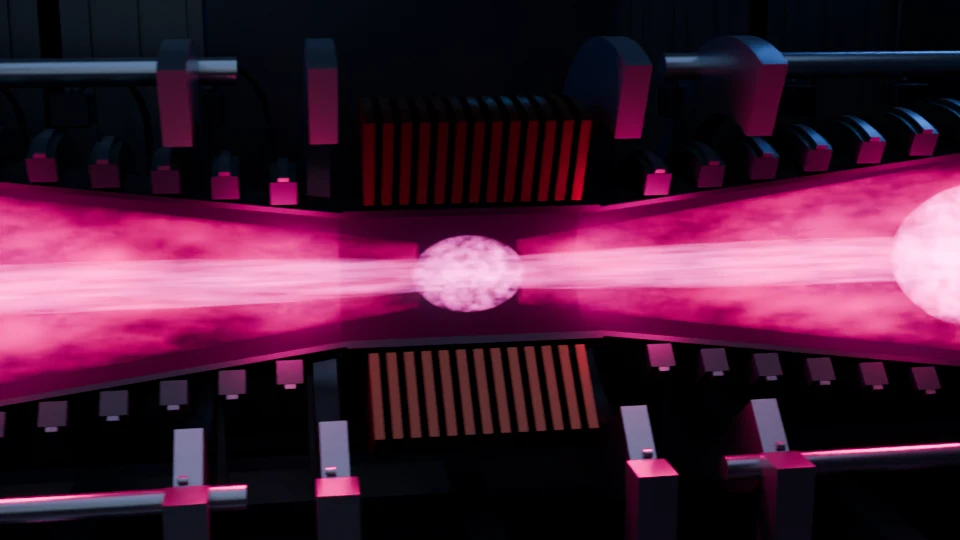
Helion describes forming two magnetically confined plasma structures called field-reversed configurations, or FRCs. Plasma is an electrically charged gas. Magnetic fields accelerate the two structures toward the center, where they merge and are compressed.
Think of the magnets as the system’s way of holding and squeezing extremely hot fuel. The luminous forms in these films are visual explanations, rather than a measured view of those fields. [6] Helion / Fusion technology ↗
Video unavailable. Open the film directly ↗
Recover the energy.
In Helion’s proposed cycle, fusion adds energy to the plasma. As it expands against the magnetic field, the changing field induces electric current that the system aims to recapture directly. This design avoids a steam-turbine conversion step. [6] Helion / Fusion technology ↗[5] Helion / Polaris ↗
Helion’s long-term commercial fuel plan uses deuterium and helium-3. Polaris tests several fuel mixtures, including deuterium–tritium. The 2026 test fuel and the eventual commercial fuel cycle represent different stages of development. [5] Helion / Polaris ↗
The power changes.
The furnace still
makes the steel.
Nucor uses electric-arc furnaces to melt recycled scrap and other inputs into new steel. Electricity is already central to that route, which makes the proposed connection to fusion easy to understand. [8] Nucor / Steelmaking emissions ↗
The power source would change upstream. Steelmaking still requires controlled inputs, the right chemistry, and a production process that delivers the specified product.
- 01 / Generate
Fusion plant
Convert fusion energy into usable electricity.
- 02 / Deliver
Electrical system
Condition and deliver power to the mill.
- 03 / Melt
Electric-arc furnace
Melt scrap and iron inputs. Refine the chemistry.
- 04 / Manufacture
American steel
Cast and process steel into useful products.
Cleaner power,
cleaner steel.
A lower-carbon electricity supply can reduce the emissions associated with running an electric-arc mill. Other emissions still come from process inputs, purchased materials, and transportation. Fusion power would address an important part of the footprint; the finished steel would still need product-level emissions accounting. [8] Nucor / Steelmaking emissions ↗
Lower power costs,
a stronger cost position.
If fusion electricity costs less to deliver than a mill’s alternative supply, it could reduce one of steelmaking’s major operating expenses. The relevant comparison includes plant construction, maintenance, fuel, financing, and dependable delivery. Cheaper electricity creates an opportunity for cheaper steel; market prices also depend on raw materials, labor, demand, and competition.
A steel mill needs
more than a
successful pulse.
Xeon NC analysis / The industrial tests that would make the promise useful.
Useful net electricity
Measure power delivered after the complete plant’s electrical needs, across a meaningful operating period.
Dependable operation
Show that repeated pulses, equipment life, maintenance, and fuel supply support the mill’s production schedule.
A competitive delivered cost
Establish an electricity price that works after construction, financing, operation, and connection to the customer.
A plant that can be repeated
Complete the site and commissioning work, then show that manufacturing and deployment can scale beyond the first installation.
A big win for
American
manufacturing.
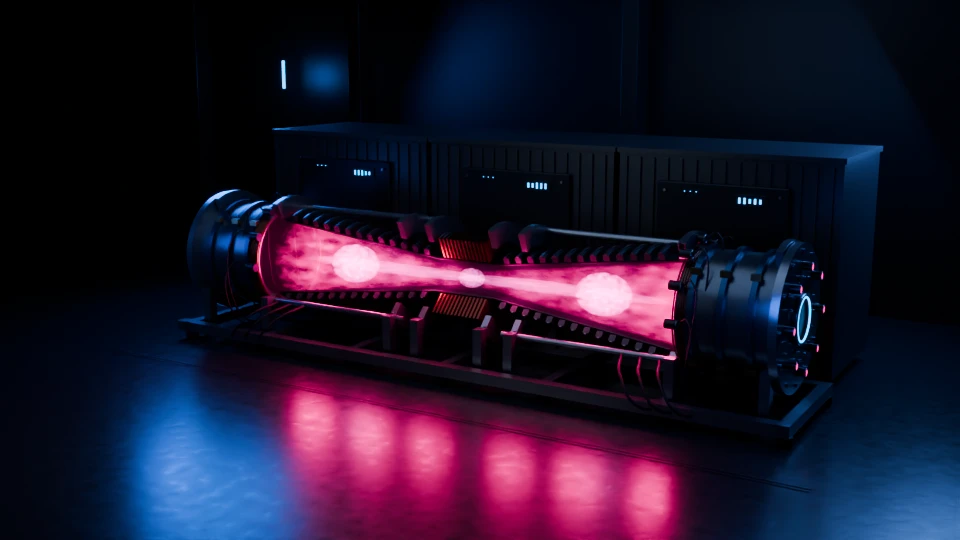
If fusion delivers reliable electricity at a competitive cost, American steel could be manufactured both cleaner and cheaper.
That would be a big win for manufacturing in the USA. Steel flows into buildings, machinery, vehicles, energy equipment, and the parts manufacturers work with every day. A cleaner, lower-cost domestic supply could improve the economics of making those products here.
The benefit would reach beyond the mill: more competitive material inputs for fabricators, a stronger basis for domestic investment, and a way to grow industrial production while reducing the emissions tied to its power supply.
Those gains remain conditional on the technology and the economics. Lower production costs would create room for more competitive prices, but the announcements reviewed here do not establish a commercial fusion electricity price or a reduction in steel prices.
Our view: fusion is a credible opportunity for the future of U.S. steel manufacturing. The Nucor–Helion collaboration gives that opportunity a concrete industrial application. Dependable power at a competitive price is what would turn it into an advantage for American makers.
Keep exploring U.S. manufacturingCleaner energy.
More competitive steel.
More possibility, made here.
Follow the evidence.
Company announcements establish what has been announced and reported. The assessment of manufacturing benefits and the conditions for lower costs are Xeon NC’s analysis. Project targets are presented as targets.
- Nucor / The 500 MW fusion agreement ↗September 27, 2023. Proposed capacity, original 2030 target, and $35 million investment.
- Helion / Series G funding and September update ↗June 4, 2026; updated September 2026. Initial $465 million round, final $500 million close, and reported Polaris milestones.
- Helion / Orion licensing update ↗June 16, 2026. Company announcement of Washington licenses and construction progress for Orion.
- Nucor / Second-quarter 2026 results ↗Second-quarter 2026 results. $61 million non-cash, pre-tax benefit from the increased value of its Helion investment.
- Helion / Polaris ↗Current prototype objectives, electrical diagnostics, and distinction between electricity recovery and net electricity.
- Helion / Fusion technology ↗Company explanation of plasma formation, magnetic compression, and direct electricity recovery.
- Helion / Orion ↗The separate Washington project for Microsoft, its 50 MW commitment, and planned initial operations in 2028.
- Nucor / Steelmaking emissions ↗Electric-arc steelmaking and the distinction between electricity, process, and supply-chain emissions.