Elongation at break chart.
How far each material we offer stretches before it breaks, on one scale for metals and one for plastics — from MIC-6 cast plate at 3% to 304 at 60%. High elongation draws, stretches and fails slowly; low elongation is the price of hardness and strength. Pick a use to see which materials fit.
| Material | Offered as | Elongation | Basis | Spec minimum | Published as | Fit |
|---|---|---|---|---|---|---|
| MIC-6 cast plate | Sheet stock | ≈ 3% | Typical | — | — | — |
| 1100-H14 | Sheet stock | ≈ 9% | Typical | — | — | — |
| 7075-T6 | Sheet stock · CNC | ≈ 11% | Typical | — | — | — |
| 5052-H32 | Sheet stock | ≈ 12% | Typical | — | — | — |
| 6061-T6 | Sheet stock · CNC | ≈ 12% | Typical | — | — | — |
| 3003-H14 | Reference | ≈ 8% | Typical | — | — | — |
| 2024-T3 | Reference | ≈ 18% | Typical | — | — | — |
| Magnesium AZ31B-H24 | Reference | ≈ 15% | Typical | — | — | — |
| C110 copper, half hard | Reference | ≈ 14% | Typical | — | — | — |
| C360 free-cutting brass | Reference | ≈ 20% | Typical | — | — | — |
| C260 cartridge brass, half hard | Reference | ≈ 25% | Typical | — | — | — |
| AR500 | Sheet stock | ≈ 8% | Typical | — | — | — |
| Spring steel 1075 / 1095 | Sheet stock | ≈ 8% | Typical | — | — | — |
| Corten (weathering) | Sheet stock | ≈ 21% | Typical | — | — | — |
| HSLAS Grade 50 | Sheet stock | ≈ 22% | Typical | — | — | — |
| A36 HR pickled & oiled | Sheet stock | ≈ 23% | Typical | — | — | — |
| A36 mill finish | Sheet stock | ≈ 23% | Typical | — | — | — |
| G90 galvanized | Sheet stock | ≈ 30% | Typical | — | — | — |
| A1008 cold rolled | Sheet stock | ≈ 40% | Typical | — | — | — |
| A1008 electro-galvanized | Sheet stock | ≈ 40% | Typical | — | — | — |
| 1018 cold drawn | Reference | ≈ 15% | Typical | — | — | — |
| 4140 annealed | Reference | ≈ 26% | Typical | — | — | — |
| 304 | Sheet stock | ≈ 60% | Typical | — | — | — |
| 316 | Sheet stock | ≈ 60% | Typical | — | — | — |
| 17-4 PH, H900 | Reference | ≈ 10% | Typical | — | — | — |
| 430 | Reference | ≈ 30% | Typical | — | — | — |
| 303 | Reference | ≈ 50% | Typical | — | — | — |
| Ti-6Al-4V (Grade 5) | Reference | ≈ 14% | Typical | — | — | — |
| CP titanium Grade 2 | Reference | ≈ 25% | Typical | — | — | — |
| Inconel 718, aged | Reference | ≈ 20% | Typical | — | — | — |
| Monel K-500, aged | Reference | ≈ 25% | Typical | — | — | — |
| Inconel 600 | Reference | ≈ 40% | Typical | — | — | — |
| Monel 400 | Reference | ≈ 40% | Typical | — | — | — |
| Inconel 625, annealed | Reference | ≈ 42% | Typical | — | — | — |
| Hastelloy C-276 | Reference | ≈ 60% | Typical | — | — | — |
| PA-12 glass bead (HP MJF) | 3D printing | ≈ 10% | Typical | — | — | — |
| PA-12 (HP MJF) | 3D printing | ≈ 20% | Typical | — | — | — |
| PA-11 (HP MJF) | 3D printing | ≈ 50% | Typical | — | — | — |
| Acrylic (PMMA) | Reference | ≈ 4% | Typical | — | — | — |
| ABS | Reference | ≈ 20% | Typical | — | — | — |
| Acetal homopolymer (Delrin) | Reference | ≈ 30% | Typical | — | — | — |
| PEEK (unfilled) | Reference | ≈ 45% | Typical | — | — | — |
| Nylon 6/6 (dry) | Reference | ≈ 50% | Typical | — | — | — |
| Polycarbonate | Reference | ≈ 110% | Typical | — | — | — |
| PTFE (Teflon) | Reference | ≈ 300% | Typical | — | — | — |
| UHMW polyethylene | Reference | ≈ 350% | Typical | — | — | — |
How much stretch the job needs.
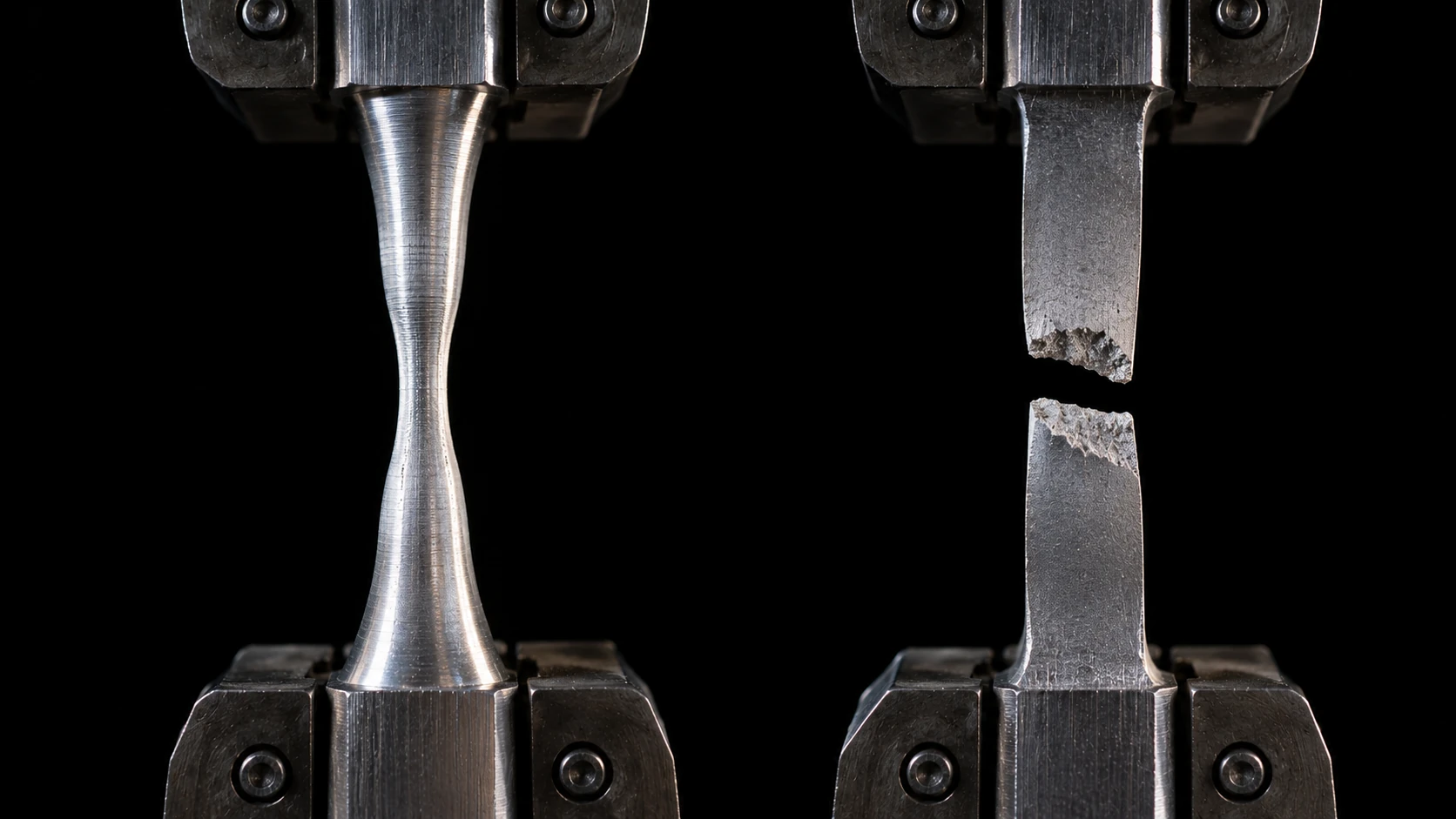
Elongation at break is how much longer a test bar is when it snaps, as a percentage of its starting gauge length. It is the quickest read on ductility: whether a part bends or cracks, stretches or tears.
A drawn cup, a stretched panel or a part that must deform before it fails needs plenty of it. A spring, a wear liner or a stiff plastic part gives most of it up for strength, hardness or stability. Choose a use below to see which materials fit.
Stretch
Strength first
Same metal, different number
Most of the stretch near the break is in a short neck, so a shorter gauge length reads higher. Metals here are on a 2 in (50 mm) gauge; values on 4D or 5.65√A are not comparable. Thin sheet also reads lower than thick plate of the same alloy.
Not a bend-radius rule
The outside of a bend strains about t / (2R + t): 33% at R = 1t. 5052-H32 makes that bend with a 12% elongation; 6061-T6, at the same 12%, may crack. A bend concentrates strain in a thin layer, and alloys differ in how evenly they spread it. Take radii from tested bend data, like our per-gauge tables.
Strength costs stretch
Inside one alloy, the stronger temper stretches less: annealed 5052-O runs about 25%, 5052-H32 about 12%. Cold work and heat treatment trade ductility for strength. Always read elongation with the temper — the chart lists the one we stock.
Bars, minimums and the bend line.
Each bar is the elongation in the condition we stock. Where a product spec sets a minimum — ASTM B209 for aluminum sheet, A240 for stainless, A1011 and A36 for steel — a tick marks it: certified material meets at least that. Plastics stretch up to ten times further, so they get their own scale.
The dotted blue line is the outer-fiber strain of the bend you pick. It is there for scale, not as a pass line: a ductile alloy routinely bends past its own bar average. The drawing shows the tensile test itself — a 2.000″ gauge length stretched to its length at the break.
Where the numbers come from.
- ASTM E8/E8M — Tension Testing of Metallic Materials (2 in / 50 mm gauge for sheet-type specimens) — ASTM International · source
- ASTM D638 — Tensile Properties of Plastics (Type I specimen, 50 mm gauge) — ASTM International · source
Values marked ≈ are from a closely related product or typical for the material. Typical values are not specification limits; check the governing spec or the mill certificate for a guaranteed minimum.